Anew breed of robots deployed at hospitals allows physicians to virtually
consult with patients, even if they are miles away. So far, patient reaction to
these mobile robot systems has been favorable. A study by Johns Hopkins Hospital
shows that 80 percent of patients surveyed feel that the robots increase
physician accessibility.
In the future, Dr. Neil Martin, professor and chief of neurosurgery at UCLA
Medical Center, believes the robots can be used to help man emergency rooms
where time is of the essence.
“Immediate care is critical,” he says. “Telemedicine and virtual presence
allow physicians who are not physically on site to avoid the time waste that’s
involved in traveling to the site of care.”
Smart Business spoke with Martin about how the mobile robot system
operates, the benefits that it provides for patients and the importance of
medical innovations.
How does the mobile robot system work?
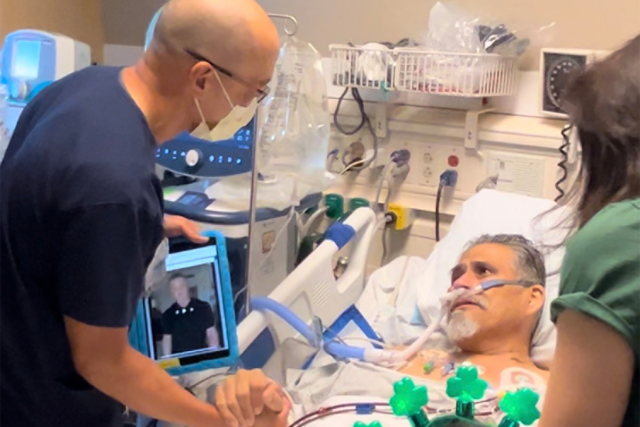
There is a robot in the intensive care unit which is about 5 1/2 feet tall.
It has, as its head, a flat panel computer screen and just above the computer
screen is a camera. Doctors who use the robot are usually sitting in a remote
location, and they use the robot to make rounds at the intensive care unit.
On the physician side, you have a computer screen with a camera above it,
just like the robot does, and you can see what the robot sees so you can drive
it with a joystick. The remote physician can drive the robot from bed to bed and
have a realtime, face-to-face discussion with the nurse at the bedside.
The developers of the robot call this virtual presence, because you can turn
the head of the robot to look at the patient, the family or the nurse and have a
two-way discussion as if you were standing there.
What are the advantages and disadvantages of being monitored by a
robot?
The old system, from a patient’s perspective, was that when the nurses saw a
problem, they would call the physician and they would talk over the phone about
what was going on. The physician was totally dependent on the nurse’s
observations.
Now the physician can actually observe the patient and interact with the
patient. It’s that much better than a phone call — you get direct information,
you can examine patients, ask them how they’re feeling, and they can ask you
questions. The robot doesn’t replace the physicians’ normal daily personal
rounds.
It does extend their ability to make rounds of a similar sort 24/7 from their
home or office.
What feedback have you received from patients?
By and large, they feel a little bit selfconscious when they first start
talking to you through the robot. Then very quickly, they engage with you
eye-to-eye and they start talking to you as if you were standing right there.
People in the past have said they would rather interact with their own doctor
through the robot than some doctor that they don’t know in person. Kids love it.
All the kids, whether they’re your patients or not, want you to do rounds on
them.
What changes in training does this new technology require?
All that it requires is that somebody sit down at the control station and
learn how to operate the software and operate the joystick to drive the robot.
Otherwise, the interaction is exactly as if you were standing there. The
technical training might take an hour.
How important are innovations such as the mobile robot system?
It’s known that if an intensivist is managing the patients in an ICU, the
morbidity and mortality rates go down, the cost of care is less and the length
of stay is (shorter). Overall, the care is safer, better and more effective.
There have been various telemedicine systems used to allow remote
intensivists to participate in the care of patients in an ICU. There is a
growing amount of evidence that telemedicine can be an effective way for
physicians to manage patients remotely. and I think that we will see more and
more circumstances where telemedicine is used.
Will this practice help pave the way for shorter hospital stays, and
ultimately, decreased health care costs?
There are studies that have been published that demonstrate that intensivist
participation in the ICU via telemedicine reduces cost. If you can render better
care, it’s going to be more cost-effective. And the cost of the technology is
not extreme by any means. It is very realistic.
DR. NEIL MARTIN is a professor and chief of neurosurgery UCLA Medical
Center. For more information, reach UCLA Center Neurosurgery Department at (310)
825-5111.