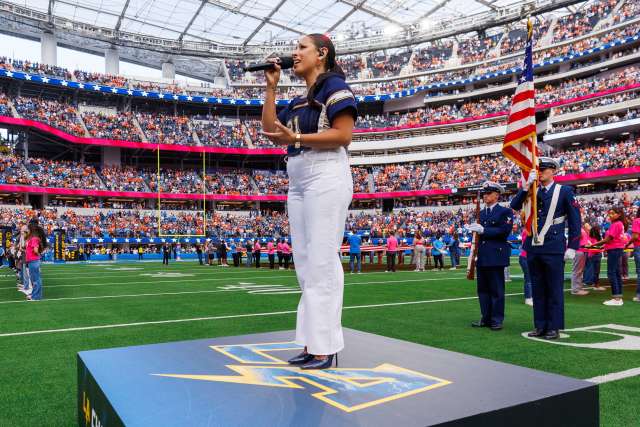
If Jeslyn Gorman was nervous, it didn’t show. Wearing a custom-made Los Angeles Chargers jersey and her dark hair pulled into a sleek ponytail, she strode out to the field at SoFi Stadium like the veteran performer she is. As a backing vocalist for artists including Taylor Swift, Meghan Trainer, Nick Jonas and others, Gorman has sung for sold-out crowds in arenas all over the world.
But this day was different. It wasn’t just that she was alone and singing the national anthem, which she’d never performed before. It was that she was a breast cancer survivor, standing in front of a field full of other breast cancer survivors, for the Chargers’ annual Crucial Catch game — part of a league-wide effort to support cancer prevention and early detection.
Gorman’s life had been derailed by cancer at the height of her career. And now she was on the other side.
A sound engineer wired up her mic pack. Three men ran onto the field carrying a rectangular box that would serve as a stage. Gorman stepped onto it. An announcer introduced her, and, acapella in front of nearly 70,000 fans, she began to sing.
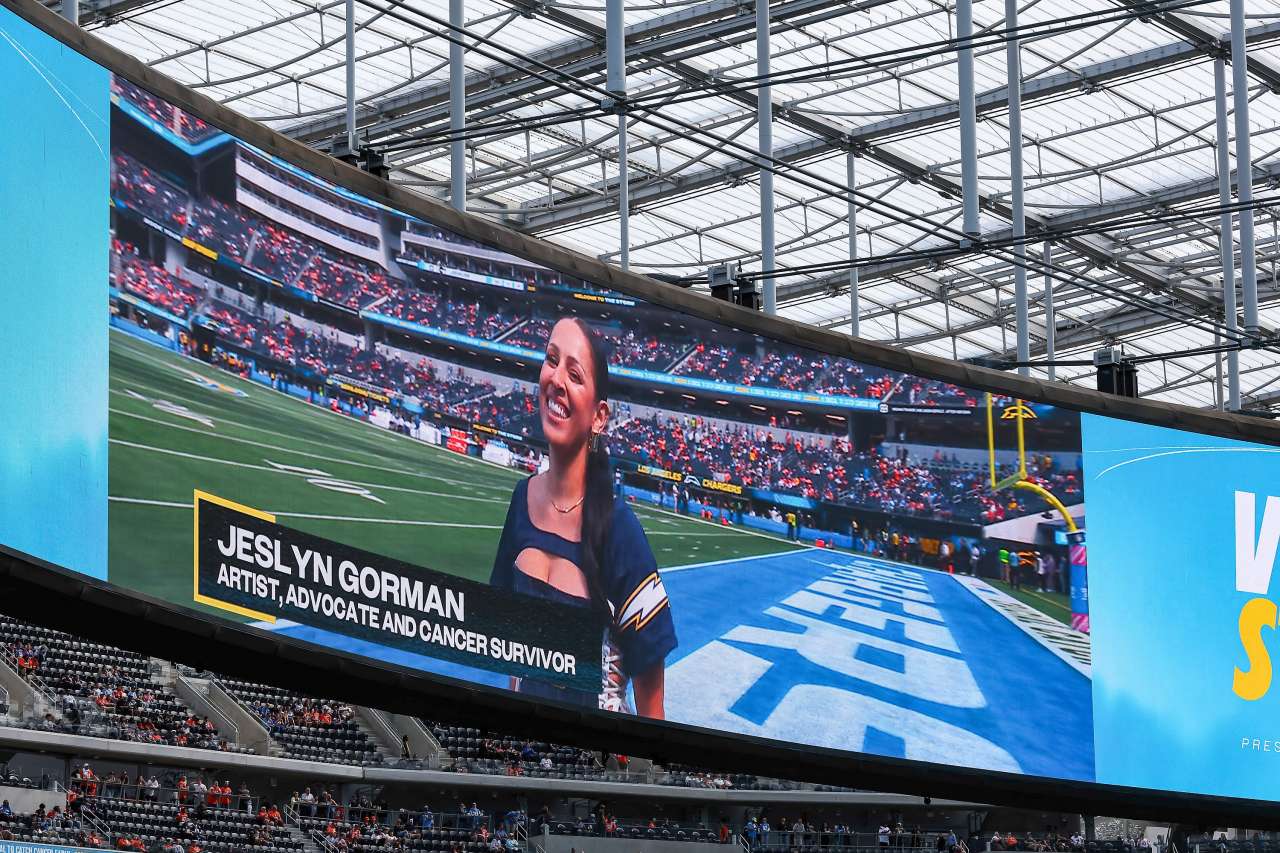
In less than two minutes, it was over. Suddenly, she was being hugged by actress Rita Wilson, who was standing on the sidelines, eager to meet her. Selfies were snapped. Then Gorman was off to join her parents, brother, two cousins and a nephew who’d flown in from Florida for the occasion, collecting high-fives and kind words from people she passed along the way.
A surprise diagnosis
It all began with a breast self-exam in 2022. A friend of Gorman’s who was diagnosed with breast cancer posted on social media about the importance of self-exams, so Gorman went ahead and did one, even though cancer doesn’t run in her family.
She “just kind of felt around a little bit” and found a lump. She assumed it was a cyst. Her friends had had them. Besides, Gorman was 35 years old. Only about 10% of breast cancer cases are diagnosed in women younger than 45, according to the National Breast Cancer Foundation.
She didn’t have a primary care doc, so months passed before she got checked out. A mammogram and ultrasound took months more.
“I thought, ‘That’s fine, no problem,’” she recalls. After all, she considered the procedure a formality to confirm there was nothing wrong.
Instead, she was told she needed a biopsy.
It was the middle of the U.S. leg of Swift's The Eras tour. Gorman packed her bags the next day to fly out and perform.
Thus began a series of medical visits wedged between tour dates. The biopsy, then hop on a plane. The diagnosis, then hop on a plane. Challenging medical news, then performing for thousands of ecstatic fans on the highest-grossing concert tour in history.
“It was a balance of really heavy and really joyful,” Gorman says. “It was kind of my medicine at that time.”
Even before she knew what kind of breast cancer she had or what stage it was, Gorman shared the news with her tour family.
“They were so supportive,” she says.
In the 2025 docuseries “Taylor Swift: The End of an Era,” Swift says, “I’ll never forget when she told us. Everyone was just in shambles.”
The medical journey
Gorman continued scheduling medical appointments between tour stops for as long as she could. Her UCLA Health providers worked around her schedule as much as possible.
Gorman would need chemotherapy, surgery and radiation. But first, treatment to freeze her eggs, since chemotherapy and radiation can affect fertility. Gorman underwent the process as she continued touring, once giving herself the necessary hormone injection in an airport bathroom.
She reminded herself to be present, to really drink in the moments on tour, not knowing how long she’d be able to continue.
“The show really helped me balance the really scary, negative, heartbreak feelings with I get to do this: I get to be here and I get to dance and sing and be with these amazing people,” she says.
Once the U.S. leg of the tour ended, Gorman started chemotherapy, which would last three months.
That was followed by surgery, then radiation.
“My muscles got so weak,” she says.
But she had a goal — to return to the tour — so she pushed herself to go to yoga, to take walks and go hiking: “That was my fuel to get up off the couch.” She also tended to her mental health with therapy through the Simms/Mann UCLA Center for Integrative Oncology, and her spiritual health through her church.
Gorman would ultimately miss six months on the road. But as soon as she was cleared to return, she was on a plane and back onstage.
“I cannot believe she was back in a few months,” Swift says in the docuseries. “The will to come back and do the hardest show ever? None of us could believe it.”
Sharing her story
Gorman says she knew early on that she wanted to share her story in some way — she shot photos and footage throughout the experience.
Gorman’s journey is featured in the third episode of the six-part “End of an Era” series. She was flooded with messages from well-wishers and people recently diagnosed. Gorman responded to every single one, she says: “It’s a deeply personal type of thing that allowed me to be able to connect with people on a really human level.”
Sharing her story, she says, feels like “a quiet act of purpose.”
And she hasn’t stopped speaking out. She’s appeared on podcasts, including UCLA Health’s “Medically Speaking”; partnered with breast cancer nonprofits and advocated for early detection and regular checkups.
Cancer has left her “forever changed,” she says, and sharing what she’s learned allows her experience to help other people.
Which is why performing at the Crucial Catch game was so meaningful. She wasn’t just there as a singer, but “because of what I’ve overcome and what I’ve pushed through and to be there supporting other patients and survivors and thrivers,” she says. “It’s even more powerful — and an honor.”