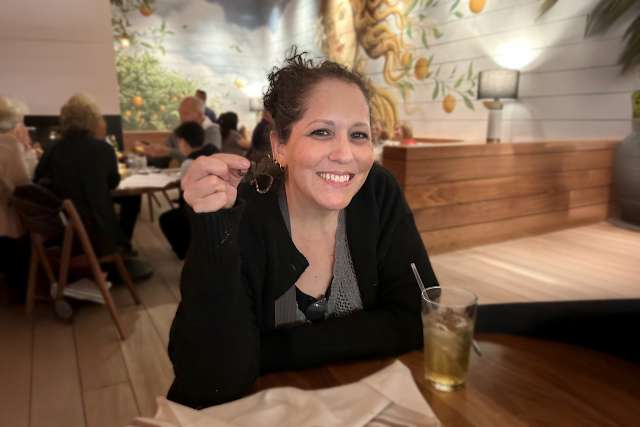
Jeanette Barbosa had already survived cancer once. She never expected to have to do it again.
She was 33 when she was diagnosed with thyroid cancer in 2007. After treatment, she went more than 16 years without really thinking about cancer. Cancer, she said, was something she had put behind her.
Then in early 2023 she began feeling exhausted all the time
On a family vacation in Cancun, she found herself sleeping while everyone else went out for activities. It wasn't like her.
Months later, she felt a sharp pain in her breast and discovered a lump. She immediately knew something wasn’t right.
“I told my husband I thought it might be cancer,” Barbosa said.
She was right.
Barbosa, now 52, was initially diagnosed with stage 2 invasive lobular breast cancer. Surgery revealed that the disease was more extensive than doctors had initially thought, including cancer in her lymph nodes, and her diagnosis was upgraded to stage 3.
She underwent chemotherapy and radiation. But as she approached the end of treatment, she wanted another opinion, particularly about radiation and its potential side effects.
She shared her concerns with a friend she met at a cancer retreat, who suggested she get a second opinion at UCLA Health.
That’s where she met Rena Callahan, MD, clinical professor of medicine at the David Geffen School of Medicine at UCLA and investigator in the UCLA Health Jonsson Comprehensive Cancer Center.
“From the very beginning, when I walked in her office, I just felt so hopeful,” Barbosa said of Dr. Callahan. “We just felt like we landed in the right spot. I didn't feel defeated. I felt like she was handing me my life back.”
Along with recommending Barbosa continue radiation, Dr. Callahan suggested that Barbosa consider participating in a clinical trial evaluating giredestrant, a daily oral targeted therapy designed to block estrogen from fueling the growth of certain breast cancers and potentially lower the risk of the cancer returning.
“It was clear when I met Jeannette that she wanted to do whatever might help cure her breast cancer,” said Dr. Callahan. “We spoke about how, with standard treatment, she had an excellent chance of cure. However, despite taking all recommended treatments, about a third of patients with high-risk breast cancer experience a recurrence. I was hopeful that this trial could offer her an even higher chance of cure.”
Barbosa and her husband took the trial information home. They read it together and talked about whether to participate.
“I don’t want to get cancer again, so I knew this is the route I want to go,” she said.
The lidERA trial: A different approach to hormone treatment
About 70% of breast cancers are hormone receptor-positive, meaning the cancer cells have receptors that allow hormones such as estrogen to promote their growth.
For people with early-stage hormone receptor (HR)-positive, HER2-negative breast cancer, surgery is often followed by endocrine therapy to reduce the chance that the cancer will return. Depending on the patient, treatment can include tamoxifen or an aromatase inhibitor, often taken for five years or longer.
The treatments have helped make breast cancer one of the more treatable forms of cancer. But recurrence remains a concern, and some patients struggle with side effects during years of treatment.
Giredestrant belongs to a newer class of drugs called selective estrogen receptor degraders, or SERDs. Rather than simply blocking estrogen's interaction with the receptor, the drug is designed to bind to the estrogen receptor and promote its breakdown.
Researchers wanted to know whether that approach could further reduce the risk of early-stage breast cancer from returning.
Promising results lead to FDA approval
The international phase 3 trial, called lidERA, enrolled 4,170 people with HR-positive, HER2-negative breast cancer. Aditya Bardia, MD, Director of the Breast Oncology Program, professor of medicine at the David Geffen School of Medicine at UCLA and Director of Translational Research Integration at the UCLA Health Jonsson Comprehensive Cancer Center, was the trial’s global principal investigator.
Participants were randomly assigned to receive either giredestrant or one of several standard endocrine therapies for up to five years. After a median follow-up of about 32 months, patients receiving giredestrant had a 30% lower risk of invasive disease recurrence or progression than those receiving standard endocrine therapy. The risk of distant disease, meaning cancer that had spread to another part of the body, was also reduced by 31%.
The safety profiles were broadly similar. Joint aches, hot flashes and headaches were among the common side effects, and most were low grade. Fewer patients taking giredestrant stopped treatment because of side effects than those receiving standard endocrine therapy.
The results were presented at San Antonio Breast Cancer Symposium in December 2025 by Dr. Bardia, which ultimately led to the FDA approving giredestrant for the adjuvant treatment of stage 1 through 3 hormone receptor HR-positive, HER2-negative breast cancer. It was approved on Nov. 23.
“This is a very significant development and perhaps one of the most important breast cancer advances in recent years for hormone receptor-positive disease,” Dr. Bardia said. “As clinicians, our goal is always to prevent recurrence and help patients live longer, healthier lives and this brings us closer to that.”
A chance to help others
For Barbosa, participating in the clinical trial went beyond just helping herself. She had another reason for wanting to participate. A friend's mother had once enrolled in a clinical trial for thyroid cancer and lived years longer than doctors had expected.
Barbosa saw her own participation as an opportunity to help people who might face breast cancer in the future.
“I didn’t just do this for myself,” she said. “I'm doing it for other women, too, to potentially combat cancer for the rest of our lives.”
She has experienced some minor side effects and occasional low energy, but said the side effects have been manageable and have not prevented her from living her normal life.
That includes fostering puppies and kittens, caring for her two French bulldogs, spending time with her husband and children and hosting a foreign exchange student.
“I feel honored and so lucky and privileged to be part of this,” she said. “I'm so grateful.”