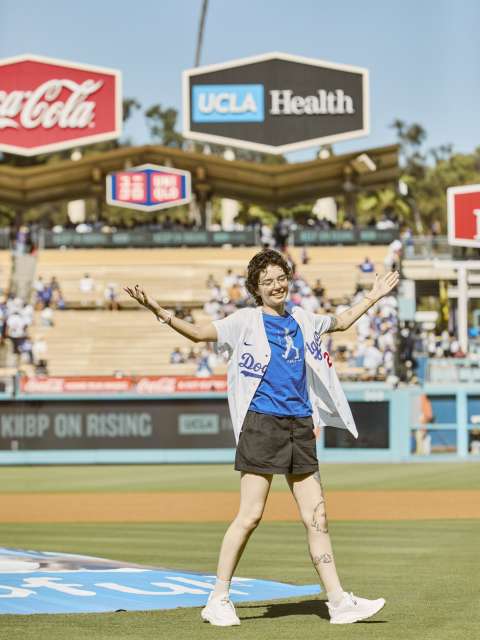
Abbie Finch stood on the field at Dodger Stadium, baseball in hand, with tears streaming down her face.
“It was a surreal experience,” says Finch, 27. “I just cried — I cried throwing the first pitch, I cried shaking the catcher’s hand and I cried walking off.”
One year earlier, Finch had undergone a bone marrow transplant to treat chronic myelogenous leukemia — a rare blood cancer that originates in the bone marrow and causes the body to produce abnormally high levels of white blood cells. Now, on Aug. 22, she was honored at Dodger Stadium, celebrating her recovery alongside the community that had supported her throughout the journey.
“It was incredible to have my friends, family and grandparents there with me,” she says. “I was able to be recognized not only by my team but by my city.”
The celebration held an especially personal meaning for Finch.
The Dodgers, her favorite baseball team, had been a source of comfort during her time in the hospital. During treatment, she regularly watched their games and followed the team’s run toward a second consecutive championship. When the Dodgers won the 2025 World Series, their victory gave Finch another reason to celebrate alongside her recovery.
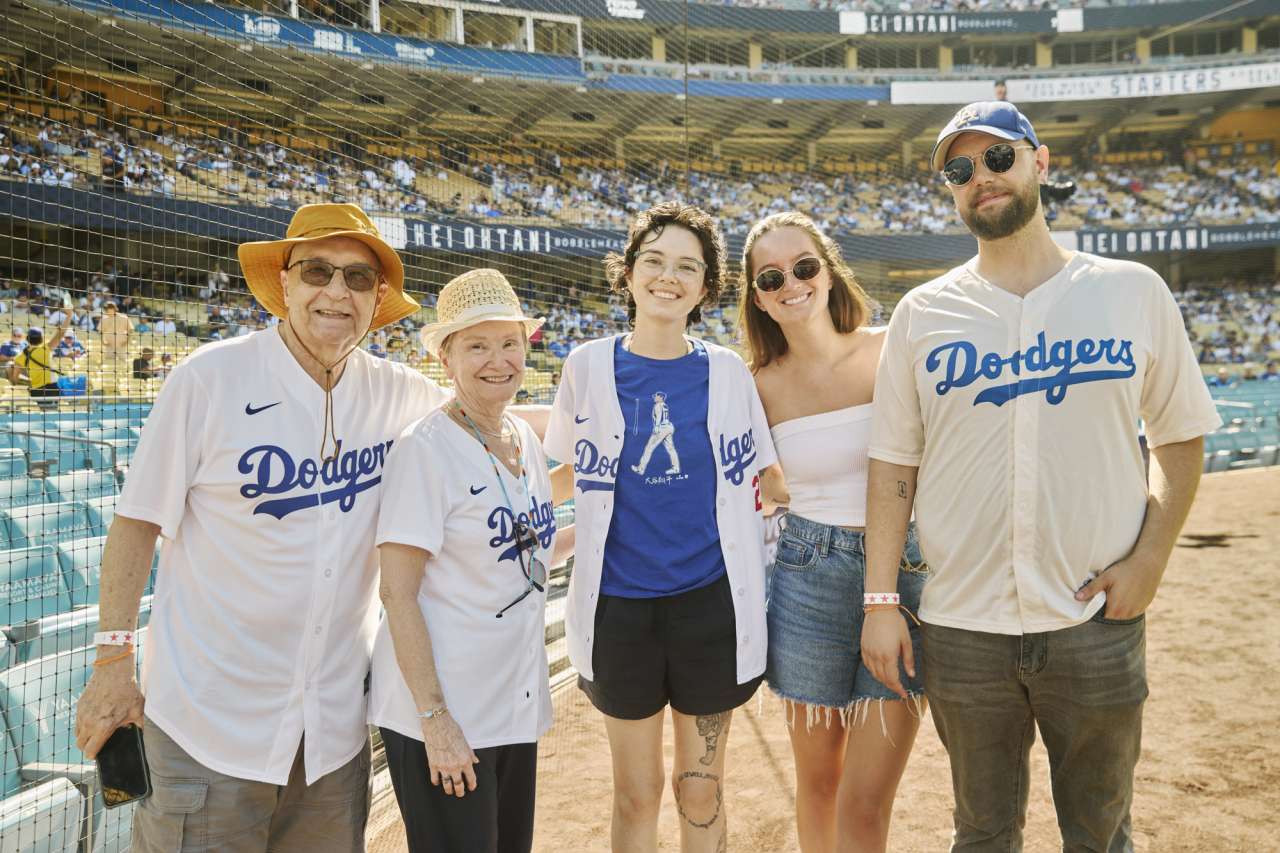
“It was really nice to come out of this whole experience feeling like I had won, that I was doing well and that this transplant was successful,” Finch says. “On top of that, this family that I had been watching my whole time throughout this experience — to also see them win as well felt like a beautiful conclusion to my time in the hospital and my whole transplant experience.”
An unexpected diagnosis
Finch, who resides in Los Angeles, was 24 and completing graduate school at Pacific Oaks College. She was preparing to begin her career as a marriage and family therapist.
However, her final year of graduate school took an unexpected turn when she developed an intense migraine.
“The migraine was so bad that it was making it difficult to think, and my boyfriend noticed that my smile was not lifting,” she says. “I initially thought I had Bell’s palsy, so we went to the local hospital just to be safe.”
It wasn’t Bell’s palsy. The doctors discovered that Finch had suffered a stroke — an uncommon complication of cancer, which can increase the risk of stroke — and referred her to UCLA Health in early August 2023 for further evaluation. There, she was diagnosed with chronic myelogenous leukemia.
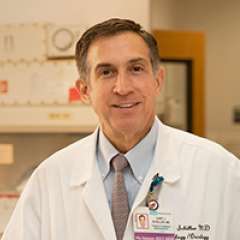
Within a week of her diagnosis, Gary J. Schiller, MD, determined that Finch’s abnormally high white blood cell count had contributed to bleeding in her brain, which caused the stroke. To reduce the number of white blood cells in her system, Dr. Schiller performed a procedure that removed and separated the excess cells from her blood.
“Chronic myeloid leukemia is fairly uncommon,” says Dr. Schiller, a professor of Hematology/Oncology in the Department of Medicine, director of the Hematological Malignancies/Stem Cell Transplantation Unit and a member of the UCLA Health Jonsson Comprehensive Cancer Center. “There are only a few newly diagnosed cases per 100,000 population every year.”
If the disease cannot be sufficiently controlled with oral medication, Dr. Schiller says, it can progress to a more aggressive form of leukemia, which may no longer be curable, even with a bone marrow transplant.
Lifesaving transplant
Finch received medication for two years to control her cancer. But when the disease proved resistant to standard treatments — including imatinib, the most commonly used drug, as well as the alternative drugs asciminib and ponatinib — Dr. Schiller escalated her treatment.
In early May 2025, a bone marrow biopsy revealed a chromosome deletion — a genetic mutation involving the loss of a chromosomal segment and critical genes — and signs that her leukemia was progressing.
On Aug. 8, 2025, Finch underwent a bone marrow stem cell transplant from an unrelated, matched donor. To prepare her body for the procedure, she first received three days of chemotherapy and eight rounds of radiation.
“What was uncommon about her disease was that it proved itself to be so resistant to a number of medications that we have, that have been known, for the vast majority of patients with chronic myeloid leukemia, to be lifesavers,” says Dr. Schiller, who is a member of the Cancer and Stem Cell Biology Research Program. “This required us to intervene before her disease could evolve to a more fatal stage.”
Finch remained hospitalized over the next month as she recovered from the transplant, receiving medications to prevent life-threatening infections and complications.
It was during her long hospital stay that watching Dodgers games gave her something to look forward to every night.
And when Finch was discharged in September 2025, she returned home just in time to watch the Dodgers win the World Series with friends and family.
“When I was in the hospital, I was watching the games, and I was watching us get closer and closer to this championship — and it felt like my reward for getting out was getting to watch them win and complete a back-to-back championship,” she says.
Comprehensive care model
In addition to Dr. Schiller, nurse practitioners Amy Jacobson, NP, and Karolina Faysman, NP, supported Finch throughout her transplant experience.
“(Jacobson) really helped me when I was undergoing a maintenance drug clinical trial at UCLA,” says Finch. “I felt really respected, cared for and listened to.”
“Dr. Schiller has also been incredible as well,” she reflects. “He takes everything that I say very seriously and really listens to me. His confidence in me has really allowed me to feel more confident in myself and this process.”
Finch adds that engaging in the Adolescent and Young Adult (AYA) support program, led by Carly Nahin, LCSW, at the Simms/Mann UCLA Center for Integrative Oncology, also played a pivotal role.
“(Nahin) is so incredible and an amazing advocate for all of us in the group,” she says. “She really created a space for us to talk about what is going on for us and cultivated a genuinely warm and welcoming space for us to talk about how cancer impacts every aspect of our lives.”
Dr. Schiller says Finch’s experience reflects the continuity of care that defines UCLA Health’s collaborative approach to cancer care.
“We have a very interesting model that is not being done much in other parts of the United States,” says Dr. Schiller. “The same doctors who treat the leukemia are the doctors who do the transplant. Patients continue to receive care from familiar physicians and nurses in a familiar environment.
“We continue to innovate and change the pattern of treatment to make it easier and hopefully more successful for our patients,” he says.
A second chance at life
Finch is recovering well and returns to UCLA Health for check-ups every few months. She enjoys spending time with her partner and family, working with clients as an associate marriage family therapist, going on walks with her Scottish terrier, Finn, attending music festivals with friends — and, of course, watching the Dodgers.
“Abbie is doing quite well,” says Dr. Schiller. “She has, like many young people, responded very well to the treatment.
“There is no evidence of markers of residual disease, so she is in a deep remission, and time will tell if she's really cured of the disease,” he adds. “But we see no markers of disease by very sensitive tests. She is being followed by gynecology as well as endocrinology, and she receives emotional support from the palliative care team and from therapists that work for our unit.”
Finch says her journey has not only shaped her perspective on life but also influenced her professional goals.
“I always wanted to pursue therapy to help people, and I think that being diagnosed and going through my transplant have opened me up to helping even more people. This experience has given me insights that I would not have gained anywhere else,” she says. “Now, I feel more comfortable talking with clients who are navigating cancer or supporting family members with chronic illnesses.”
That experience has also changed how Finch approaches her own life, giving her a newfound appreciation for the opportunities that come with a second chance.
“Time is so precious, and anything can be taken from you at any minute,” she says. “I think it has really opened my eyes to taking my needs and wants more seriously and living my life to the fullest.
“When you receive your transplant, they call it your second birthday because it’s considered a second chance at life, and that has always been a big thing for me,” she says. “I got a second chance at life — I don’t want to waste any time.”