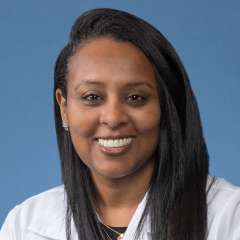
The future of breast cancer care extends beyond treating the disease, itself, says Mediget Teshome, MD. Increasingly, the field is evolving toward a more personalized approach to treatment.
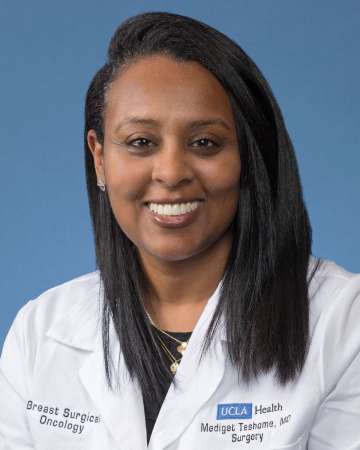
“When we think about breast cancer management and how it's evolved over the past several decades, a lot of it has been driven by a shift in our understanding of breast cancer,” says Dr. Teshome, chief of breast surgery and director of breast health at UCLA Health, and a member of the UCLA Health Jonsson Comprehensive Cancer Center.
“We used to think of breast cancer as a surgical disease — isolated to the breast and the lymph nodes,” she says. “But now, we recognize it as a systemic disease that can affect the whole body.”
Fortunately, advances in technology and increased multidisciplinary collaboration are connecting providers across specialties to deliver care that reflects each patient’s unique needs.
“It’s really been the adoption of a multimodal approach to treatment — with medical therapies, radiation, surgery and a better understanding of genetics and tumor biology — that has helped us achieve better outcomes and understand the trade-offs of treatment,” says Dr. Teshome. “If we can do that in a way that maximizes outcomes and minimizes the risks and harms to the patient, that is always the ideal.”
From diagnoses through treatment, Dr. Teshome identifies several key approaches to advancing the personalization of breast cancer care.
Breast conserving surgery
Traditionally, breast cancer treatment has primarily involved a total mastectomy or other highly invasive surgeries. Today, more conservative procedures are increasingly available, preserving most of the natural breast.
“That approach can have equivalent outcomes to a mastectomy,” Dr. Teshome says. “For some women, this can be important when it comes to not only conserving the breast but also considering the sensation, feeling and other aspects pertaining to quality of life.”
Dr. Teshome notes that working collaboratively with plastic surgeons introduces a wider range of options for patients considering breast reconstruction.
“For many women, especially those with an earlier stage of the disease, we can perform a skin- or nipple-sparing mastectomy,” she says. “By working with plastic surgeons, we can provide more aesthetic or natural results to the breast with safe outcomes.”
There are also newer, more personalized, options for patients who choose not to pursue reconstruction.
“In that situation, we do a full mastectomy,” says Dr. Teshome. “We leave the chest flat, and we create an aesthetic flat closure that maintains a natural contour and shape of the chest. In the future, women can also choose to wear a prosthesis that is custom-fitted.”
Non-surgical interventions
In some cases, surgery may not be the first step in a patient’s treatment plan. Chemotherapy or other systemic therapies — such as hormone or targeted treatments that work throughout the body — may be the preferred course of treatment, allowing providers to assess how the tumor responds before proceeding to surgery.
“It can open the door to different opportunities, such as shrinking the tumor or facilitating breast-conserving surgery, which is a tremendous benefit,” Dr. Teshome explains.
This shift in treatment also influences how providers care for patients with ductal carcinoma in situ (DCIS), a non-invasive, stage zero form of breast cancer in which abnormal cells are confined to the breast’s milk ducts. Because DCIS remains localized, patients may be able to pursue more conservative — or even non-surgical — approaches, unlike invasive forms of cancer that typically require surgery.
“There is a lot of research being conducted in the U.S. and abroad about if we need to proceed with surgery or radiation in these situations,” says Dr. Teshome. “One clinical trial in particular, led by colleagues at UCSF and also open here at UCLA, is investigating a nonoperative strategy — using medical therapies such as chemotherapy, endocrine therapy and targeted therapies, first, before considering surgery.”
Dr. Teshome adds that this research reflects a trend across all areas of breast cancer care.
“Our understanding of breast cancer not being just one type has been a pivotal change,” she says. “In every space of breast cancer there is ongoing research to help us better understand how we can rethink the ways that we approach treatment. This has enabled more targeted therapies and approaches to the way that we treat different subtypes of breast cancer — and that truly has been a game changer.”
De-escalating axillary surgery
Dr. Teshome also highlights a growing shift toward reducing the extent of axillary surgery — the removal of lymph nodes in the armpit area — particularly for patients with early-stage breast cancer.
“There have been a lot of clinical trials that have helped us understand when we should proceed with an axillary lymph node dissection (full removal),” explains Dr. Teshome. “This distinction is important because axillary dissection carries a higher risk of lymphedema, or the swelling of the arm, and can lead to a limited range of motion, mobility issues, or symptoms of numbness and tingling.”
One clinical trial found that medications that treat the whole body can effectively clear cancer in about 40% of patients overall — and up to 60%-70% in certain subtypes of cancer, says Dr. Teshome.
“Instead of performing a full axillary dissection in these patients, we can start with a less-extensive procedure that doesn’t involve removing all lymph nodes,” she explains. “We can then use that information to determine whether additional surgery or radiation is needed.”
That same approach extends beyond surgery.
“It’s not just surgery that is being de-escalated,” says Dr. Teshome. “It is also limiting medications or radiation therapies that may not be necessary, creating more personalized, abbreviated regimens that are easier for patients to tolerate. So, it’s exciting to see clinical trials open up more avenues for treatment in certain breast cancer subtypes, based on how they respond to chemotherapy, targeted therapy and other medical treatments. These studies are all creating more opportunities for a personalized, tailored approach to care.”
Maintaining the standard of traditional therapies
But, while some care plans are minimizing surgical intervention, it is also important to recognize when traditional treatments remain necessary, depending on the cancer type. One example is inflammatory breast cancer — a rare and aggressive form of breast cancer that often affects the skin and carries a higher risk of unfavorable outcomes. Dr. Teshome says that for these patients, the standard of care is still to perform a mastectomy with no reconstruction and a full lymph node dissection.
“There may be some situations where we still need to treat patients differently or adhere to the standard,” says Dr. Teshome. “That’s why it is important to consider how we can tailor therapy best to the patient and work together as a team.
“In the end, our goal is always to achieve the best oncologic outcomes — increasing survival and decreasing the risk of recurrence — but we also must consider the importance of minimizing morbidity, lessening treatment side effects, improving aesthetic results, and considering quality of life indicators,” she adds.
The future of multidisciplinary care
Dr. Teshome envisions breast cancer care continuing to evolve through multidisciplinary collaboration, alongside developments in artificial intelligence, genetic testing and less-invasive surgical approaches.
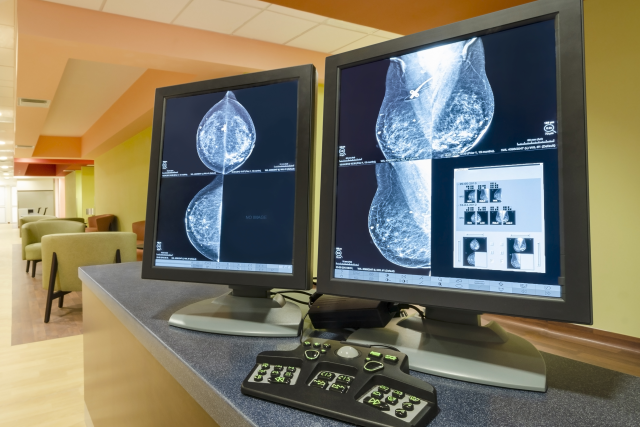
“We try to treat patients in a multidisciplinary clinic — including a breast surgeon, radiation oncologist and medical oncologist — so that together, as a team, we can go through the imaging, history, pathology and staging to determine the next steps in the workup,” she says.
This collaborative model also extends to the patients, encouraging them to be active partners in their care plan.
“My goal is always for patients to feel as empowered as possible throughout the process,” says Dr. Teshome. “Cancer is a very devastating diagnosis that brings a lot of uncertainty and hardship, but having information on all treatment options can be so empowering and impactful in the long-term.”
That sense of empowerment, she adds, comes from keeping patients’ values at the forefront of their care plan — considering factors pertaining to work history, stress levels, prior biopsies, preserving sensation, or minimizing surgery.
“It’s like we are creating a roadmap for the treatment plan,” Dr. Teshome explains. “But certainly, things may change as we go because we're constantly uncovering new information. This is where we adapt and talk as a team to make sure we’re all in alignment, because there is no one-size-fits-all approach to treatment.”