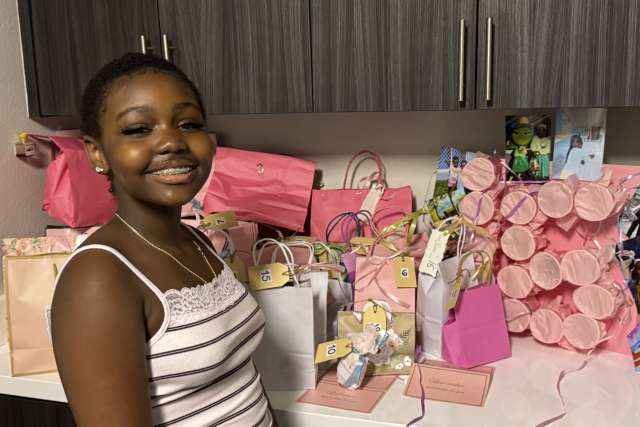
Yasmin Mbeyu, 15, is savoring normalcy after becoming the first pediatric patient at UCLA Health to undergo a novel gene therapy for sickle cell disease.
She’s going to school and hanging out with friends – things she couldn’t do when she spent weeks at a time in the hospital for severe pain from sickle cell anemia.
In January 2026, the Los Angeles teen became only the fourth UCLA Health patient of any age to undergo an infusion of her own genetically modified blood stem cells to allow her body to produce normal red blood cells.
“I feel good,” Yasmin said. “I’m not in pain, as I used to be.”
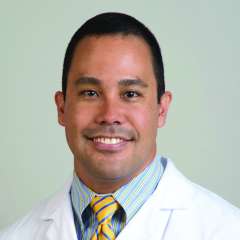
Satiro De Oliveira, MD, a UCLA Health pediatric hematologist/oncologist who oversaw her treatment, said UCLA Health has been among the first U.S. medical centers to offer the Lyfgenia gene therapy since the Food and Drug Administration gave approval in late 2023.
The therapy, available to patients 12 and older, provides particular benefit to young people such as Yasmin, who have decades to reap the benefits.
“With someone younger, the body has not been hurt as much by the disease,” said Dr. De Oliveira, a clinical professor at the David Geffen School of Medicine at UCLA and a member of the UCLA Health Johnsson Comprehensive Cancer Center. “There’s less possibility of chronic pain, for example, and chronic heart or lung disease. Younger kids, if they have the indication for the treatment, could be the more desirable candidates.”
Painful condition
Roughly 100,000 Americans are living with sickle cell disease, the most common genetic disease in the country. It predominantly affects African Americans and a smaller number of Latinos.
People with sickle cell disease may experience infections, stroke, severe pain and vision loss, resulting in chronic illness, debilitation and premature death.
Yasmin is originally from Kenya, where at age 5 she was diagnosed with sickle cell anemia, the most common and severe form of sickle cell disease.
Sickle cell disease is caused by a gene mutation that makes abnormal hemoglobin, the protein the carries oxygen. As a result, the red blood cells become hard, sticky and crescent-shaped. Additionally, the sickled cells die early, resulting in a constant shortage of red blood cells that leads to anemia.
As a younger child, Yasmin missed school and lacked the energy for play and other fun activities, said her stepmother, Deborah “Debbie” Curtis, a pediatric intensive care nurse.
“If we would take them swimming, she would have to get out of the pool first because she was out of energy,” Debbie said. “She was always tired. She was always cold.”
Yasmin moved to the United States in 2021 and lives with Debbie and her younger sister. In late 2024, she began experiencing what are known as pain crises, where stiff red blood cells get stuck in tiny blood vessels, preventing oxygen from reaching muscles, bones and organs. When small micro-clots form all over the body, the obstructed blood flow causes sudden, severe pain.
“As it happens to a lot of patients, as they get older, the pain crises and complications because of the sickle cell become more frequent,” Dr. De Oliveira said.
Despite taking medication to prevent the painful blockages, Yasmin began spending weeks at a time in the hospital. Debbie remembers Yasmin crying in pain or knocked out by powerful narcotics.
“She’s not in pain now, but this isn’t a life for her,” Debbie recalled thinking, as she watched her daughter in the hospital bed. “She can’t sleep through life.”
The hospitalizations put her behind in school, starting in eighth grade. She was hospitalized for severe pain about six times, with the longest for about three weeks.
“Any part of your body could hurt,” Yasmin said. “The pain felt like somebody is stabbing you or you’re stepping on Legos. It was throbbing. For me, it would usually start in my back and then go to my knees, my ankles, my thighs.”
To prevent the pain episodes, she began receiving blood transfusions every two weeks to replace the sickled blood cells and improve oxygen flow.
But Dr. De Oliveira said she developed antibodies to the donated blood, making it much harder to find compatible donors and requiring close coordination with the blood bank. Additionally, her iron levels became too high from the frequent transfusions.
“It’s very dangerous, it might get to a point where the person will run out of safe donors for their transfusions,” he said.
Yasmin needed a long-term solution.
New treatment option
Her care team pursued a potential bone marrow transplant but no match was found. The procedure, which can be curative, also carries risk of rejection and other complications because the blood stem cells are from a donor.
With that option ruled out, Yasmin could undergo a one-time gene therapy that would extract her blood stem cells and add a human-made gene to produce normal hemoglobin.
“The advantage for gene therapy is we use the patients’ own cells,” Dr. De Oliveira said. “We are not infusing cells from someone else, so the risk of complications is less.”
Yasmin and Debbie wanted to learn more about potential side effects, but they ultimately decided to go with the new therapy, which was covered by insurance.
“I thought it was an opportunity,” Yasmin said. “They were giving sickle cell patients an opportunity to get better.”
In the months leading up to the treatment, Yasmin underwent stem cell extraction twice at Ronald Reagan UCLA Medical Center, over five days. She stayed still in her hospital bed for 10 to 12 hours while a machine collected her blood stem cells.
“It was very cool to see the blood going out of my body and going back in and seeing the bag of cells even though I couldn’t see the cells,” she said.
The cells were then sent to Lyfgenia for modification. The synthetic gene is delivered to the cells by a harmless virus that then goes away.
With either a bone marrow transplant or gene therapy, patients must first undergo chemotherapy to destroy the faulty blood cells. The chemo can also cause infertility so Yasmin underwent an ovary freezing procedure that should allow her to conceive naturally or through in-vitro fertilization in the future.
Fresh start
In January, Yasmin entered Ronald Reagan UCLA Medical Center to undergo chemotherapy followed by the gene therapy infusion a few days later.
The chemo proved the worst part of the process because she developed painful, bleeding sores in her mouth and throat as a side effect. “It was very hard because every time I would wake up, there would be blood on my pillow and all over my bed,” she said. “I wouldn’t eat because my mouth was hurting.”
Three days after the completion of chemotherapy, it was time for her to receive her modified cells through a PICC (peripherally inserted central catheter) line in her arm. Doctors, nurses, residents and medical and nursing students gathered to watch.
Yasmin was prepared for an audience. She made a light-hearted sign that she hung above her bed advertising $5 tickets.
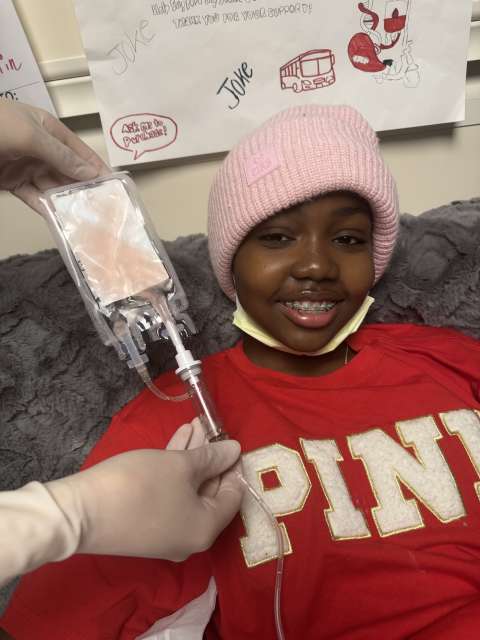
“It took only a few minutes,” she said. “People came to watch my infusion – they were happy. It felt good.”
The group applauded when the two bags of modified cells were safely inside Yasmin.
“It was like her birthday,” Debbie said. “It was like she was getting a second chance at life. I’m really proud of her for being the first and leading for other teenagers.”
Yasmin needed to wait in the hospital and stay isolated from others after the infusion to avoid infection while her blood counts recovered from the chemotherapy. The new cells also needed time to engraft or find their way into her bone marrow to begin producing the normal red blood cells.
She went home from the hospital in February and has not needed a blood transfusion since May.
Dr. De Oliveira said he’s checking Yasmin’s blood counts for the presence of sickle cells. Previously, without blood transfusions, 100% of her cells were sickled. Now, after the gene therapy, that has dropped to about 33%.
“Usually, it doesn’t go completely to zero. We actually don’t need it to go to zero,” he said. “As long as it’s less than half, it’s good. Cells with gene therapy live longer. With time, the gene-modified cells will take over.”
Patients such as Yasmin will help doctors determine if gene therapy can be considered a cure.
“This is something we are still debating and we are still watching as more people get the gene therapy,” Dr. De Oliveira said. “The tendency now is to call this instead of a curative therapy, a transformative therapy. We have to follow and learn from the patients and see how they do. We certainly helped her and maybe this behaves like a cure. Time will tell.”
For Yasmin and Debbie, the gene therapy has been life-changing.
“I see the difference in her,” Debbie said. “Her eyes aren’t as yellow. She has more energy. She has a good appetite and she’s starting to grow some. I think overall she is 100% better.”
Yasmin has been enjoying trips to Disneyland and has plans for a birthday cruise.
“I think UCLA is the way to go,” Yasmin said. “It gave me a better shot.”