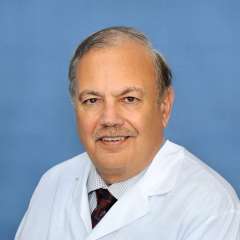

Dr. Dennis Slamon, a pioneering oncologist and researcher at the UCLA Health Jonsson Comprehensive Cancer Center, has been awarded the 2026 Albany Prize for discoveries that transformed the understanding and treatment of cancer.
Slamon shares this year’s prize with Dr. Tony Hunter of the Salk Institute for Biological Studies. The two scientists are being recognized for breakthrough discoveries in cancer biology that helped reveal the molecular mechanisms driving cancer and led to lifesaving treatments for millions of people worldwide.
The Albany Prize, one of the largest awards in medicine and biomedical research in the world, comes with a $500,000 award and recognizes scientists whose work has translated fundamental discoveries into advances that improve patients’ lives.
“I’m incredibly honored to receive the Albany Award, but I think the best award is the fact that we — and I say we because it was not just me alone, but a group of us working on this — saw that we made an impact on so many lives,” Slamon said.
Slamon, director of clinical and translational research at the UCLA Health Jonsson Comprehensive Cancer Center and chief of hematology/oncology at the David Geffen School of Medicine at UCLA, is best known for research that led to the identification of HER2-positive (HER2+) breast cancer and the subsequent development of the drug Herceptin, the first targeted treatment for this type of breast cancer.
Slamon’s work helped establish that cancers arising in the same organ can be biologically different diseases driven by distinct molecular changes. His team discovered that about 20% of breast cancers contained multiple copies of HER2, a gene involved in regulating cell growth, and that patients whose tumors had the alteration tended to have more aggressive disease and poorer outcomes.
Slamon and his team then demonstrated that HER2 was not simply a marker of aggressive cancer but was actively helping drive tumor growth, making it a potential target for treatment.
Slamon and his collaborators began testing antibodies designed to target the HER2 protein on the surface of cancer cells. The approach initially faced skepticism at the time because previous efforts to use antibodies against cancer had largely been unsuccessful. But laboratory studies continued to show that targeting HER2 could inhibit tumor growth.
Working with scientists at Genentech, Slamon and his colleagues moved the approach into clinical testing, with Slamon leading the first human clinical trials of Herceptin at UCLA. Those early studies demonstrated that targeting HER2 with an antibody could have a positive clinical effect, and subsequent randomized trials showed that adding Herceptin to standard treatment significantly improved outcomes for patients with HER2-positive breast cancer.
The work led to the U.S. Food and Drug Administration’s approval of Herceptin in 1998 and helped transform HER2-positive breast cancer from one of the most aggressive forms of the disease into one of the breast cancers that can often be treated most successfully. Approximately 3.5 million women worldwide have been treated with Herceptin for breast cancer.
The discovery also helped establish a principle that has become central to modern cancer care, with treatments increasingly designed to target the specific molecular changes driving a tumor.
Slamon and his colleagues later applied a similar approach to other targeted cancer treatments. Their research helped demonstrate the effectiveness of CDK4/6 inhibitors, including palbociclib and ribociclib, commercially known as Ibrance and Kisquali, respectively, in hormone receptor-positive (ER+) breast cancer, which is the most common subtype of breast cancer accounting for approximately 65-70% of the disease globally. This class of drugs has now become part of the standard treatment for ER+ breast cancers.
The impact of the HER2 discovery has continued to expand. HER2-targeted therapies are now used to treat other cancers driven by the same molecular alteration, while newer antibody-drug conjugates build on the approach by using antibodies to deliver cancer-killing drugs more directly to tumor cells.
“Dennis’ work represents the very best of what we strive to do in cancer research, taking discoveries made in the laboratory and translating them into treatments that fundamentally change patients’ lives,” said Dr. Michael Teitell, director of the UCLA Health Jonsson Comprehensive Cancer Center. “His pioneering research not only transformed the treatment of breast cancer but helped change how we understand and treat cancer more broadly. This recognition is incredibly well deserved.”
Slamon continues to investigate new antibody-based therapies and treatment combinations aimed at improving cancer control while reducing treatment-related side effects and preserving patients’ quality of life.
Over his more than 40-year career at UCLA, Slamon’s contributions to biomedical research have earned him some of the highest scientific honors in oncology and medicine, including the Lasker-DeBakey Clinical Medical Research Award, the Szent-Györgyi Prize for Progress in Cancer Research from the National Foundation for Cancer Research, the Sjöberg Prize from the Royal Swedish Academy of Sciences and Sweden’s Sjöberg Foundation, the American Cancer Society’s Medal of Honor for Clinical Research, and the Canada Gairdner International Award.