
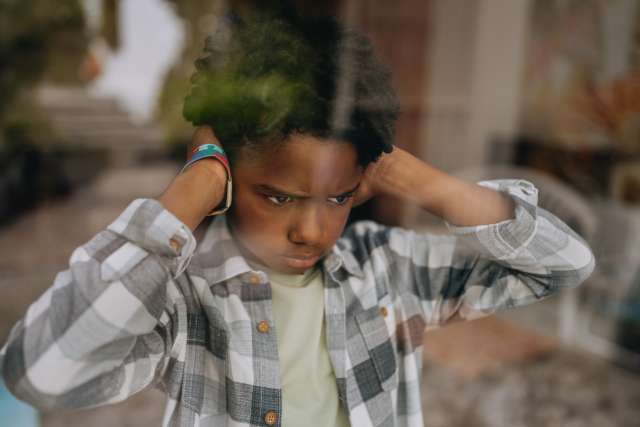
For many autistic children, everyday sensations such as the feel of scratchy fabric or the sound of a loud car alarm can be intensely distressing. Known as sensory over-responsivity, this common symptom can affect all aspects of everyday life from school to family life to friendships, yet few research-based treatments exist.
A UCLA Health study suggests that a commonly used strategy in cognitive behavioral therapy can reduce activity in the brain's sensory regions in autistic children and teens.
The study, published in the Journal of Child Psychology and Psychiatry, included 47 autistic and 45 typically developing youth ages 8 to 15. While in an MRI scanner, participants had unpleasant textures, including artificial grass and scratchy wool, rubbed on their forearms. Before the scan, they were taught a technique called cognitive reappraisal, which involves changing the way you think about something to change how it feels. Children learned it as a “reporter game.” On some trials they focused on how the texture felt while in others they described it objectively, sticking to the facts like a news reporter.
When autistic participants played the reporter game, activity in the brain's sensory regions dropped significantly compared with when they focused on how the texture felt. Both groups also showed more activity in areas at the front of the brain that help regulate emotional responses, although this was stronger for older compared to younger autistic youth.
“For years we've been identifying what's happening in the brain,” said the study’s senior author Shulamite Green, associate professor-in-residence of psychiatry and biobehavioral sciences at UCLA. “This is us finally getting to the point where we can test for possible treatments.”
Older autistic children may use the strategy more effectively. Green said typically developing children may use frontal regions of the brain to regulate sensory responses at younger ages, and that autistic children may show a developmental delay in this type of regulation.
However, only typically developing youth rated the texture as less unpleasant when using the reporter game strategy. Autistic youth did not, even though their brain activity changed. Green said one possible explanation is challenges with cognitive flexibility which may make it difficult for autistic participants to shift ratings of the same sensation in a short time span. Longer-term intervention may also be needed for changes in brain activity to translate into a change in how a sensation feels, Green said.
The reappraisal strategy is already a standard part of cognitive behavioral therapy, which Green said makes it easy to incorporate into existing therapies rather than having to create a new one.
“We know cognitive behavioral therapy interventions work for anxiety and emotional responses, so there is no need to reinvent the wheel,” Green said.
The authors noted that the measured responses were from a single scan session and cannot show whether practicing the strategy over time would ease sensory difficulties in daily life. Green said the next step is to test it as an intervention.