
June, age 65
Book An Appointment
See a doctor, virtually or in-person, with our easy online booking options.
I’m 65, but feel much younger. I’ve always been athletic. I was a dancer and competitive ice skater. At 18, during a routine checkup, my doctor told me I had a heart murmur. He mentioned it was nothing to worry about. I pursued a dancing career, performing in large production shows in Las Vegas, Reno and Paris, France, at the Lido Cabaret. Again at 25, I was told I had a heart murmur, but not to worry.
In 1986, while working in Paris, I married Patrick. We moved to the United States, arriving in Las Vegas. We settled in and started a family, being blessed with two children, Michael and Julia.
In 1994, while working at the Tropicana Resort and Casino in Las Vegas in the Folies Bergère, I experienced what I thought was an anxiety attack that caused my heart rate to peak at 206 bpm. I was taken to the local emergency room and recovered quickly, but needed to see a cardiologist the next day. I learned I had a severe leak of my mitral valve and would require surgery.
Luckily, after seeking opinions from reputable cardiologists locally, across the U.S., and in France — including Dr. Alain Carpentier — I found Dr. Hillel Laks at UCLA Health. He repaired my mitral valve on October 3, 1994.
After 16 years of professional dancing, I retired, and we moved to Los Angeles in 1998. I started a business manufacturing window treatments for residential and commercial properties. The business grew exponentially, and I quickly went from working at my dining table to operating a manufacturing facility. For fun, I started training for triathlons and competed in three, and did very well.
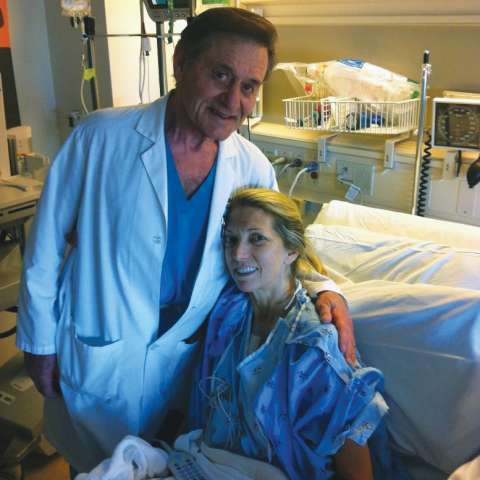
On October 3, 2013, 19 years to the day after my first open-heart surgery, I suffered what I thought was another anxiety attack. However, this one brought the sensation of every fiber of my body tearing from my ankles to my eye sockets, then down my back to my hips. Trying to remain calm, I couldn’t comprehend what was happening, but I eventually realized I needed medical care.
My husband took me to the emergency department at our local hospital, where I was quickly diagnosed with an aortic dissection. There seemed to be a lot of discussion about who could perform the surgery. We wanted to be transported to UCLA Health, but we were told that time was of the essence. I was quickly taken into surgery, and several days passed before I became coherent again.
I learned that the repair required a Dacron graft, and once my chest was sutured closed, I flatlined and had to be reopened. I required manual heart massage for 7 minutes before my heart began beating on its own. My chest was closed once more, and a TEE (transesophageal echocardiogram) was performed, causing a Mallory-Weiss tear at the opening of my stomach, which resulted in a massive GI bleed necessitating multiple blood transfusions. I was kept in amedically induced coma for days.
My husband and family were present every minute as they watched me struggle, wrestling with their own fears while coaching me to breathe calmly, holding my hands and watching both me and the oxygen, heart monitors and the tree of IV fluids. My family and friends carried the weight of their worry internally and showed me only hope and love as they encouraged me to stay calm, breathe and not to worry.
I couldn’t talk, but I’m sure the expression in my eyes revealed helplessness and fear. Eventually, after 3 weeks, I went home with daily nurse visits and routine IV medication treatments. In December, the cardiac surgeon released my care to the cardiologist that I had seen in the hospital. At this point, I decided to contact the UCLA Health Cardiology Department.
After my visit to the Ahmanson/UCLA Adult Congenital Heart Disease Center with Linda Houser and Dr. Jamil Aboulhosn, they recommended a consultation with Dr. Hillel Laks and Dr. William Quinones. They would repair the aorta and peripheral arteries. The surgery included replacing the aortic valve with a bovine valve and placing stents where needed. This is called a Bentall procedure where the aorta is replaced up to the arch.
This repeat surgery was necessary since the dissection had torn into the aortic root and peripheral arteries and also extended throughout the aorta to the right iliac artery. Including preparation time, the operation lasted 19 hours and was very successful.
Each time I face a health issue or another surgery, I think, “This can’t be happening. I’ve already had my share.” But I find strength in knowing how much I have to live for, knowing I have an incredible support team of family and friends, and knowing I am in excellent hands with my UCLA Health team.
Through genetic testing, I discovered that I had a connective tissue disorder called Loeys-Dietz syndrome, a genetic mutation that is inherited as a dominant gene. This disorder is characterized by a predisposition to mitral valve prolapse and aortic dissection.
I later required a follow-up surgery to replace the pulmonary valve with a porcine valve, and my tricuspid valve also required repair.
As time passed, the replaced pulmonary valve began to leak, and I was fortunate to qualify for a new valve that could be implanted through a transcatheter procedure known as TCPVR.
Unfortunately, I encountered insurance denials. The insurance company considered the transcatheter valve replacement to be “experimental” and preferred that I undergo another open-heart surgery, which would have been my fifth surgery.
On my behalf, Dr. Aboulhosn arranged peer-to-peer meetings with the insurance company’s physicians to explain why TCPVR was not only less invasive, but also less risky — especially in my case — and would result in a much quicker recovery time. Despite this, the insurance company still denied the procedure.
At that point, I contacted the California Department of Managed Health Care, and they were able to overturn the insurance company’s decision. I was finally able to undergo the transcatheter pulmonary valve replacement in July 2022. I’ve experienced a few other incidents since then, but nothing that couldn’t be managed.
I decided to close my business and retire, which was a difficult choice because I truly loved what I did. But now I have a new purpose in life. I visit my grandson as often as I can, and soon Patrick and I will celebrate our 40th wedding anniversary.
I’m grateful to the UCLA Health ACHD team that continues to care for me. At every visit, I feel reassured that my health issues are behind me. I’ve come to understand and respect my limitation while learning new ways to channel my energy and embrace this chapter of my life.
Thank you, UCLA Health. We’ve been together for 32 years.