As a newborn in the neonatal intensive care unit (NICU), JJ Howard’s future was uncertain. A machine breathed for him during his first two weeks of life, and he remained in the NICU at UCLA Mattel Children’s Hospital until he was more than 3 months old.
Today, JJ’s future is uncertain in a different way. The 11-year-old math prodigy is starting college.
After auditing a physics class at UCLA typically taken by second-year undergraduate students and earning a letter of recommendation from his professor, JJ was pulled out of fifth grade and his mom enrolled him part-time at Santa Monica College.
“If only I could go back in time and tell myself, ‘Don’t worry,’” Erin Copen Howard said, reflecting on JJ’s time in the NICU. “He’s going to find his own path.”
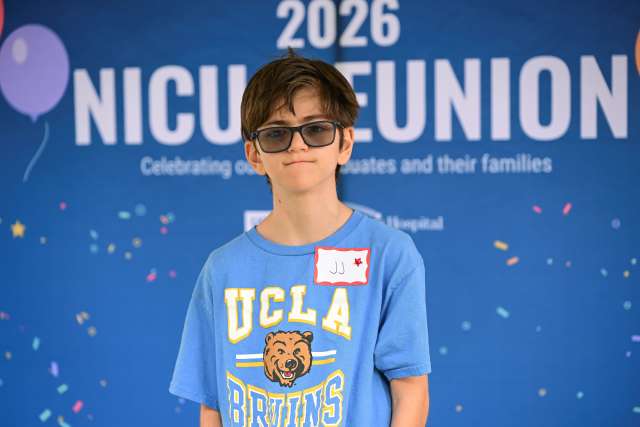
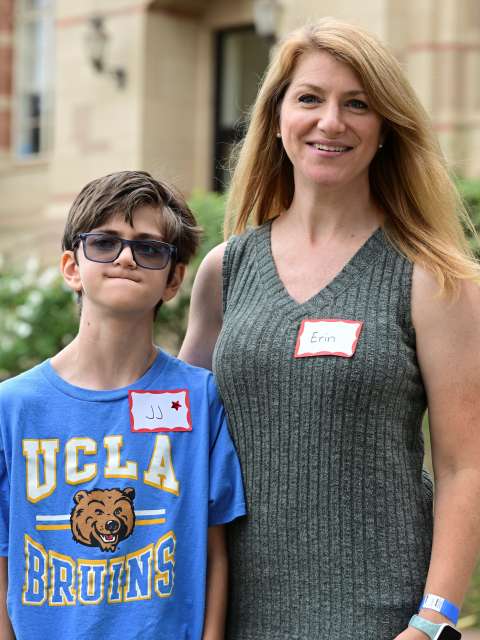
JJ and Howard celebrated his bright academic future recently at the UCLA Health NICU reunion, which brings together doctors, nurses and families every two years for a day of festive, kid-friendly fun, including face painting and a petting zoo.
“It’s always meaningful to see the doctors and nurses who cared for him during his first 101 days,” Howard said, “especially now that he’s found his way back to UCLA as a student at only 11!”
A challenging start
Twenty weeks into her first pregnancy, Howard learned that her baby had a congenital diaphragmatic hernia – a condition in which a fetus’ diaphragm is not fully formed – and would need specialized care.
“I was with a different hospital at the time, and they said you’re going to need to switch over to UCLA because this is very serious and they have a NICU that can actually handle it,” Howard recalled. “And I was like, ‘You mean he’s going to need to go into the NICU?’”
JJ was born in November of 2014 and immediately put on ECMO life support. Howard’s mind spiraled as she considered what might happen, she said, and she “grieved the image I had of who he was going to be.”
“When you’re pregnant, you naturally imagine all the milestones ahead: first steps, the first day of kindergarten, learning to ride a bike, graduating from high school, going off to college, and eventually finding their place in the world. You picture this whole trajectory for your child,” she said. “But when JJ was born, all those expectations disappeared, and I was suddenly living day to day, not knowing what tomorrow would bring.”
She credits the NICU physicians and nurses for keeping her informed, while a support group for NICU parents let her know she wasn’t alone in her worries.
“Everyone at the NICU, they were such a supportive, wonderful family,” she said. “Extremely professional, but warm and so transparent.”
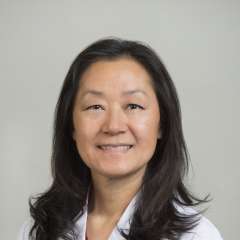
When Howard finally brought her baby home, she felt adrift without their constant care. But JJ’s pediatrician, Heide Woo, MD, filled in all the gaps, Howard said: “Really, he’s alive today because of her.”
A gifted child
JJ was diagnosed with autism and ADHD at age 5, she said, around the same time his intellectual gifts started revealing themselves. He’d been filling pages with symbols that Howard assumed were some kind of made-up language. When she sent him to an academic camp that summer, the counselors there told her it was actually linear algebra.
JJ would spend all day thinking up new equations. He “restructured the Pythagorean theorem” at age 6 or 7, Howard said, adding that he loves exploring abstract ideas, developing his own mathematical models and theories, and finding connections between seemingly unrelated concepts.
But elementary school wasn’t holding his interest. Instead of following along with what was being taught, he was in his own world of math and physics, his mom said. She wanted to find a mentor for him, so she started emailing professors at UCLA.
Finally, through a social connection, she persuaded a UCLA physicist to check out JJ’s work, which eventually resulted in a meeting.
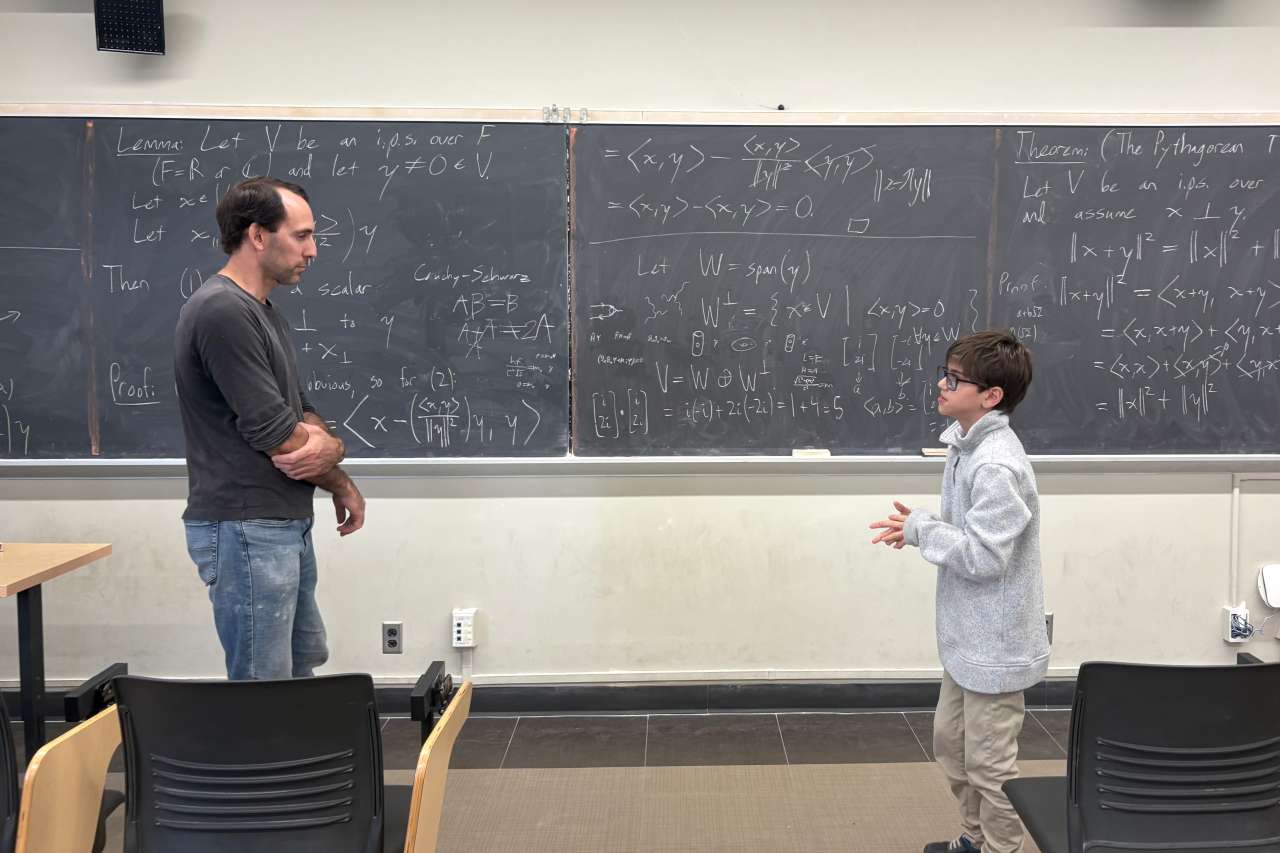
Sufficiently impressed, several professors invited JJ to sit in on their classes. He tried linear algebra, quantum mechanics and mathematical methods. Ultimately, physics professor Chris Gutierrez, PhD, invited JJ to audit the mathematical methods course.
With the elementary school’s blessing, Howard pulled JJ out of class early three times a week so he could learn alongside undergraduates in a UCLA classroom.
JJ preferred that environment, he said.
“It was engaging,” he said. “In the elementary school class, it was always loud, and they constantly were like, ‘Do this. Do this. Do this. Do this. Do this.’”
JJ’s mathematical background was “at or above average in comparison to the other second-year UCLA physical science students,” Dr. Gutierrez wrote, adding that JJ is proficient in calculus, complex numbers and linear algebra. “There are some small gaps in his knowledge base which is why undertaking formal college coursework I think will be very beneficial to him.”
Enrolling in college
JJ underwent a comprehensive psychological evaluation at the Jane and Terry Semel Institute for Neuroscience and Human Behavior at UCLA, Howard said, which concluded that he is “profoundly gifted” and recommended he pursue college-level coursework.
Howard is homeschooling JJ to complete his high school equivalency credential while he takes classes at Santa Monica College, which made a special provision to admit a student younger than 13, she said.
JJ is taking calculus and Howard sits beside him in class as his chaperone. It’s been about six weeks, and so far, so good.
“He got an A on the first exam,” Howard said, adding he hopes to transfer to UCLA.
JJ still has communication challenges and medical issues and will continue to need Howard’s support. Yet his life is unfolding in ways she couldn’t have imagined.
She’s learned not to live too far ahead of the moment, she said.
“I've learned that you can't map out your child's future. You can only help them find their own way,” Howard said. “JJ's path is nothing like what I once imagined, but that's what makes it so extraordinary.”