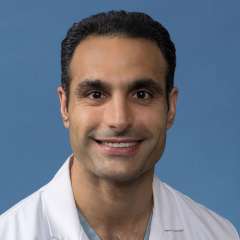
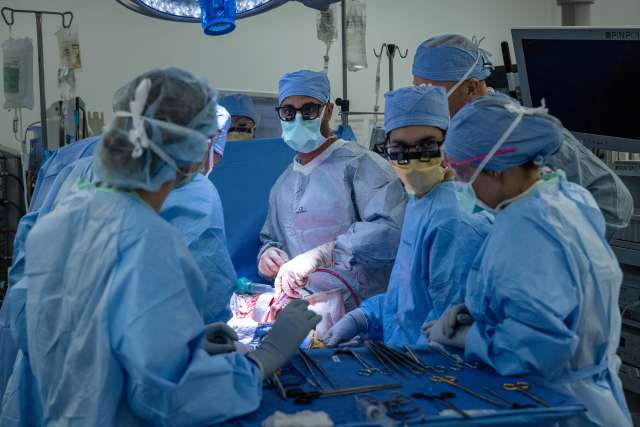
It’s 2 am. Nima Nassiri, MD, has just removed a bladder from a research donor and is attempting to flush it with solution – a critical step that will determine if he is able to keep the blood supply to the organ intact. He's been here before – but prior attempts weren’t always successful.
This time it works.
It will take Dr. Nassiri several more practice runs to perfect the procedure, all mostly done in the middle of the night.
Dr. Nassiri began exploring bladder transplantation during the COVID-19 pandemic. He started with pigs, progressed to cadavers and finally to human organ and tissue donors.
Then, in May of 2025, Dr. Nassiri and Inderbir Gill, MD, performed the world’s first combined human bladder and kidney transplant at UCLA Health. On June 23, The Lancet published their paper detailing the “first in human feasibility trial” of bladder transplantation.
And Dr. Nassiri is just getting started. The 38-year-old surgeon and director of the UCLA Bladder Transplant Program has already done two more bladder-kidney transplants as part of an ongoing clinical trial. Two more patients are in line to complete the study, and plans are in place to expand access to the life-changing procedure, Dr. Nassiri says.
“I have my trajectory forward. I see the path,” he says. “It’s hard to find something that you’re super passionate about … having something you can devote yourself to is really important – it sustains you in a career in academic medicine. I’m really grateful to have found that early on.”
The first bladder transplant
Paradigm-shifting medical milestones are rare. Bladder transplants are particularly challenging because of the vascular structure of the pelvic area and the technical precision required to remove and successfully establish blood supply to the organ.
In April 2024, a chance meeting led the bladder transplant team to its first patient: Oscar Larrainzar. Dr. Nassiri was a member of the surgical team that removed both of Larrainzar’s failed kidneys in 2020. He had also survived a rare form of bladder cancer, which left him with a non-functional organ. Larrainzar had been on dialysis for many years when he walked into UCLA Health’s surgical evaluation clinic, where he and Dr. Nassiri recognized each other immediately.
A little more than a year later, Larrainzar became the world’s first bladder transplant recipient.
While that timeline may seem fast, to Dr. Nassiri, it felt slow. Performing a never-been-done transplant requires extensive planning, regulatory oversight and cooperation from many departments and individuals, he says. The bladder transplant needed approvals from the United Network for Organ Sharing, the Institutional Review Board, a Patient Selection Committee and an Oversight Committee, along with departmental and hospital support.
“Bladder transplantation could only have happened at UCLA, because of the culture of support for innovative therapies, and logistically, for the fact that the Department of Urology has a rich history of clinical and scientific contribution to the field of kidney transplantation,” Dr. Nassiri says. “Much credit should also be given our organ procurement organization, OneLegacy, which supported the project from day one and has been an invaluable partner in research designed to advance the field of transplantation.”
Successfully completing the first bladder transplant was groundbreaking, garnering attention from The New York Times, The Los Angeles Times, TIME magazine and Men’s Health. TIME100 Health named Dr. Nassiri one of the top 100 individuals shaping the future of medicine.
For Larrainzar, 43, the operation has been life changing. His new kidney and bladder worked right away, and he was able to urinate on his own for the first time in seven years.
“It has been beyond expectations,” said Larrainzar. “It’s like living … a normal life again.”
Becoming a medical innovator
Dr. Nassiri didn’t go into medicine planning to make history. He wanted to be a surgeon so he could bond over shared experiences with his older brother, a vascular surgeon.
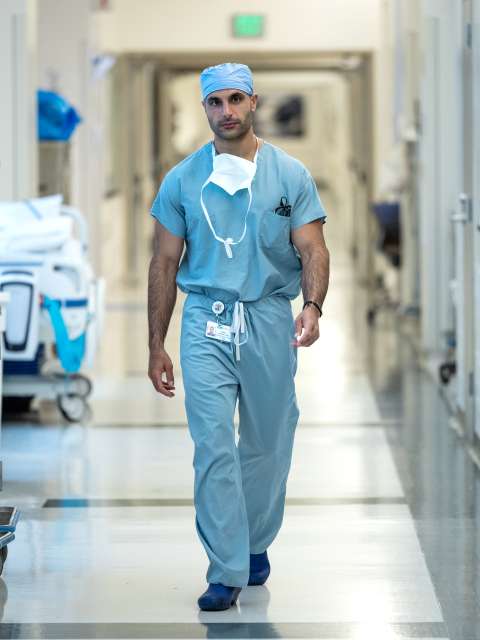
Getting into the David Geffen School of Medicine at UCLA was a “transformational moment,” Dr. Nassiri says: “Not only because it was the best medical school, but also because I was exposed to the powerhouse that is UCLA Urology.”
During his medical school rotation in urology, Dr. Nassiri worked with Jeffrey Veale, MD, a pioneer of "tolerance” kidney transplantation, which eliminates the need for lifelong immunosuppressive medication to prevent the body from rejecting the new organ.
Dr. Nassiri loved the urology team and the impact its work had on patients.
After graduating from UCLA, he began his residency at USC. He returned to UCLA Health for his fellowship in kidney transplantation and then joined the faculty at the David Geffen School of Medicine in 2025. He says he immediately found the support he needed as a surgeon and investigator within the Department of Urology, especially from former chair Mark Litwin, MD.
“Bladder transplantation has been Dr. Nassiri’s principal academic focus since we recruited him to the UCLA faculty,” Dr. Litwin says. “It’s incredibly gratifying to see him take this work from the laboratory to human patients at UCLA.”
Dr. Nassiri credits his success to the integrated team at UCLA Health. Transplant “is a team sport,” he says.
“You need a medical director, a surgical director, you need coordinators, dietitians, social workers and many other members of the transplant team,” he says. “The infrastructure to introduce a new transplant existed well before I got here. I just had to tailor it to what we needed. I'm incredibly honored to be at UCLA and to be a part of the incredible culture that exists here.”
The future of bladder transplant
With two bladder-kidney transplants scheduled to complete the clinical trial, Dr. Nassiri is looking ahead to make the procedure more widely available.
It’s ideal for people with end-stage bladder disease who are already on or will need to be on immunosuppression, he says. Residents and fellows have been learning the technique as well – one fellow plans to bring it to his home program in Canada, Dr. Nassiri says.
Next up is making bladder transplant available for pediatric patients.
“In children and adolescents, one of the major causes of kidney failure is bladder failure,” Dr. Nassiri says. “Absent a bladder transplant, these children undergo urinary reconstruction using bowel or intestine, which comes with its own set of lifelong complications.”
His ultimate dream is to combine bladder-kidney transplant with the tolerance program led by Dr. Veale, so organ recipients can live without toxic anti-rejection drugs.
“My ideal situation would be this: There’s a patient who doesn’t have functional kidneys or a functional bladder, and we give him a kidney and we give him a bladder, and we take him off immunosuppression and he lives a normal life,” Dr. Nassiri says.
He’s excited about what the future holds, he says, and grateful for the support he receives both on the job and at home: “I have the love and support of my family, which allows me to dedicate myself wholeheartedly.
“I don’t really want to be doing anything else,” Dr. Nassiri says. “I’m really enthralled by the work that we have here, and I look forward to getting out of bed and coming here every day.”