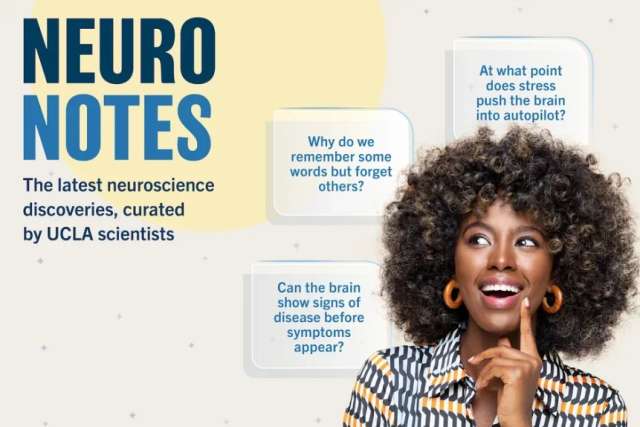
How did our brains evolve to be uniquely human? What makes us wired to help each other? Can chronic stress remodel the brain?
Instead of waiting in long lines after seminar talks for the chance to ask speakers questions such as these, or spending hours deciphering complex academic papers, interested community members can interact with new UCLA research in a streamlined digital Q&A format.
A tool developed by UCLA Neuroscience Research allows users to dive deep into the work of leading neuroscientists on campus.
NeuroNotes is an AI-enabled platform that allows users to explore research at an accessible level. The resource was designed as an access point for community members, researchers and students to discuss the high-level research taking place at UCLA, said Jamie Lynn, senior executive director of UCLA Health Sciences Development.
Eight key themes
NeuroNotes currently consists of eight themed collections of research, but more are being added. Readers can learn about brain development and aging; the effect of PTSD and stress on memory and brain health; advances in our understanding of brain cancer and Multiple Sclerosis; the neural mechanisms affecting decision-making; and the science behind empathy.
Each collection is curated by the UCLA researchers themselves, including papers that serve as the foundation for their work, allowing users to gain deeper insight into their research and the frameworks that guide their approach.
“We wanted to give faculty the opportunity to represent their work and their research, but also to share where they draw their inspiration from,” Lynn says.
NeuroNotes generates its responses solely from the studies uploaded by the researchers, citing the exact source to support further learning and exploration. The tool allows visitors to translate complex terminology, experimental methods, and the key takeaways of each research paper, and tailor the experience to their specific interests.
“It was really important (that) the AI didn’t hallucinate and start interpreting the science in a way that would sacrifice the integrity of the work,” Lynn says.
The final tool was fully vetted and approved by the faculty members who curated their collections, she adds.
Researcher Anne Churchland, PhD, says the tool allows people with different interests to engage with her work in ways that are important to them.
Churchland’s research on decision-making has applications for artificial intelligence, understanding the pathology of neurological disease, and healthy aging.
If you’re coming from a patient or family member perspective, Churchland says, you’re probably not up for digging deep into every acronym in a scientific paper. You just want to get to the information.
The ability to follow up and ask the AI tool additional questions is important to understanding her research, she says. For example, Dr. Churchland uses tamoxifen, a drug often used as a cancer treatment, in her experiments to target specific types of excitatory neurons in animal models.
It’s a common technique, says Dr. Churchland. “But if you’re reading my paper and you look it up and find it’s a treatment for cancer, it’s totally confusing.”
Communicating with NeuroNotes allows users to quickly understand how it is used in her experiments.
“Without (the) ability to ask very specific questions, if you're an outsider to the field, you can get lost and go down a rabbit hole that takes forever,” she adds.
How to make the most of NeuroNotes
Lynn says the best way to engage with the tool is to start with the research collection you find most compelling.
“Keep asking questions of the questions and keep asking questions of the answers,” she says.
NeuroNotes is intended to serve as the first step of engagement with the neuroscience community at UCLA, Lynn says. The tool can help clarify your interests and help you have deeper conversations about the research, rather than starting more broadly.
Support for neuroscience research
Researcher Weizhe Hong, PhD, says NeuroNotes offers a space akin to “digital office hours” where people can engage with his work on the science of empathy and compassion.
Beyond solely generating interest, Dr. Hong says the tool can show people how they can help advance the work. “Everyone can play a role here, and everyone can help advance this research,” he says.
Making scientific discoveries available to as many people as possible is essential, says Dr. Churchland.
“Most of the research that I do is funded by the National Institutes of Health and by the National Science Foundation, so those discoveries belong to everyone,” she says.
Her hope for NeuroNotes is that it will expand the possibilities for everyone who funded the research to get the information most relevant to them immediately, much different from how the public has been able to access scientific information in the past.
As NeuroNotes expands to include more researchers and topics to explore, Lynn says the team is also seeking to make the learning more interactive, such as through videos and direct connections to faculty members.
“NeuroNotes is meant to be the beginning of the journey,” Lynn emphasizes.