
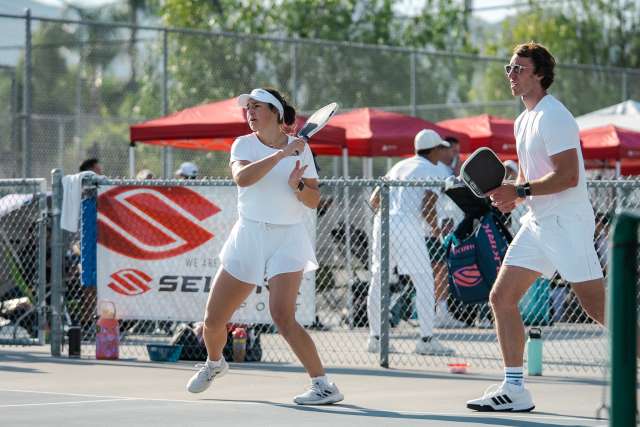
Whether it’s practicing with friends on a Calabasas pickleball court, traveling to compete in tournaments across the country, or treating a patient at his UCLA Health West Hills office, Jeremy Swisher, MD, keeps sports at the forefront of his life.
Growing up in a sports-loving Texas family meant Dr. Swisher focused on being an athlete from an early age. Football and basketball camp were summer routines in the Swisher household, but basketball was his main niche, earning him the nickname “Swish.”
“It made me have to practice shooting because I didn't want to not be good at shooting” with a nickname like that, laughs Dr. Swisher.
At age 13, however, he fell through the attic in his parents’ home on the Fourth of July, breaking a bone in his left foot and fracturing two vertebrae. His X-rays were sent to his radiologist cousin, who told him he may never play sports again.
“It was really scary,” said Dr. Swisher. “But going through that experience and spending so much time around imaging and doctors is what first sparked my interest in medicine.”
Specifically – and not surprisingly – his interest was drawn to sports medicine.
Part of a team
Despite the potentially poor outlook for his athletic career, Dr. Swisher healed well from his fall. He continued playing high school basketball and went on to play for the Division III team at Austin College before being accepted to medical school at Texas A&M University.
He then completed three years of medical residency at Wake Forest University in North Carolina and moved to Los Angeles for a sports medicine fellowship at the David Geffen School of Medicine at UCLA.
Dr. Swisher decided to specialize in primary care for athletes, a path that would enable him to “take care of all aspects of the team”; not just issues requiring surgery, but common issues such as elevated blood pressure and rashes.
A busy schedule
Lately, his weeks have been jam-packed with work in his West Hills orthopedic clinic Mondays, Thursdays and Fridays, and in Westwood, near the undergrad clinic, on Wednesdays. Tuesdays are dedicated to athletes in the training room, including members of the UCLA men’s golf and the women’s volleyball, swimming and diving teams.
He also reviews MRI results with patients, teaches an ultrasound class to new doctors, and works with the HERO Lab sports medicine research team. The lab is currently focused on patellar tendinopathy, which is an overuse injury of the tendon just below the kneecap. The team is studying treatments such as shockwave therapy, which may break up calcium deposits and increase blood flow to the tendon to stimulate healing. They aim to find interventions beyond physical therapy and rehabilitation for patients looking to get back on their feet faster.
There’s always time for pickleball
And yet, he still manages to fit pickleball practice into his schedule. A friend in residency introduced him to pickleball and he fell in love with the game right away.
His love stems from how social and inclusive the sport is, he said, adding that pickleball is perfect for “all levels” of players.
“I’ve played with 12-year-olds and 84-year-olds,” said Dr. Swisher.
The Calabasas Pickleball Club helped form his fondness for the sport as well as his skillset – it’s where he was trained by world-class pickleball player, and now friend, Gabe Joseph.
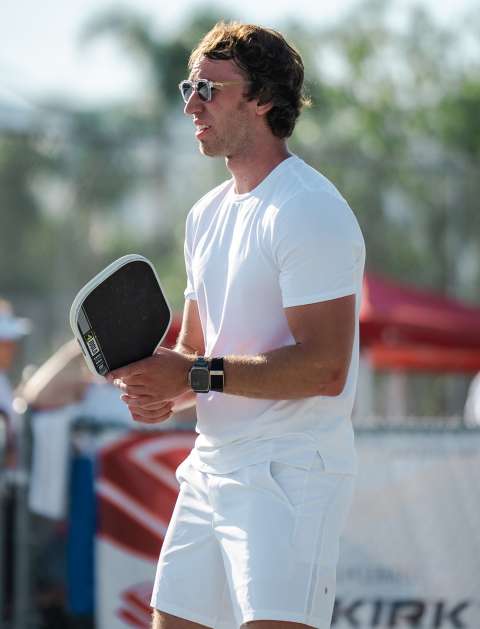
It also fills his desire for competition, playing tournaments with casual and pro-qualifying players. Dr. Swisher’s next tournament is the 2026 PPA Tour's Veolia Malibu Showcase at Pepperdine University in December. He will be competing in the amateur bracket in this professional and amateur event.
Not only has pickleball created a community for Dr. Swisher outside of work, but it has aided him in connecting to his patients, some of whom are pickleball and basketball players themselves.
“Building that relationship through shared experiences does a good thing for building confidence and coming up with a plan together,” explained Dr. Swisher.
Dr. Swisher utilizes his sports experience when working with UCLA sports teams and patients in general, knowing exactly what potential injuries to look for. Common injuries for pickleball players, for example, include meniscus tears and rotator cuff tendinitis, because the game involves repetitive moves.
“I take care of athletes, but I take care of active individuals of all ages,” he said. “You don’t have to play a sport to have a meniscus tear or to get a wrist sprain.”
Dr. Swisher has created a community with his patients and teammates.
“You get to meet so many like-minded, nice people,” he said. “I’m going to Hawaii with pickleball friends in January.”