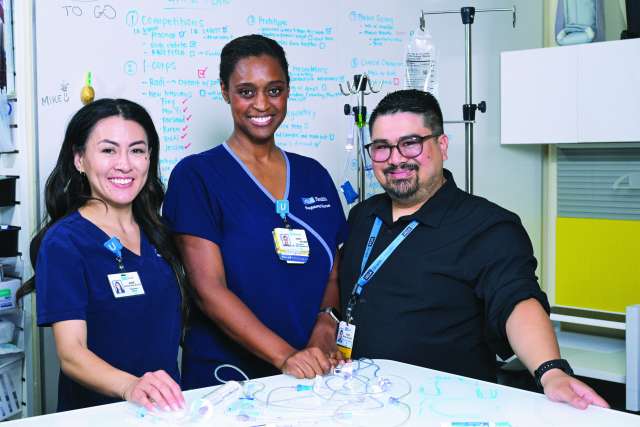
UCLA Health nurses are trained to lead with their minds as well as their hearts, as evidenced by a new product conceived and designed by nurses, for nurses. U-SNAP is a versatile snap-band IV-line organizer, designed to improve patient safety and streamline workflow by managing lines efficiently. The product is being refined through usability testing in clinical environments with nurses and patients.
The concept for U-SNAP emerged from the Research and Innovation Council’s first-ever nurse innovation sprint, led by Onike Williams, MSN, NP-C, program director for the UCLA Biodesign Program. In this program, bedside nurses engaged in a short period of brainstorming solutions to common problems they encountered on their floors.
The problem of line management was selected from 23 problem pitches, and an eight-member focus group of nurses was formed to continue the research. The work began in the New Knowledge and Innovation Collaborative Council (NKI) and later moved to the Research and Innovation Council (RIC).
“These eight nurses conceptualized this and did the research,” says Williams, who also leads nurse innovation at UCLA Health. “They took the charge and worked together wonderfully. We pulled in some of our biodesign engineers to help get that first prototype out and put something in the nurses’ hands.”
Validating the Problem
U-SNAP is a wearable device that uses flexible snap-band technology to help manage IV lines and prevent tangles or dislodgement issues. “If patients are tangled in lines, it’s hard for them to move safely,” Williams says. “But it’s also about protecting the line and its integrity while not having them get pulled by tugging or tripping or other incidents that can happen while a patient is in bed or in motion.”
The sprint group identified gaps in IV-line management through interviews and surveys with about 780 UCLA Health clinicians. They focused on the time spent managing IV lines, problems incurred and common workarounds. The responses showed 82% had witnessed tangled medical lines three to seven times during a 12-hour shift, and 77% had witnessed lines pulled out due to tangling or catching on equipment or furniture.
Other findings from their research included:
- Across the U.S., 19 million IV lines are projected to be replaced due to dislodgement at a cost of more than$266 million annually.
- The impact of dislodgement can create delays in treatment and use extra staff time (between six and 30 minutes) to replace the line.
- About 40% of patients experience psychological distress from reinsertion.
- Emergency Care Research Institute (ECRI) reports infusion lines on the floor create major fall risks, with each inpatient fall costing hospitals about$62,000 on average.
The focus group conducted an extensive review of existing products and patents, searching for any information related to IV-line management. They collaborated with a UCLA Health biodesign engineer on several solutions, including magnetic devices and other cable-management systems.
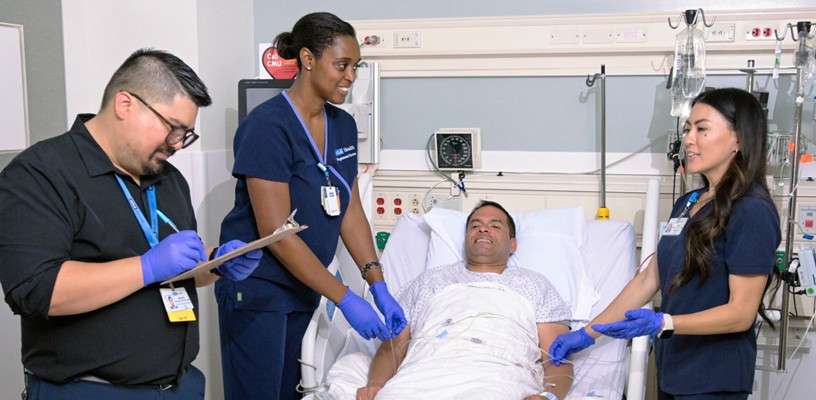
Feedback Essential
The nurses refined the design several times based on key criteria: It must have a quick attachment/detachment mechanism and be versatile, adaptable, comfortable for patients and compatible with hospital equipment.
Ultimately, they focused on a device that allows nurses to secure lines and organize all the lines, then quickly transfer to any location, such as a bedside rail, an IV pole, or a patient’s arm using a snap-on mechanism.
U-SNAP is currently patent-pending as the group makes prototype design changes to improve usability.
“It was a very engaging process,” says focus-group member Janar Bauirjan, MSN, RN-BC, CNRN, a resource nurse on the medical-surgical float team. “We attended NKI meetings before coming into the RIC meeting, so we had the opportunity to gather feedback from nurses with experience across a wide range of clinical backgrounds and care settings. So even though it was the eight of us in the focus group, we still received input and shared a lot of our process along the way.”
Biodesign Champions
After an initial prototype was developed, two nurses from the original group of eight were selected to participate as fellows in the Biodesign Program to do a deeper dive into the product: Bauirjan, along with Francis Soriano, BSN, RN, SCRN, a clinical informaticist.
The Biodesign Accelerator Fellowship kicked off with an intensive boot camp that Soriano describes as “a crash course in everything medical technology.”
“We came from bedside nursing, so this was a whole new world for us,” Soriano says. “We had to learn how to create a product, build a business and think like entrepreneurs.”
They also learned about the intricacies of manufacturing, regulations, market analysis and the patenting process.
The two fellows leveraged the UCLA innovation ecosystem, advancing U-SNAP through the Biodesign Accelerator and the Anderson Venture Accelerator, refining their business plan and validating the market need. They also gained experience pitching their product.
“We really learned to cater our pitch and our story to different audiences,” Bauirjan says. “So, what we might say to clinicians is different from what we would pitch to investors. We have to make our pitch relatable, tailor language and highlight the business and marketing aspects.”
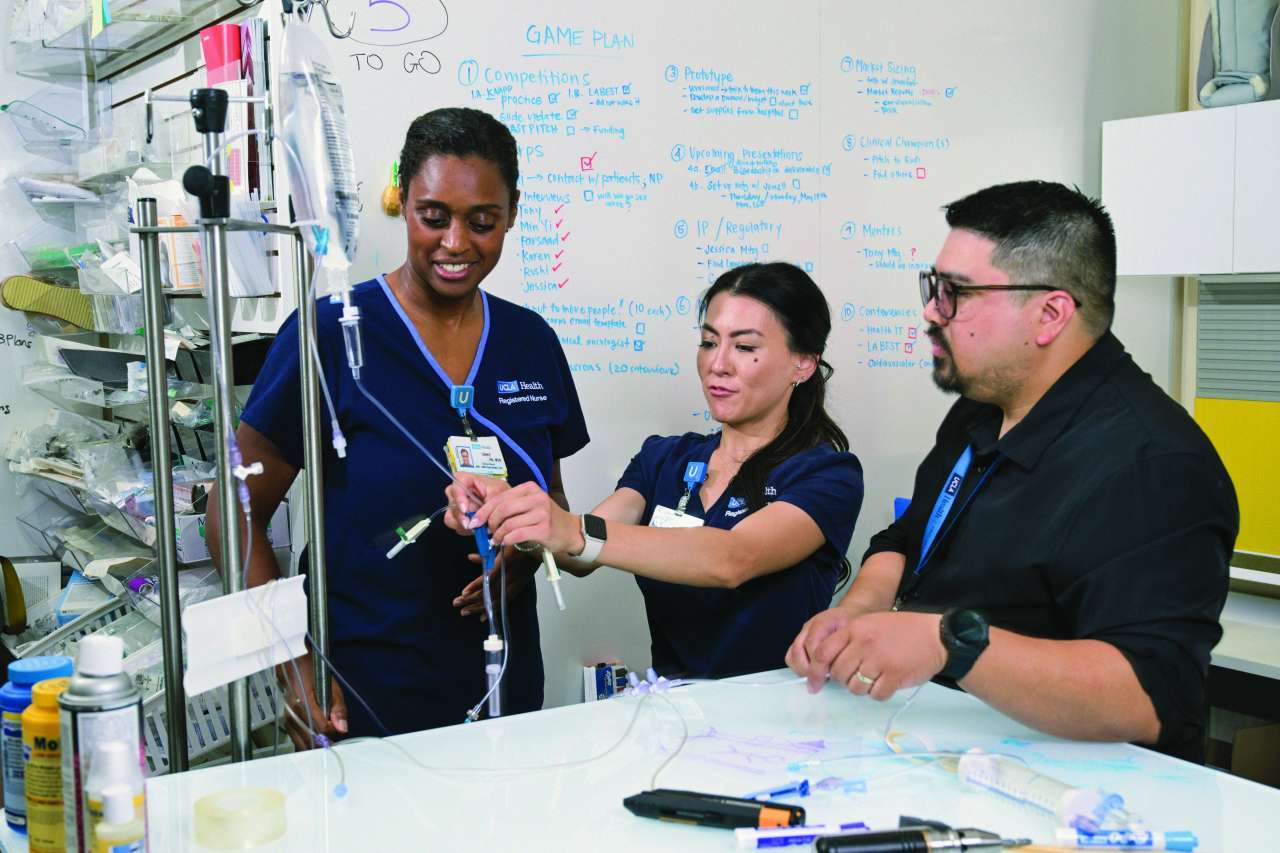
Pathway to Innovation
An important aspect, Soriano says, was bringing the information they learned to the other nurses in the Research and Innovation Council. “We did report-outs every month, and we created presentations where we taught them what we had learned over the past month.”
“If you identified a problem that needs a solution or thought of a solution that needs to be created, UCLA has the resources to support you.”
Williams notes that UCLA Health’s professional governance structure is an excellent place to foster innovation because it puts people in touch with nurses throughout the hospital system.
“This diversity in thought and knowledge leads to better solutions that meet the needs of a wide range of caregivers, from pediatric nurses to geriatric nurses,” Williams says.
Soriano agrees. “If a nurse comes to me and says, ‘Hey, I have an idea — what should I do?’ I say let’s talk about bringing your idea to RIC and to Onike,” he says.