UCLA Health Nursing is piloting a program to provide a pathway for nonclinical staff to transition into clinical positions by offering financial sponsorship, resources and support as participants train to become certified nursing assistants (CNAs). This initiative creates a direct pipeline for participants to apply their certification as clinical care partners within UCLA Health’s specialized care teams.
The program, in partnership with Santa Monica College, is the brainchild of Nursing’s Unity in Diversity Council and its Professional Advancement Subcommittee, which is focused on providing structural support for career advancement within UCLA Health.
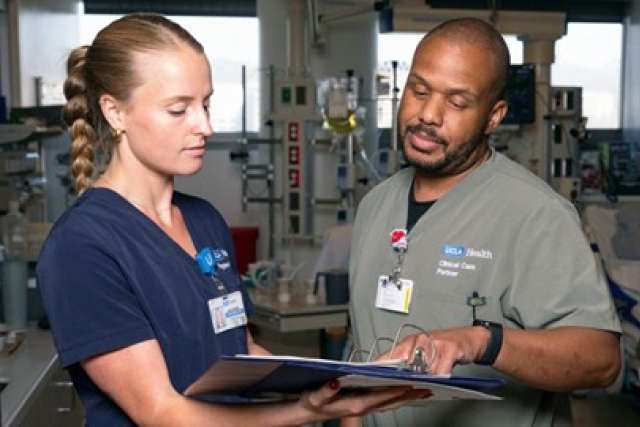
“As we reviewed our workforce, we saw individuals in custodial services, linens, labs, transport, all supporting hospital operations,” said Christopher H. Lee, MBA, BSN, RN-BC, a Clinical Nurse III on the Medical-Surgical Specialty Unit (6 West) at Ronald Reagan UCLA Medical Center, and the Professional Advancement Subcommittee lead. “We asked ourselves, ‘Do they have the same access to opportunities for higher earning potential, professional development and education as nurses do?”
Backbone of Nursing
The subcommittee decided to look at the clinical care partner role. “They ultimately support our patients, they support our nurses and they help reduce our workload,” Lee says.
A survey of health care staff taken during Unity and Kindness Day in 2023 revealed a genuine interest in the role, which Lee notes routinely runs about 20 short in staffing per day throughout the UCLA Health system. The survey also revealed the biggest barriers to transitioning to a clinical role were lack of financial support, resources, mentorship and scheduling difficulties.
“We took all the responses and we said, ‘Let’s see who’s available in our local community,’ and we identified Santa Monica College,” Lee said.
Roll Out of ‘CNA 1.0’
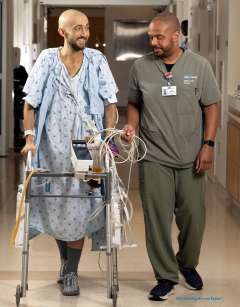
The CNA Training Program launched in 2024 and received high interest, garnering 170 applications over two weeks, ultimately resulting in five candidates, four of whom completed their certification.
“We learned that Santa Monica College was able to provide CNA courses,” Lee says, “and we worked with them to develop this pathway to certification in partnership with UCLA Health Nursing and our Office of Health Equity and Inclusive Excellence (OHEIE). We were able to provide sponsored tuition, wage protection, flexible scheduling and then mentorship toward certification at the end of the eight-week period.”
The program also paid for recipients’ supplies, including textbooks, scrubs and stethoscopes. Additional support included resume-building and interview-skills training.
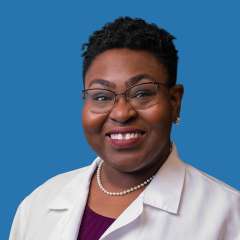
Lee worked with Kemi Reeves, DNP, MBA, GNP-BC, associate director of the UCLA Alzheimer’s and Dementia Care Program and the inaugural director of Nursing Health Care Equity; and Elizabeth Maister, BSN, MBA, RN, NE-BC, senior director of Nursing Business Systems, to conceptualize the program rollout. The plan included building candidate selection criteria, as well as developing objective measures for success and evaluation methods for program recipients.
Dr. Reeves also connected Lee with the Office of Health Equity & Inclusive Excellence, which cosponsors the program.
Filling a Need
Dr. Reeves notes that the CNA Training Program checks a lot of boxes, including enhancing workforce development and filling an organizational need for more clinical care partners. “It gives a career path to people who are dedicated to the health system and really have an interest in taking a more active role in the delivery of care,” says Dr. Reeves.
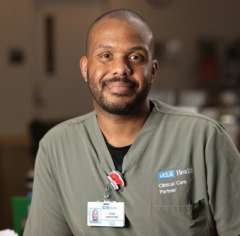
Chaz Valentine was working as a rehabilitation aide in the occupational and physical therapy department when he heard about the program. Seeing it as an opportunity to further his career, he decided to apply. Valentine took the course in fall 2024 and said he enjoyed the experience.
“Just having the contacts with UCLA Health, I was able to reach out to anyone at any point and get a response, so I felt really supported,” he said. “The class and the proctors at the school were great, and the whole experience ran smoothly.”
One of the primary tenets of the proposal, Dr. Reeves says, was not only to support the recipients financially but to work with their managers to ensure they had the protected time to attend class and to ensure their enrollment in the program did not affect their take-home pay.
“You can have the best intentions in the world, but if you have to put food on the table, you start to change your priorities,” she adds.
After Valentine received his CNA certification, he transferred to the Transplant Surgical Intensive Care Unit (8 ICU) at Ronald Reagan UCLA Medical Center, where he now works as a clinical care partner. He says the experience solidified his plans to become an RN. “I felt like this was a perfect step to start that path,” he says.
Future Plans
As the Professional Advancement Subcommittee wraps up CNA 1.0, it is actively working to launch an expansion of the program, again in partnership with Santa Monica College, UCLA Health Nursing and the Office of Health Equity and Inclusive Excellence.
Lee says the vision is for the program to be adopted across the entire health system and serve as a blueprint for other career pathways. The model could be adapted to help CNAs, RNs and other clinicians advance into new roles, building a stronger, more agile workforce for the future. He adds that internal career advancement is a key driver of employee satisfaction and retention, leading to better patient outcomes.
“You’re strengthening your internal community, supporting one another and enhancing the care we deliver. This ‘triple dignity investment’ of patient, staff and business proves that it is possible to balance return on investment with goodwill,” he says. “Ultimately, the patient is the one who benefits from better, safer care, happier staff and people who want to be there.”