People become doctors for all sorts of reasons. Some are shaped by a life-altering diagnosis. Others follow in the footsteps of a role model who devoted their career to medicine.
Adrian Escobar once aspired to become a physician because he was angry.
The neuroscience PhD student at UCLA grew up in a working-class family in Santa Ana, California. His parents encouraged him to pursue any path he wanted, but he struggled to find his purpose.
“I didn’t gravitate to anything during my school years,” Escobar said. “I was just kind of there: taking classes, surviving.”
By the time he started as an undergrad at California State University, Fullerton, Escobar had resolved to become a medical doctor — not out of enthusiasm for the vocation but out of determination to ease his family’s hardship. He was mad that his parents, who worked brutal hours in food service and nursing homes, often sacrificed meals and sleep to take care of him and his brother.
Escobar’s thought process was pragmatic: physicians make a lot of money, which could improve his parents’ quality of life. But encountering classmates with a genuine passion for caregiving made Escobar question whether clinical work was really meant for him. It wasn’t until an advisor and faculty member at Cal State Fullerton suggested joining a research lab that he discovered his true calling.
“It was the most fun I’ve had — ever,” Escobar said. “I felt like I was a kid again.”
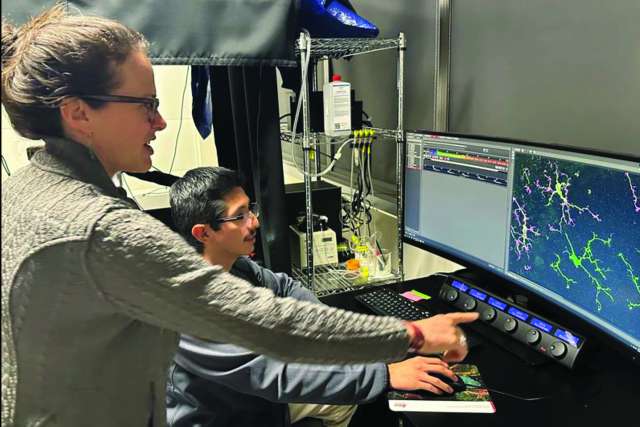
Now four years into his PhD program at UCLA, Escobar is mounting his most ambitious research project yet alongside his mentor Lindsay De Biase, associate professor of physiology and neurobiology, thanks to a recent grant from the W.M. Keck Foundation. They are studying microglia, immune cells that keep the brain healthy by “eating” harmful material, particularly during aging.
The duo’s goal is to determine if, how and why microglia malfunction in the aging brain and in patients with neurodegenerative diseases such as Parkinson’s, Alzheimer’s and dementia. To closely examine the receptors microglia use to eat various molecules, Escobar and De Biase optimized a way to detect all the cell surface proteins on microglia using chemically preserved human tissue.
This method is unprecedented: Scientists have long tapped chemically preserved human tissue for anatomy and cell identification experiments — but not for cell-specific proteomics, the term for this comprehensive and granular technique.
What’s more, Escobar and De Biase have shown that they can apply this technique to tissues chemically preserved for longer than 24 hours — including tissues preserved for weeks and, potentially, months. This milestone unlocks access to a plethora of brains stored for an extended period in tissue banks throughout the world.
“We both knew that the payoff — in terms of what kind of information we were going to get about the cells and how they’re changing in the aging brain — was worth sticking through a lot of experiments that aren’t working,” De Biase said. “But now we’re in this place where it’s working. We’ve got promising initial results, and it’s really exciting.”
De Biase and Escobar believe their project was a good fit for the Keck grant because of its innovative nature and broad applicability. Ideally, countless scientists will be able to consult their findings and collect protein-sequencing datasets from chemically preserved organs that could lead to targeted therapies for brain and other diseases.
De Biase and Escobar agreed that the foundation's investment has been instrumental, particularly amid federal funding constraints.
“If we want to analyze a lot of samples from different ages or a lot of samples from different human tissues, it adds up,” De Biase said. “This funding allows us to deploy this new technique in a much more impactful way.”
The far-reaching implications remind De Biase of her father, a primary care physician who often expressed a desire to advance human health on a grander scale. In turn, De Biase lamented the long, slow arc of science and wished for the power to make individual people feel better.
“The grass is always greener, right?” she joked.
With this grant, this investigation has the potential to accomplish both. And not only patients stand to benefit: Escobar intentionally engineered their protein extraction technique to be affordable and accessible for scientists with fewer resources — including his future self and mentees.
When he earns his PhD and leaves UCLA, Escobar hopes to run his own laboratory at a smaller, undergraduate institution like his alma mater, Cal State Fullerton.
"I always try to pay it forward," Escobar said. "That’s why building things that are cost effective means a lot to me. Because this whole world completely changed my life.”