A surgical robotics system developed through collaborative research at UCLA has achieved a significant breakthrough in ophthalmic surgery. The technology, which emerged from more than a decade of multidisciplinary research at UCLA, was recently used in the world's first human clinical trial of robotic-assisted cataract surgery.
Cataracts — clouding of the eye's natural lens that can lead to vision impairment and ultimately blindness if left untreated — affect approximately 94 million people worldwide. The condition remains the leading cause of global blindness, accounting for about 33 percent of all blind people. Cataract surgery is often cited as the most frequently performed surgery in the world, with more than 26 million procedures a year worldwide. Traditional cataract surgery, while common, poses significant challenges for surgeons, requiring visualization of transparent ocular tissues and extreme precision due to the small (few microns) dimensions of the anatomical structures.
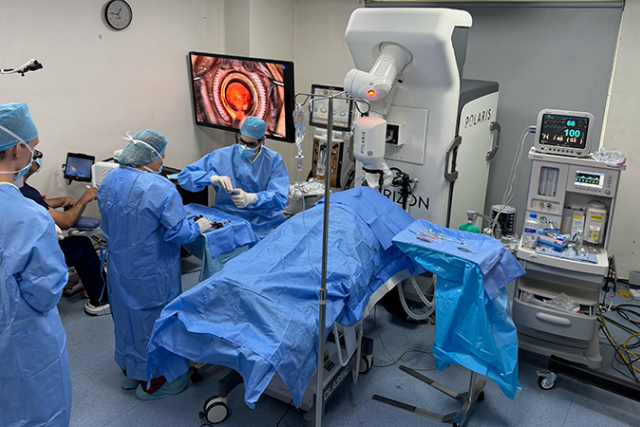
The first-in-human study, conducted in October, successfully completed robotic-assisted cataract surgery on 10 patients with no adverse events. Dr. Uday Devgan, a former professor of ophthalmology, and Dr. David Lozano Giral, an assistant clinical professor of ophthalmology and a director of Ocular Trauma service at the Jules Stein Eye Institute at UCLA, performed the surgeries, marking a historic milestone in ophthalmic surgical robotics.
The Technology
The robotic platform developed at UCLA enables surgeons to operate from a specialized cockpit located in the operating room. The cockpit incorporates an advanced input device that provides real-time augmentation, guidance overlays and tactile feedback while the surgeon views a 3D monitor displaying ocular anatomy captured through multimodal imaging systems. Surgical robotic arms use interchangeable microsurgical tools to make small corneal incisions and remove the cataract-affected lens, after which the surgeon implants a clear, patient-specific artificial lens to restore vision.
UCLA's Research Foundation
The breakthrough represents more than a decade of multidisciplinary collaboration between engineers at the UCLA Samueli School of Engineering and physicians at the UCLA Stein Eye Institute, funded in part by multiple National Institutes of Health awards. The research team was led by Jacob Rosen, a professor of mechanical and aerospace engineering and bioengineering and director of the Bionics Lab, and Tsu-Chin Tsao, a distinguished professor of mechanical and aerospace engineering and director of the Mechatronics and Controls Laboratory, working alongside Dr. Jean-Pierre Hubschman, a former professor of ophthalmology at UCLA and founder and former director of the Advanced Robotic Eye Surgery Laboratory, and Dr. Steven Schwartz, former chief of the Retina Division at the UCLA Stein Eye Institute.
In a recent preprint titled "High‑Precision Surgical Robotic System for Intraocular Procedures," the UCLA researchers reported that laboratory testing demonstrated a tooltip accuracy of 0.053 millimeters, highlighting the technology's potential to improve safety and consistency in complex eye surgeries, including cataract procedures.
"The professional journey from a concept sketched on a napkin to the first robotic cataract procedure was profoundly meaningful and deeply impactful," Rosen said, reflecting on the collaborative research that made the advancement possible.
Path to Clinical Application
After more than 15 years of development at UCLA, the technology was licensed through UCLA's Technology Development Group, which manages the university's intellectual property and helps bring innovations from the lab to the marketplace.
"This milestone demonstrates the strength of UCLA's innovation ecosystem, where cutting-edge engineering, medical expertise and entrepreneurial support come together to improve lives," said Amir Naiberg, associate vice chancellor and president and CEO of UCLA Technology Development Group. "This success underscores the critical role of university technology transfer in advancing both science and patient care."
The completion of the first clinical study marks a pivotal step in the clinical regulatory process toward broader adoption of robotic-assisted ophthalmic surgery. The technology continues to be refined as it progresses through additional clinical studies and regulatory review.