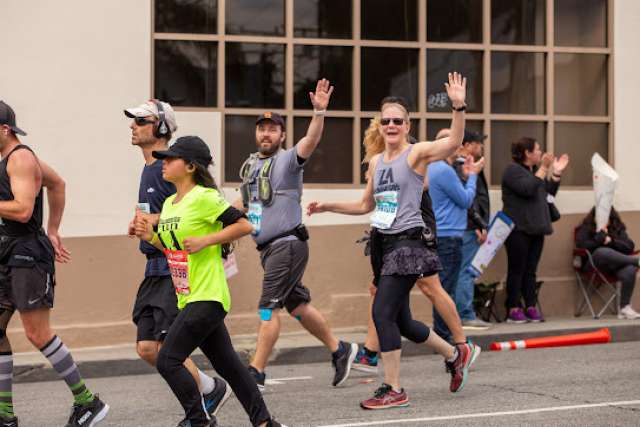
It may not have been Barbara Corrigan’s fastest marathon, but it was undoubtedly her most meaningful.
On Oct. 30, 2022, just three months after donating a kidney through a paired exchange, Corrigan crossed the finish line at the Dublin (Ireland) Marathon with a respectable time of 5:51:19 and a grateful heart.
It was Corrigan’s 15th marathon, and she had set a goal to finish before the course was closed at the seven-hour mark.
Corrigan trains with the LA Leggers, and her kidney donation was a few days before the start of the 2022-23 season. For the first few weeks, she walked the workouts instead of running, starting with 2 miles.
“Once I could run, I ran with my pace group as far as I could and then walked the rest of the mileage," she says. "I was able to run about half of the mileage all season, and I completed the mileage at a walking pace.”
Corrigan reached the 12-mile point in the club’s training schedule shortly before she left for Dublin, so her longest run before the marathon was about 6 miles, with 6 miles of walking. She was able to run about 10 miles in Dublin – at a faster pace than she expected – before she finished at a walking pace.
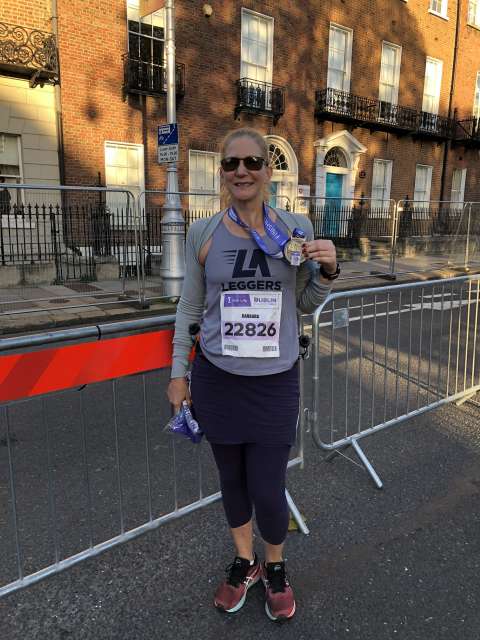
“I was full of question marks. I had no idea how far I could run, how fast I could run,” Corrigan, now 56, recalls. “I knew I could finish a marathon, but I didn't know if I could do it in time. And realizing that I could – and with leftover time – was really thrilling. That was my goal, and I did it.”
After the Dublin Marathon, she continued training with her group for the 2023 LA Marathon, running about half of the mileage and walking the rest. Eight months post-donation, she ran and walked the LA Marathon and has since completed four more marathons.
Kidney donation
Corrigan had been considering donating a kidney after a couple of her friends became donors. A few years went by, and then she met a woman whose 11-year-old daughter urgently needed a kidney, but whose mother was not a suitable donor for her.
“That made it seem like, OK, this is the time,” Corrigan says.
Corrigan and the young girl were not a compatible match either, but Corrigan had already initiated her donor process through UCLA Health’s Living Kidney Donor Program – which guides qualified, healthy people to be living kidney donors – and she entered a paired kidney exchange on the girl’s behalf.
The National Kidney Registry – which facilitates living-donor transplants – matches incompatible donor-recipient pairs into exchange chains. Through UCLA Health’s association in the registry, Corrigan’s kidney went to a man elsewhere in the chain, and in return, the girl received a compatible kidney from another donor in the exchange.
“I’m so grateful that I’m super healthy and strong,” Corrigan says. “I felt like there are people who don’t have those blessings, and I do, so why not show my gratitude in that way?”
Ensuring safety
UCLA Health is one of the largest centers in California for living kidney donations. For the past three years, it has ranked in the top four in the state for applications received – about 1,500 annually. The transplant program selects healthy donors through a thorough screening process to ensure safe donation and rapid recovery in which donors can resume a normal life without compromise.
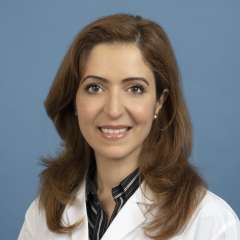
Fewer than 130 donors are selected to donate annually, says Lama Matni Abdelnour, MD, the medical director of the Living Kidney Donor Program.
“We don’t accept a patient as a kidney donor unless we’re confident the donation won’t alter their life afterward,” she says. “Our surgeons go above and beyond to ensure every donor recovers well and every surgery goes smoothly, without complications.”
Since its first transplant in 2008, the National Kidney Registry has facilitated more than 13,000 living donations through 102 member centers nationwide, including UCLA Health. The benefits of receiving a living donation versus a kidney from someone who has died are significant, Dr. Abdelnour says. They include better graft survival, fewer complications and a faster healing process because the kidney starts working from the moment it is transplanted.
“Plus, every patient who receives a living donation is removed from the waitlist and opens an opportunity for another patient to move up on the list,” she adds.
Those who are given the green light by UCLA Health to proceed as donors go through a robust evaluation that assesses kidney and liver function, blood chemistry, blood cell counts and exposure to infections such as hepatitis B, hepatitis C, HIV and tuberculosis. Potential donors also undergo electrocardiograms, chest X-rays and CT scans.
In addition, each kidney must be healthy and individually functioning well, Dr. Abdelnour explains: “We want to give the recipient a good kidney, so they have the best possible graft function and quality of life after transplant. The general rule is that we leave the donor with the better-functioning kidney.”
Speedy recovery
Donors generally spend no more than 24 hours in the hospital. The laparoscopic surgery is a minimally invasive procedure that uses a lighted video camera inserted through small incisions in the lower abdomen.
Corrigan remembers how kind the staff at Ronald Reagan UCLA Medical Center were to her the day of the surgery, even praising her for her decision to donate.
“Afterward, they took such good care of me,” she says. “It definitely wasn’t a traumatic experience.”
The morning after surgery, donors are educated on post-op care and then discharged. After a single follow-up visit, they are usually cleared to return to work two weeks post-surgery.
“There was a bit of pain for a few days, but I had a marathon coming up in three months, so I was eager to get back to running,” Corrigan says. “It was a real struggle for me, balancing the demands of marathon training with the common sense of not pushing too hard.”
Corrigan said it helped her to make lists of the milestones in her post-op activities: walking the first week and running as soon as she could. After three weeks she walked a 10K and went back to dance lessons (she’s an amateur competitive ballroom dancer). After seven weeks she walked and ran 7 miles with her running club on a Saturday and walked/ran a 10K race and did a half-day dance competition the following day.
“I felt like this might be pushing it, but I had a great time,” she says.
No limits
Dr. Abdelnour notes that while few people will run a marathon shortly after donation, “You can go back to dancing, swimming, running within a very short period of time,” she says. “And when Barbara shared with us that she was able to run the marathon three months post-donation, it was a big statement and testament to how healthy kidney donors can be after donation.”
Seven months after Corrigan’s donation, she participated in her first big multiday dance competition post-procedure. Her next big competition was in July 2023, in Rome, and she recently competed in a single competition that moved from Paris to London.
“It’s had no effect on my dancing,” she says. “There have been no limits.”

She only missed one dance competition after surgery, she says, but “everything else just fit itself in."
"And the emotional benefits of knowing that I’ve done something helpful for another person far outweigh the one missed competition,” she adds. “I have no regrets. It was all good.”
One aspect of her donor journey she calls “magical serendipity” holds a special place: The day she ran the Dublin Marathon, the young girl who inspired her to donate received her kidney transplant.
Says Corrigan: “I was thinking of her and praying for her the whole time.”