
UCLA & Regeneron Publications
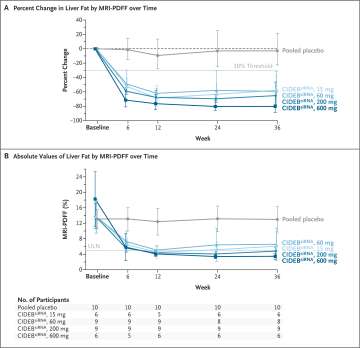
A Liver-Targeted CIDEB siRNA in Adults with MASLD
November 8, 2026
Norton TD, Taubel J, Imperato GH, Aziz-Zaman S, Witkin J, Miller J, Mohammadi KA, Wang S, Swanson T, Stoms M, Cheng X, D'Antonio J, Habib S, Workman D, Cho J, Patel Y, Xavier V, Chen C, Smith DJ, Smith S, Pereira S, Forlenza D, Pindar J, Crosby M, Fidotta S, Leal M, Tanios F, Gusarova V, Sleeman M, Hamilton J, Davis J, Gonzalez Trotter D, Liu R, Musser B, Cox E, Braunstein N, Verweij N, Lotta LA, Yancopoulos GD, Baras A, Herman GA, Lederer DJ; ALN-CIDEB-NASH-2486 Study Investigators, Regeneron Genetics Center (RGC), Geisinger Health System–RGC DiscovEHR Collaboration, Penn Medicine Biobank, Colorado Center for Personalized Medicine, Mayo Clinic–RGC Project Generation, Malmö Diet and Cancer Study, Indiana University School of Medicine (Indiana-CLDB), UCLA Health–RGC ATLAS Collaboration, Mount Sinai Million Health Discoveries Program, and the University of Texas Southwestern, Dallas Biobank. A Liver-Targeted CIDEB siRNA in Adults with MASLD. N Engl J Med. 2026 Nov 8. doi: 10.1056/NEJMc2612905. Epub ahead of print. PMID: 43001761.
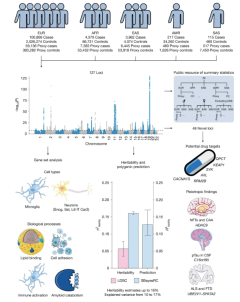
Alzheimer’s disease genetics converges on microglial and neuronal dysregulation
October 28, 2026
Uffelmann, E., Wightman, D.P., Bahrami, S. et al. Alzheimer’s disease genetics converges on microglial and neuronal dysregulation. Nature (2026). https://doi.org/10.1038/s41586-026-11206-y
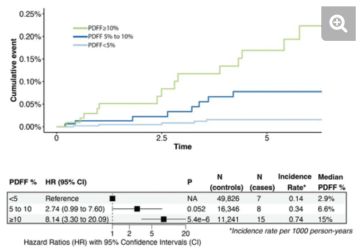
Causal relationship between liver fat reduction and clinical outcomes in human genetic studies and randomized clinical trials of metabolic-dysfunction associated steatohepatitis
September 28, 2026
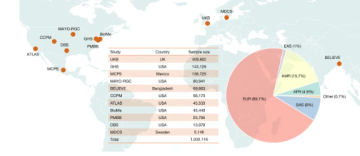
FNIP1 variants are associated with favourable metabolism in 1 million humans
August 5, 2026
Hindy, G., Adam, R.C., Sosina, O. et al. FNIP1 variants are associated with favourable metabolism in 1 million humans. Nature 657, 703–712 (2026). https://doi.org/10.1038/s41586-026-10864-2
Autoimmune hepatitis and primary biliary cholangitis are among a subset of autoimmune diseases defined by profound co-prevalence and genetic risk association with the IL12 pathway
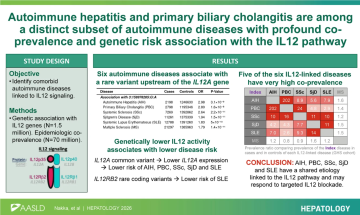
July 15, 2026
Nakka P, Hobbs BD, Sidore C, Palmer WH, Murdock D, Gurski L, Glatman Zaretsky A, Moll K, Campos AI, Joshi A, Gaynor SM, Guerreiro R, Kosmicki JA, Tang J, Marcketta A, Baldassari A, Joseph T, Watanabe K, Yu S, Bai X, Gillies CE, Mbatchou J, Sun K, Ganel L, Casullo VM, DiMartino S, Geba GP, Zhang L, Zhu W, Xia Z, Melander O, Chalasani N, Hemmer B, Gasperi C, Held F, Uibel P, Jones M, Shuldiner AR, Balasubramanian S, Ghoussaini M, Ge W, Reid JG, Overton JD, Salerno WJ, Marchini J, Kessler MD, Yancopoulos GD, Orengo JM, Baras A, Lotta LA, Abecasis GR, Siminovitch K, Ferreira MAR; Regeneron Genetics Center; Houston Scleroderma Family Registry and DNA Repository; Consejo Superior de Investigaciones Científicas Study; University of California Los Angeles ATLAS Collaboration; Mayo Clinic Project Generation; GHS-RGC DiscovEHR Collaboration; Colorado Center for Personalized Medicine; Penn Medicine Biobank; Aurora Healthcare System; Mount Sinai Million Health Discoveries Program; Indiana Biobank; Malmö Diet and Cancer Study; University of Tennessee Health Science Center BIG Initiative; Mayo Clinic PBC Cohort; Australia and New Zealand MS Genetics Consortium; Northwestern Scleroderma Patient Registry; Accelerated Cure Project Repository; Technical University of Munich MS Study; University of Pittsburgh PROMOTE Cohort; Oxford Million Women Study; University of Alabama at Birmingham Autoimmune Disease Biorepository; Discover Me South Africa Study. Autoimmune hepatitis and primary biliary cholangitis are among a subset of autoimmune diseases defined by profound co-prevalence and genetic risk association with the IL12 pathway. Hepatology. 2026 Dec 1;84(6):1642-1655. doi: 10.1097/HEP.0000000000001819. Epub 2026 Jul 15. PMID: 42868031; PMCID: PMC13764249.
Rare protein-coding variation and the genetic architecture of height in >1.4 million individuals
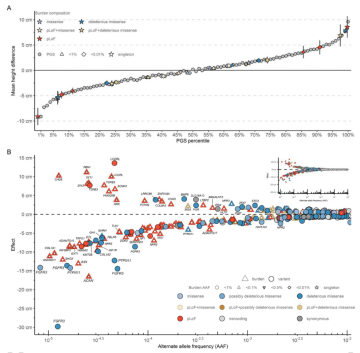
June 24, 2026
Genomic analyses reveal new insights into Alzheimer’s disease
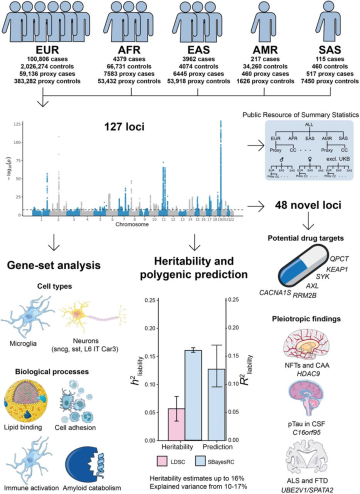
May 20, 2026
Humans with function-disrupting variants in the myostatin gene (MSTN) have increased skeletal muscle mass and strength, and less adiposity
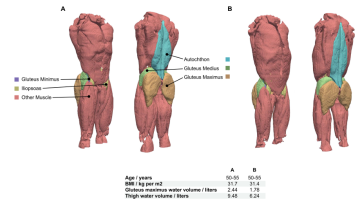
March 13, 2026
Herman, J.L., Dornbos, P., Landheer, K. et al. Humans with function-disrupting variants in the myostatin gene (MSTN) have increased skeletal muscle mass and strength, and less adiposity. Nat Commun 17, 3891 (2026). https://doi.org/10.1038/s41467-026-70422-2
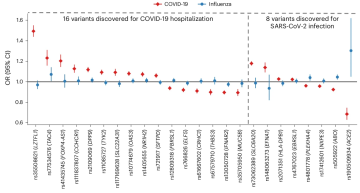
Genetic risk factors for COVID-19 and influenza are largely distinct
August 5, 2024
Kosmicki, J.A., Marcketta, A., Sharma, D. et al. Genetic risk factors for COVID-19 and influenza are largely distinct. Nat Genet 56, 1592–1596 (2024). https://doi.org/10.1038/s41588-024-01844-1
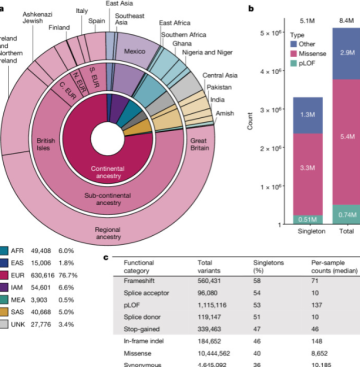
A deep catalogue of protein-coding variation in 983,578 individuals
May 20, 2024
Sun KY, Bai X, Chen S, Bao S, Zhang C, Kapoor M, Backman J, Joseph T, Maxwell E, Mitra G, Gorovits A, Mansfield A, Boutkov B, Gokhale S, Habegger L, Marcketta A, Locke AE, Ganel L, Hawes A, Kessler MD, Sharma D, Staples J, Bovijn J, Gelfman S, Di Gioia A, Rajagopal VM, Lopez A, Varela JR, Alegre-Díaz J, Berumen J, Tapia-Conyer R, Kuri-Morales P, Torres J, Emberson J, Collins R; Regeneron Genetics Center; RGC-ME Cohort Partners; Cantor M, Thornton T, Kang HM, Overton JD, Shuldiner AR, Cremona ML, Nafde M, Baras A, Abecasis G, Marchini J, Reid JG, Salerno W, Balasubramanian S. A deep catalogue of protein-coding variation in 983,578 individuals. Nature. 2024 Jul;631(8021):583-592. doi: 10.1038/s41586-024-07556-0. Epub 2024 May 20. Erratum in: Nature. 2025 Jan;637(8047):E26. doi: 10.1038/s41586-024-08571-x. PMID: 38768635; PMCID: PMC11254753.
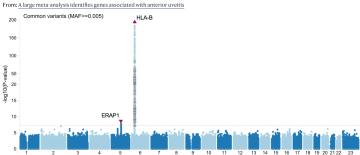
A Large Meta-Analysis Identifies Genes Associated with Anterior Uveitis
November 11, 2023
Gelfman, S., Moscati, A., Huergo, S.M. et al. A large meta-analysis identifies genes associated with anterior uveitis. Nat Commun 14, 7300 (2023). https://doi.org/10.1038/s41467-023-43036-1
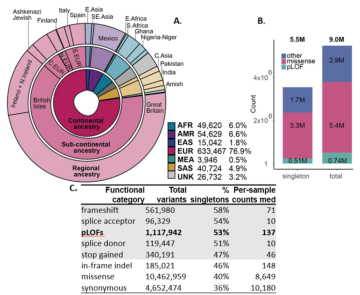
A deep catalog of protein-coding variation in 985,830 individuals
November 2, 2023
, , , , , , , , , , , , , , , , , , , , , , , , , , , , , , , , , , , , , , , , , , , , , , , doi: https://doi.org/10.1101/2023.05.09.539329.