Measles cases continue to concern public health officials in Los Angeles County and nationwide, as 733 confirmed cases already have been reported in 2026, according to the Centers for Disease Control and Prevention.
This includes three confirmed cases in Los Angeles County and two in Orange County, according to the L.A. County Department of Public Health.
In 2025, 2,267 measles cases were reported nationwide, the highest annual count in more than three decades.
The CDC says most of the cases so far this year stem from outbreaks in 2025. Two new outbreaks have been reported in 2026.
The increase in measles cases is multifactorial, says Sanchi Malhotra, MD, medical director of pediatric infection prevention for UCLA Mattel Children’s Hospital and a professor in the division of pediatric infectious diseases at the David Geffen School of Medicine at UCLA.
Vaccination rates declined during the COVID-19 pandemic and have yet to rebound to the 95% required for herd immunity, Dr. Malhotra says. There are also more measles cases circulating globally, and the highly contagious nature of the disease allows it to spread quickly.
Like COVID-19, measles spreads through airborne particles. But measles is six times more contagious, she says. One person infected with measles can infect up to 18 others in an unvaccinated population. With COVID-19, that rate was one to three. Furthermore, when someone with measles leaves a room, the room remains infectious for two hours as airborne particles continue to circulate.
“It can be really hard to control from an infection-prevention and public health standpoint, given how contagious it is,” Dr. Malhotra says.
The best way to prevent measles is through vaccination. Before the measles vaccine was introduced in 1963, an estimated 3 to 4 million people in the U.S. were infected each year, 48,000 were hospitalized annually and 400 to 500 people died, according to the CDC. Two doses of the measles, mumps and rubella (MMR) vaccine are 97% effective at preventing infection, it says.
“The measles vaccine is incredibly safe and effective,” Dr. Malhotra says. “It’s really our most effective tool to prevent measles, and it’s really responsible for the significant decline we saw in measles cases starting from when the vaccine was introduced.”
Vaccination rates against measles are high in Los Angeles, Dr. Malhotra says. The California Department of Public Health requires children to receive two doses of the measles, mumps and rubella vaccine before attending public schools.
Measles symptoms
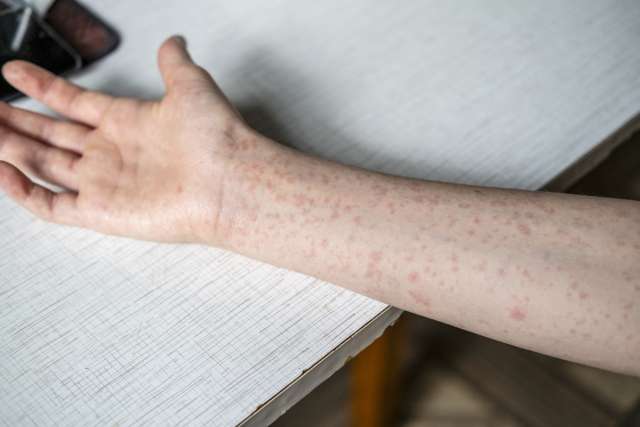
Measles initially presents with cold-like symptoms – cough, runny nose, red eyes – before patients develop its characteristic rash. A person is contagious four days before onset of the rash, Dr. Malhotra says.
Some people will go on to develop pneumonia or a degenerative neurological disease. Measles can also affect immune cells, making them “essentially forget” immunity to diseases they were previously exposed to, she says.
“After a measles infection, kids tend to have more episodes of colds, diarrhea, other illnesses they might have already encountered because of measles directly affecting their immune system,” Dr. Malhotra says. “There are a lot of possible complications from measles. So it’s not just a benign disease. It actually can be quite scary.”
Who is most at risk?
Young infants are particularly vulnerable to infection, as children typically receive their first dose of the MMR vaccine at 12 months old. However, infants who will be traveling internationally or visiting an outbreak area may be eligible to receive the vaccine at 6 months, Dr. Malhotra says, advising parents to speak to their pediatrician.
Immunocompromised individuals are also at higher risk of infection, but they should discuss with their physician if they may be eligible to receive the MMR vaccine, she says.
Measles vaccinations are typically provided free through the Vaccines for Children program.
Side effects of the measles vaccine may include fever pain at the injection site. “The risk of complications with measles is significantly higher,” Dr. Malhotra says, “than any small risk from the vaccine, usually of a fever or a sore arm.”