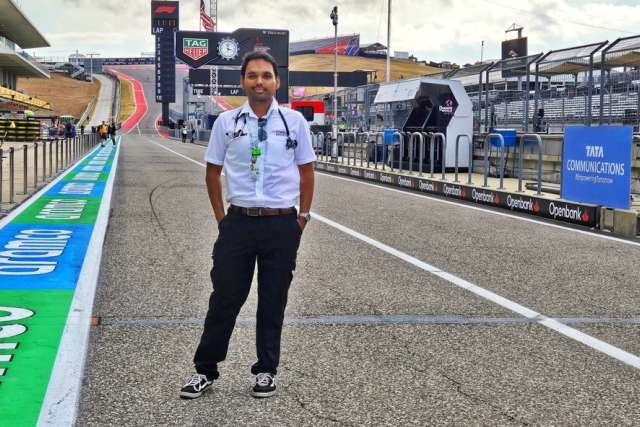
Neil Ray, MD, was watching the Netflix documentary series “Drive to Survive,” a behind-the-scenes look at Formula 1 racing, when inspiration struck: could Formula 1 use an emergency physician with a background in engineering and physics, like him?
Dr. Ray started emailing racetracks across the country, eventually connecting with an organization called Formula Medicine, which provides medical support for Formula 1 teams around the world.
Now, Dr. Ray, who works in the Emergency Department at UCLA Santa Monica Medical Center and UCLA West Valley Medical Center, is the onsite physician at U.S. Formula 1 races. In October, he’ll be at the United States Grand Prix in Austin, Texas, followed by the Las Vegas Grand Prix in November and the Miami Grand Prix in May.
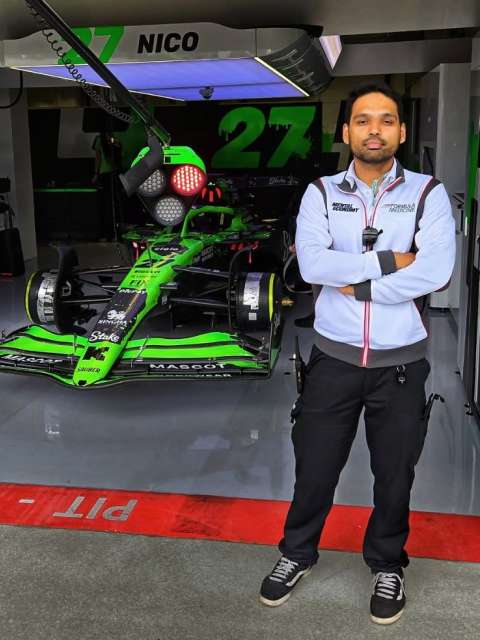
“Never in my life had I thought I would be in the most exclusive area of the racetrack taking care of people,” Dr. Ray says. “It’s a world I never would have interacted with.”
Caring for racers
Formula 1 cars regularly go more than 200 mph on the track, with top speeds surpassing 220 mph. That kind of velocity alone takes a toll on the body, but it’s not the only factor at play. The race car’s cockpit is like a sauna, with temperatures topping 120 degrees, and drivers’ heartrates are elevated to sprinters’ levels throughout the 90-minute, 190-mile race.
“In motorsports, it’s extreme physiology,” Dr. Ray says.
Race car drivers train throughout the year — endurance and strength training, plus targeted resistance work to keep their neck and core stable against the intense gravitational pull caused by high speeds. They also wear special “cooling vests” during races with water running through them to lower body temperature.
“Heat stroke can be a big thing,” Dr. Ray says, adding that on-track medical bays are equipped with “dunk tanks” where drivers can be immersed in a cold plunge to bring body temperature down quickly.
Drivers typically travel with their trainers and physical therapists, Dr. Ray says. He’s on hand to help with general medical issues: jet lag, viral illnesses, gastrointestinal upset. He also makes house calls to drivers’ hotel rooms when needed.
For catastrophic crashes and other emergencies during a race, there’s a track physician who responds in the “world’s fastest ambulance”: an Aston Martin driven by a professional driver that can reach any part of the course in eight seconds, Dr. Ray says.
Emergency medicine vs. race medicine
Dr. Ray also cares for others on the race crew, including mechanics, tire fitters and F1 staff. Unlike at UCLA Health, where Dr. Ray diagnoses and stabilizes patients with acute problems, “when it comes to F1, the theme is like ‘the show must go on,’” he says.
He recalls an instance where a tire fitter, who puts new tires on the car during a pit stop, was having vision issues. Not being able to work quickly when the car comes in could cost precious seconds during the race.
“It wasn’t an emergency situation but if he was unable to do his job, that would be pretty hard for the rest of the team,” Dr. Ray says. “A lot of it is being proactive and anticipating where this (condition) is going to go and trying to be active and prevent that from happening.”
Another difference from typical emergency medicine is the opportunity to see patients multiple times, he says.
“In the ER, we see a patient once and try our best to help them in that moment of time,” he says. “But here, we can see them over the course of a week; we can see them multiple times to make sure they’re getting better … it’s a different mindset to approach medicine with.”
Dr. Ray has long been interested in applying his medical expertise beyond the emergency department. He established a company, Sorayn Medical, to provide concierge medical services outside the hospital. In 2024, he took care of the 110-member Philadelphia Orchestra during a two-week tour through China. As part of UCLA Health, he also provided onsite care at the 2026 Los Angeles Marathon.
“This is the closest I’ll be to being a musician, or a race car driver, or a marathon runner,” says Dr. Ray. “But I love being able to meet these people, learn about their life experiences and have the privilege of taking care of them.”