
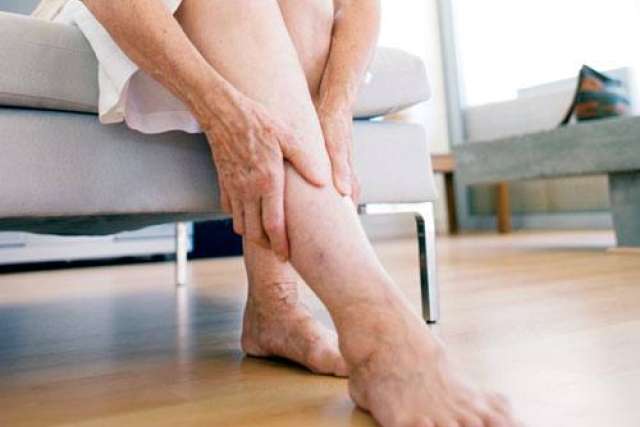
Dear Doctors: Can you please address chronic venous insufficiency? My doctor has advised me to use compression socks and elevate the legs. I find the socks hard to put on, and elevating my legs above my heart is another challenge. Help!
Dear Reader: From the moment our ancient ancestors stood upright, they gained important advantages. The new posture freed the hands to use tools and the arms to carry, and elevated the gaze to better scan for predators. It also made two-footed travel more energy-efficient. But the switch carried significant tradeoffs. Blood returning to the heart from the legs now faced an uphill climb. To compensate, a system of one-way valves developed within the veins.
Each heartbeat helps move blood upward toward the heart. Between the beats, the valves, made up of a pair of opposing flaps, spring shut. This keeps blood from flowing backward. Aided by contraction of the leg muscles and the smooth and elastic walls of the veins, this ingenious system overcomes the force of gravity.
When someone has chronic venous insufficiency, it means that the one-way system has stopped working efficiently. It can occur when the vein walls are weakened, and when the tiny valves cease to properly function. When this happens, blood pools in the veins and localized blood pressure rises. This can further damage both the veins and the valves.
Symptoms of CVI include swelling around the ankles and in the lower leg, throbbing sensation, pain, changes to skin on the lower legs and emergence of new varicose veins. The condition is more common in women than in men and is seen more often in adults 50 and older.
While there is no cure for CVI at this time, treatments can manage symptoms and improve circulation. This includes the two strategies your doctor has recommended. Compression stockings are elasticized knee-high or thigh-high socks with a snug fit. They can add support to damaged veins to boost circulation and help manage fluid buildup, a condition known as edema. Elevating the legs above the level of the heart is meant to harness the downward pull of gravity, this time making it work in your favor.
Compression stockings can be a challenge. The good news is that they come in a variety of materials and strengths. It is common to try several before finding the right match. Compression levels are measured in millimeters of mercury (mmHg). Higher numbers indicate greater pressure. You can also look for stockings specifically labeled as easy to put on. These designs may use words like soft stretch, easy glide or donning assist.
Elevating the legs above the heart each day is also very helpful. This can be done with specially designed leg elevation pillows. Composed of foam, they both support and cushion the legs. Lie flat on a bed or couch while using them, and the above-the-heart directive is easily achieved.
Check with your doctor during your search. She will be able to guide you through a process of trial and error as you look for the equipment that will help you manage your condition.
(Send your questions to [email protected], or write: Ask the Doctors, c/o UCLA Health Sciences Media Relations, 10960 Wilshire Blvd., Suite 1955, Los Angeles, CA, 90024. Owing to the volume of mail, personal replies cannot be provided.)