Eric Kezirian, MD, an internationally recognized expert in the surgical treatment of snoring and obstructive sleep apnea (OSA), tries to get seven hours of shuteye each night. Typically, while snoozing mostly on his side, he sleeps well.
Sleeping on one’s side happens to be the best position for people with OSA, the common and potentially serious disorder in which breathing repeatedly stops and starts during sleep because throat muscles relax and block the airways.
In addition to loud snoring, OSA can lead to high blood pressure, low blood oxygen and other health issues – not to mention fatigue and poor performance from a bad night of repeatedly interrupted slumbering.
Dr. Kezirian’s nearly three-decade medical career has been focused on sleep apnea and surgery.
He recently became the first physician at UCLA Health – and among the first on the West Coast – to implant in OSA patients a device the Food and Drug Administration approved in 2025. So far, he has implanted in three adult males the Genio system, which was 20 years in the making and is made by Nyxoah, a Belgium med-tech firm.
The Nyxoah Genio is a new technology somewhat similar to another OSA device Dr. Kezirian has been using since its introduction in 2014: the Inspire therapy implant. The new system shows even better promise for some patients, based on clinical trial research, says Dr. Kezirian, who has worked for more than a decade as a paid consultant for Nyxoah, serving on the company’s advisory board and assisting with clinical trials.
“It seems to result in more improvement in sleep apnea that exists with people who sleep on their backs. Unlike the Inspire device, the battery is outside the body, and users don’t have to have surgery to replace the device every 10 or so years,” he says.
Favorable results
Dr. Kezirian coauthored a study published in the Journal of Clinical Sleep Medicine that detailed favorable results of the new device in the DREAM (Dual-sided hypoglossal neRvE stimulAtion for the treatMent of obstructive sleep apnea) clinical trial.
He believes the device has the potential to change the lives of people with moderate to severe OSA who cannot tolerate CPAP (continuous positive airway pressure), the primary, highly efficacious treatment for OSA that comes with a huge asterisk. CPAP requires wearing a mask connected via a tube to a machine that delivers steady, mild air pressure to keep airways open during sleep, and many people can’t tolerate the mask.
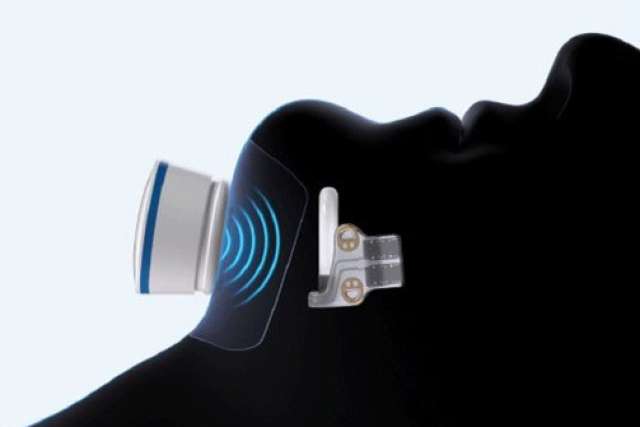
The Genio system works by delivering stimulation to the hypoglossal nerves, which control tongue movement, on both sides of the body, moving the tongue forward to open the space for breathing in the throat.
The DREAM trial, which began in October 2020 and enrolled 113 patients through its completion in February 2024, demonstrated high safety and efficacy, with a 70% median reduction in breathing events (apnea-hypopnea index, or AHI) at 12 months after implantation. Clinical trial participants also reported significant improvements in snoring and sleep apnea symptoms, and 82% of users reported having mild or less-severe sleep apnea after treatment.
AHI is a key metric used to diagnose and rank the severity of sleep apnea that measures the average number of times a person’s breathing stops (apnea) or severely slows (hypopnea) per hour of sleep.
The procedure
To determine if a person is a good candidate for the new system, Dr. Kezirian first has them undergo a drug-induced sleep endoscopy evaluation. In a technique that he has researched for more than 20 years, he uses a flexible, fiber-optic telescope to look inside the throat.
Hypoglossal nerve stimulation appears to be most effective for people whose OSA is caused by tongue base collapse, as opposed to those whose OSA is a result of the soft palate (roof of the mouth) falling back or the sides of the throat collapsing.
The implantation of the device is an outpatient procedure. Dr. Kezirian makes a single, 6-cm incision under the chin that leaves a scar but can be well-hidden in a neck crease. The device is about 3 cm inside the body as it is folded in a U shape. When unfolded, it is smaller than a playing card. After two months of healing, the device can be activated.
When a user tucks in for the night, they stick a small, disposable adhesive patch under their chin. They then connect an activation chip to the patch that weighs a little more than two quarters. That chip provides the power supply, and users can adjust or pause stimulation levels within a set range via a smartphone app.
Tailoring his treatments
A native of Los Angeles, Dr. Kezirian got interested in sleep apnea and surgery in his first two years of medical school at the University of Pennsylvania.
“I thought it was cool,” he recalls. “Sleep apnea was a common problem without great solutions, and I thought working in this field could be interesting.”
Upon graduating magna cum laude from Harvard College, Dr. Kezirian received a Master of Science degree from the University of Oxford before earning his medical degree. He completed residency training at the University of Washington and a sleep surgery fellowship at Stanford University.
CPAP treatment has been around since the early 1980s. For years, doctors would turn to one surgical solution for OSA patients: surgery of the soft palate.
“They would just hope for the best,” says Dr. Kezirian, who came to UCLA Health three years ago after spending a decade at USC and, before that, nine years at UC San Francisco.
Now, with the Inspire device and the Nyxoah Genio, and studies underway on the possible use of a pill to treat OSA, sleep specialists such as Dr. Kezirian can select which treatment is best for each patient.
“The patients are at the core of what I do,” he says. “Although I’ve always loved research, it’s a lot of fun taking care of people who have real problems and making their lives better.”