Brain stimulation delivers fast relief to patients with treatment-resistant depression, but the therapeutic mechanisms are poorly understood. New preclinical research from UCLA Health suggests that therapeutic benefits arise in part by targeting a specific neural pathway — intratelencephalic (IT) cells in the cortex.
The study, published in Cell, established a novel mouse model of transcranial magnetic stimulation (TMS) that shed light on how a fast-acting form of the treatment repairs brain circuits through a specific communication channel. These findings suggest IT neurons may be an effective target for the development of brain-stimulation treatments that are more precise, effective and customizable.
“There are so many different ways you could deliver these patterns of stimulation, and we don't know how almost any of those parameters actually change the treatment,” said Scott Wilke, MD, PhD, assistant professor of psychiatry and the Penske Family Chair in Neuromodulation at UCLA Health. “There may be a future for TMS where you can tune the protocol in a way that biases its therapeutic effects toward specific circuits that may be involved in an individual’s subtype of depression or other psychiatric conditions.”
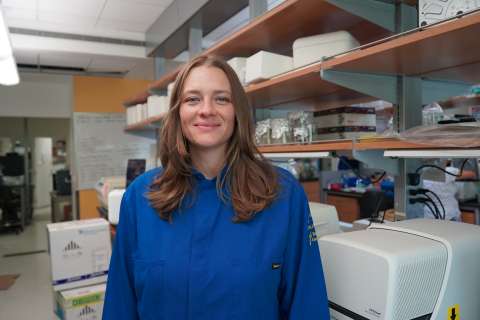
Dr. Wilke led the study with Laura DeNardo, PhD, associate professor of physiology in the David Geffen School of Medicine at UCLA. The researchers said that as they continue to better understand the mechanism behind TMS, they are also interested in studying whether brain stimulation could be combined with medications to boost the treatment’s impact.
“It could open a new avenue of precision treatment,” Dr. DeNardo said.
A faster path to depression relief
The Food and Drug Administration (FDA) first approved TMS for major depressive disorder in adults in 2008.
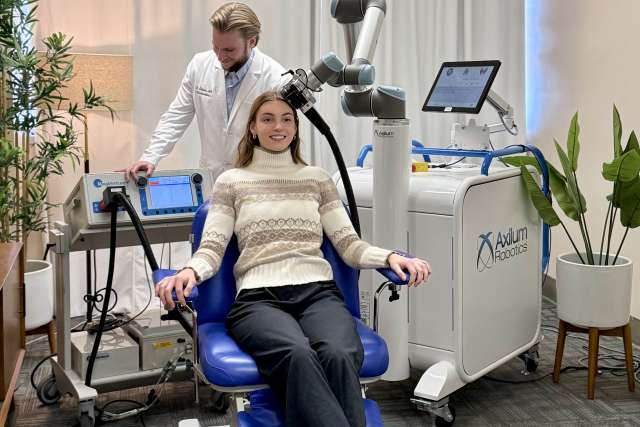
The treatment is a safe, noninvasive procedure that uses a coil to deliver repetitive, targeted magnetic pulses and stimulate brain activity. While standard TMS therapy can take weeks to show results, researchers at Stanford University developed a rapid protocol for the treatment — called accelerated intermittent theta burst stimulation (aiTBS) — that compresses treatment into just five days and has been shown to rapidly reduce depressive symptoms.
“It is the direction the field is heading — figuring out how can we make these treatments quicker for people, so they don't have to wait around for weeks or months to get better,” Dr. Wilke said.
Despite many patients experiencing positive results after TMS and the condensed protocol, some fail to respond, and many brain disorders do not have approved TMS-based therapies. Researchers have faced challenges when attempting to scale down the TMS technology for mouse models, so the biology behind the therapy has remained unclear.
UCLA Health researchers wanted to better understand the mechanistic underpinnings of rapid TMS treatment to one day contribute to improved, targeted therapies that could help a larger population of patients.
Mapping TMS effects in the brain
The research team collaborated with scientists at the National Institutes of Health to develop and test a model of aiTBS. Using mice exposed to chronic stress to simulate depression, the researchers stimulated awake animals while monitoring brain activity in real time.
They discovered that chronic stress caused neurons in the prefrontal cortex to lose dendritic spines — small protrusions that receive signals from other nerve cells. This loss of synaptic structures was observed across multiple neuron types.
The researchers found that a one-day protocol of aiTBS restored the lost spines and led to enhanced activity during depression-related behaviors in IT neurons. Another major cell type called pyramidal tract (PT) neurons was largely unaffected.
Importantly, the researchers also found that when they inhibited IT neurons in the mouse model while treatment was being delivered, this blocked the positive behavioral effects of the TMS treatment. In contrast, when the team inhibited PT neurons the positive effects of treatment on behavior remained intact.
“That revealed that activity in IT neurons is required for the therapeutic plasticity that promotes behavioral improvement,” Dr. DeNardo said.
While the study authors noted that animal models cannot fully capture the complexity and nuance of human depression, the study provides strong evidence for how brain stimulation can rapidly produce therapeutic effects at the cellular and circuit level.
Next, the researchers plan to further probe how other cell types respond to TMS and how various protocols affect those cell types.
“By using methods like single-cell RNA sequencing, we can look at the molecular pathways that are altered by TMS in a cell type-specific way,” Dr. DeNardo said, “which will begin to give us insight into the molecular signaling pathways that are vulnerable and could be restored by TMS.”
Related article
A depression treatment that once took eight weeks may work just as well in one