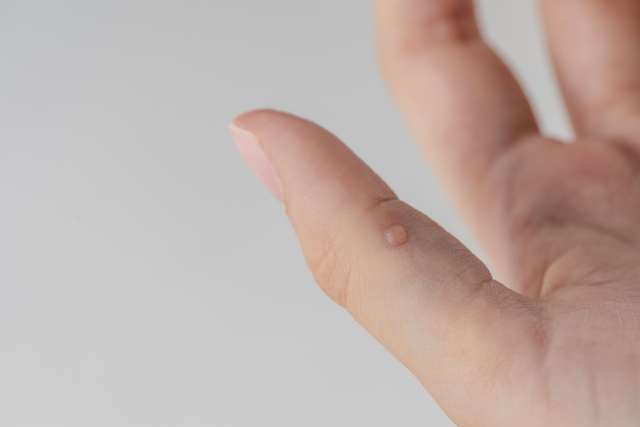
Contrary to what you might have heard as a child, you can't get a wart from a toad or frog. But you can develop a skin (cutaneous) wart — the kind that grow on hands and feet — simply by shaking someone's hand or walking barefoot on the pool deck. Having a wart is common, but getting rid of it can be challenging.
Skin warts generally go away on their own. But it can take a few months to years. If the wart is painful or in a location that leaves you feeling self-conscious, every day matters.
What is a skin wart?
A skin wart is the accumulation of fast-growing skin cells that are infected with the human papillomavirus (HPV). There are more than 150 strains of HPV, but only about 10 of them cause warts in the outer layer of your skin.
Most people are exposed to HPV at some point. In most cases, your immune system recognizes an HPV infection and attacks it. If you are exposed to a strain of HPV that causes skin warts, and your immune system doesn't recognize or attack it, a wart may develop.
Skin warts are different than genital or anal warts — those are caused by different strains of HPV and transmitted through sexual contact. According to the American Cancer Society, while genital and anal warts may cause cancer, skin warts are rarely linked to skin cancer.
Three common types of skin warts include:
- Common warts: These round or oval bumps are typically skin-colored, gray or brown and can develop anywhere. They often grow where you have broken skin or on your hands — which are likely to come into contact with HPV.
- Flat warts: These smaller warts are flat or slightly raised, smooth and pink. Flat warts are typically smaller than other skin warts and may grow in clusters.
- Plantar warts: These rough, spongy growths develop only on the bottom of your feet and tend to be gray or brown.
Why it's hard to get rid of some warts
Only your immune system can fight HPV — medication cannot eliminate it. If your immune system is taking its time fighting off the virus, treating a skin wart can help you avoid pain, embarrassment and possibly spreading the virus.
Typical first-line treatments used to remove skin warts include:
- Over-the-counter (OTC) topical treatments: Patches, liquids and creams containing salicylic acid may dissolve wart tissue.
- Cryotherapy: A dermatologist freezes the wart with liquid nitrogen in multiple sessions — spaced a few weeks apart — to ensure deep penetration and a better immune response.
- Prescription topical medication: A dermatologist can apply or prescribe topical medication containing salicylic acid or a chemical called cantharidin.
Sometimes, these treatment options don't work or the wart grows back. There are several reasons that skin warts can be challenging to treat, including:
HPV is resilient
The immune system does not always recognize HPV when it lives in the outer layers of your skin. HPV that goes undetected can continue to cause warts to develop.
Additionally, there are multiple HPV strains that cause skin warts. Some of those strains are simply more resistant to treatment than others, making it harder to destroy or dissolve the affected skin cells.
Topical treatments don't always go deep enough
A wart exists on the surface of your skin. But since HPV can infect deep layers of the skin — not just the surface — topical treatments may not be absorbed deep enough in the skin to remove the entire wart. Warts located on the sole or palm, where skin may be thicker, may require more aggressive treatment.
Dermatologists can treat stubborn warts in several ways, including:
- Combining therapies, such as applying strong medication after freezing off the top layers of the wart
- Injecting medication deeper into the wart
- Scraping, burning or filing the wart to remove it and then possibly applying a strong topical medicine
- Using lasers to destroy wart tissue or the blood vessels that supply the wart
Your immune system may need a jump-start
Your immune system plays a critical role in managing HPV. But if you are immunocompromised — meaning your immune system is being suppressed for medical reasons or isn't working as it should — you are at higher risk for developing warts. It's also possible that your immune system is just slow to react.
If your physician suspects a slow or inefficient immune response, they may recommend immunotherapy. It stimulates the immune system to fight off HPV.
Warts are contagious
HPV is everywhere. So, it is possible that a new exposure is causing new warts to grow following wart removal.
To reduce your likelihood of getting skin warts, the American Academy of Dermatology Association recommends:
- Avoid going barefoot in locker rooms, around pools or in public showers
- Clean and cover skin abrasions and cuts, since that is how HPV can get in
- Don't share personal items, such as razors, nail clippers or towels, in case someone in your family develops a wart
- Stop nail biting, which can lead to small tears in your skin
- Wash your hands often to remove HPV from your skin
When to see a healthcare provider about a wart
There are plenty of OTC wart treatments that you can try at home. But it is always a good idea to have a dermatologist or your primary care provider check out skin concerns, especially if your at-home treatment is not working or you are unsure if what you have is a wart.
It is critical to see a healthcare provider if you have:
- Warts that change, hurt, itch, burn or bleed
- Diabetes
- Known immune system weakness, which can be caused by immunosuppressant drugs or cancer
- Many warts
- Warts on your face or genitals
If warts come back after treatment — which is common — do not hesitate to contact your healthcare provider.