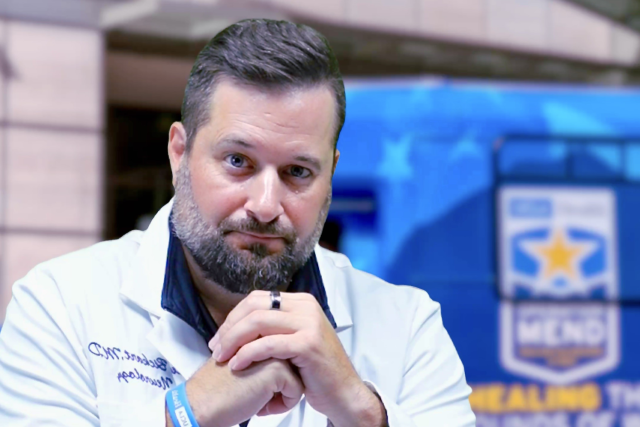
UCLA Health Operation Mend neurologist Kevin Bickart, MD, PhD, loved playing football growing up because of the mental aspect of the game and the tight bond with his team.
He continues that early drive for collaboration and understanding of the human mind in his close work with veterans, as well as athletes.
“I thought neurology provided me the best opportunity to study the mind’s role in behavior and health,” Dr. Bickart said. “I wanted to study the mental game, how somebody’s mindset would dictate their resilience to trauma and hardship and stress.”
At Operation Mend, Dr. Bickart is the lead neurologist for the Brain Health Intensive Treatment Program for active-duty service members and veterans with post-traumatic stress disorder (PTSD) and traumatic brain injury (TBI).
He is also an assistant professor in neurology at the David Geffen School of Medicine at UCLA and part of UCLA Health's BrainSPORT Program, which focuses on concussion care and TBI research.
Invisible wounds
Since 2007, Operation Mend has provided advanced specialty surgical and medical consultation and treatment for injuries sustained in post-9/11 era military service. All treatment, travel and lodging are provided at no cost to the patients and their spouses or caregivers.
The average patient age is 40. Participants travel to UCLA from all over the country. They are a combination of active duty and retired veterans, with a fair number of women.
“It provides a pretty interesting mixture,” Dr. Bickart said.
Patients with complex injuries and trauma come to Operation Mend after trying everything to recover, Dr. Bickart said.
Some haven’t been able to find a timely appointment with a neurologist in their community. Others may want help paring down a lengthy list of medications. And some have lingering symptoms that are disproportionate to their injuries.
Dr. Bickart said when patients have experienced significant body, brain and psychological trauma, a gap can exist between how their biology looks and how they feel.
“There’s this invisible aspect of trauma, both psychological and brain trauma, that you can’t image, you can’t blood test, you can’t really get a sense or pull apart what’s PTSD vs. post-concussive or post-blast,” he said. “People come for answers and for advanced care.”
Patients and family members are invited to UCLA for a week-long intensive to see if they are a good fit for further treatment by Operation Mend. They undergo diagnostic testing and learn about brain health, the effect of trauma on the brain and lifestyle changes to ease symptoms.
For those who return for intensive two-week treatment, Dr. Bickart meets with patients individually for neurology appointments and teaches sessions on topics such as TBI recovery and dementia prevention.
He said the military population has disproportionate risk factors for dementia because of repeated blasts, psychological traumas and toxin exposure in the environment of war.
“What we know right now about long-term brain health is that lifestyle factors are the most potent modifiable risk factors for dementia, degenerative disease and stroke,” he said. “We focus heavily on those.”
Operation Mend assesses patients on various health metrics and social factors tied to risk of dementia and stroke, including blood pressure, cholesterol level, physical activity and psychological well-being.
“These small movements on the scale seem to have huge dividends in terms of long-term risk,” Dr. Bickart said. “We’re relying on this recent data and fundamental aspects of living a healthy life to help guide our treatment, recommendations and our personalizations.”
In group and individual sessions, Operation Mend patients meet with clinicians including neuropsychologists, occupational therapists and nutritionists to address comprehensive needs.
“While we’re with the patients and meeting about them, we’re constantly thinking about them – all these different aspects of what makes the person tick, what makes them thrive, or what is in their way,” he said.
Advances in understanding TBI
When providing education regarding TBIs, Dr. Bickart focuses on a non-intuitive approach to recovery by reengaging in normal activities.
Forgoing everyday activities, whether socializing or spending time outside, hinders improvement because avoiding activities and stimuli builds intolerance, he said.
“Whereas the dogma in concussion management was brain rest or cocoon therapy, it actually makes things worse,” Dr. Bickart said.
For instance, after an athlete or person who exercises regularly suffers an acute concussion, resuming exercise soon after has been shown to speed up recovery, he said.
Operation Mend and BrainSPORT, he said, emphasize the importance of lifestyle redesign. That involves helping people get back to their usual activities by providing education, skills and reassurance.
“That’s one major paradigm shift that still hasn’t fully caught on in primary care or emergency rooms,” Dr. Bickart said.
Exposure therapy for persistent post-concussion symptoms is another advance by helping patients overcome fear avoidance and build tolerance for activities that trigger symptoms such as headaches, dizziness or brain fog.
Targeting a brain circuit
Dr. Bickart is conducting research funded by the Department of Defense that uses direct brain stimulation to address patients’ fear and avoidance around certain activities.
The novel study is testing personalized brain stimulation to modify a particular brain circuit that may be overactive in people who don’t fully recover within a few months after a concussion.
Researchers administer four-minute courses of magnetic pulses, called transcranial magnetic stimulation, or TMS. Some participants receive placebo stimulation.
Before undergoing a TMS session, most participants listen to a recording of their own voice talking about activities they fear will trigger symptoms to help target the circuit that may be responsible for their lingering post-concussion symptoms.
The other participants listen to a script about a neutral activity.
The trial has roughly another year left and while the outcomes are blinded, Dr. Bickart said there’s a stark difference between one group and the others.
“We do believe there is an effect of what we are doing, which is very motivating,” he said. “This is the biggest trial of its kind, both in concussion, and in some ways, in neuromodulation.”
Most of the participants are civilians. Operation Mend is the community-based research partner for the study and ensures that the research will translate to the active-duty and veteran population.
‘A joyful job’
Dr. Bickart said his greatest passions are spending time with the warriors, teaching and learning from them, and conducting research.
He said the team approach at Operation Mend is so rewarding because he and his colleagues can bring their distinct training, abilities and perspectives to every patient.
“I think having this interdisciplinary perspective helps me care about the patient in a way that I wouldn’t if it was just me,” Dr. Bickart said. “The team fills in where I can’t. I can find unique ways to use the skills I have. It’s a joyful job because it’s not just me.”