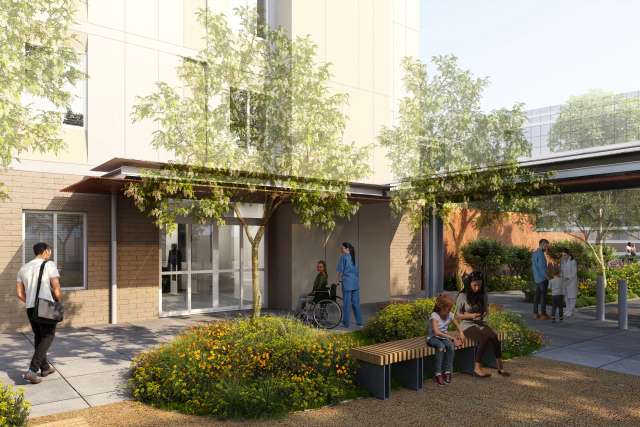
The next evolution of UCLA Health psychiatric care is near, with an expanded and state-of-the-art UCLA Resnick Neuropsychiatric Hospital on track to open in the Mid-Wilshire neighborhood of Los Angeles in late summer 2026.
The new hospital will be entirely dedicated to mental health care, created from the ground up specifically for psychiatric healing, with layout and design features informed in part by the expertise of UCLA Health physicians, nurses, social workers and other employees.
The state-of-the-art psychiatric hospital will have 119 inpatient beds, up from 74 in its current location within Ronald Reagan UCLA Medical Center on UCLA’s main campus in Westwood. The Mid-Wilshire location also will include a 20-bed outpatient unit to diagnose and stabilize patients in an acute behavioral health crisis, an asset not available in Westwood.
“Throughout a very detailed planning process, we strategically sought and capitalized on input from our highly skilled workforce to ensure a design and operational workflows that meet the needs of patients and families,” said Johnese Spisso, president of UCLA Health and CEO of the UCLA Hospital System.
Many of those employees have provided and supported UCLA Health psychiatric care since well before 2008, when the current psychiatric hospital opened within the Westwood medical center.
“There's always been a demand for beds, and there's never enough supply,” says Anna Kurtz, LCSW, who joined UCLA Health in 2006 and is now chief of the neuropsychiatric hospital’s department of clinical social work. “We're really hopeful that this new hospital will make an impact in getting the community the timely care they need.”

Kurtz notes that the new facility will have a lot of windows and sunny outdoor spaces, soothing colors and uplifting imagery, such as a “tree of hope” emblem inspired by patients a few years ago.
“I think it will feel ... more welcoming and give everybody a little bit of hope when they come in the doors,” she says.
UCLA Health Chief Operating Officer Richard Azar says the building’s design and surrounding landscape were intentionally created to serve as a healing environment for patients and their families. The hospital will also operate as an all-electric facility, a move aimed at maximizing efficiency while reducing long-term costs and environmental impact.
“We’ve installed low-flow plumbing and high-efficiency heating and cooling systems, and we’ve incorporated low-carbon, renewable building materials throughout the project,” Azar says.
Whom do psychiatric hospitals treat?
People may seek treatment at a psychiatric hospital for depression or anxiety, often with suicidal ideation, says Laurie Casaus, MD, a UCLA Health psychiatrist since 2002. Patients may also be hospitalized for psychiatric conditions such as schizophrenia or bipolar disorder.
Hospital stays are generally short, from a few days to a few weeks on average, she says. Patients are stabilized, given appropriate medications, and provided with therapy and coping skills. Their healing continues outside the hospital, she says, with ongoing therapy or an outpatient program.
Care is informed in part by research conducted by David Geffen School of Medicine at UCLA and other UCLA faculty. Professors with the UCLA Department of Psychiatry and Biobehavioral Sciences and the Jane and Terry Semel Institute for Neuroscience and Human Behavior at UCLA lead internationally recognized multidisciplinary teams that study the brain, the mind and behavior to support development of new treatments.
If your perceptions of a psychiatric hospital were shaped by stereotypical depictions in movies, modern facilities “are really nothing like that,” Dr. Casaus says.
The new hospital will have living-room-like spaces for group therapy and outdoor gardens where patients care for the plants and cultivate herbs they use for meals prepared together. There will be sensory rooms, where patients can experience weighted blankets and other amenities in a quiet space.
Nursing manager Sunnie Dishman, MSN, a 25-year employee, says she appreciates that nursing managers’ offices will be integrated onto the floors, closer to patients and staff.
There also will be a serenity room for staff and clinicians to discuss cases or decompress.

In addition to health care professionals, administrators also sought input from patients and families, says Erick Cheung, MD, chief medical officer of UCLA Resnick Neuropsychiatric Hospital.
“You take the experience of all the people that have worked in these different environments, and the lessons learned along the way … and then you get to translate that into being really intentional about how to design this space from the inside out,” Dr. Cheung says.
Handling psychiatric emergencies
The hospital’s most distinguishing feature may be its 20-bed outpatient unit to diagnose and stabilize patients with acute symptoms. People experiencing psychiatric crises in Los Angeles County often wind up in a traditional hospital emergency department, where they may wait a long time for care and initially be seen by medical staff without specific mental health emergency training, Dr. Cheung says.
At the new hospital, he says, “We’ll be able to get them seen immediately by the most highly trained and competent psychiatric professionals.”
Dr. Cheung hopes the care currently offered at UCLA Resnick Neuropsychiatric Hospital – and the care being put into the construction of the new Mid-Wilshire facility – will help reduce stigma around mental illness.
“People kind of forget that the mind is part of the body – they think of it as something different or unusual or somehow separated from the rest of medicine,” he says. “Just like you come in when you've got a cold, flu or a heart issue, you come in when you're not doing well mentally. (The brain) is an organ of the body. ... We're going to figure out what's ailing it, and we're going to come up with a treatment plan to get it working better again.”
Spisso, the UCLA Health President, says it was critically important to invest in a state-of-the-art hospital to meet the needs of especially vulnerable and underserved patients.
“At a time when many other hospitals have reduced or eliminated mental health patient beds, I am so proud that UCLA Health prioritized this investment for the community,” she says.