The David Geffen School of Medicine at UCLA has received a bequest of more than $4 million from a medical scientist training program (MSTP) graduate and molecular imaging pioneer.
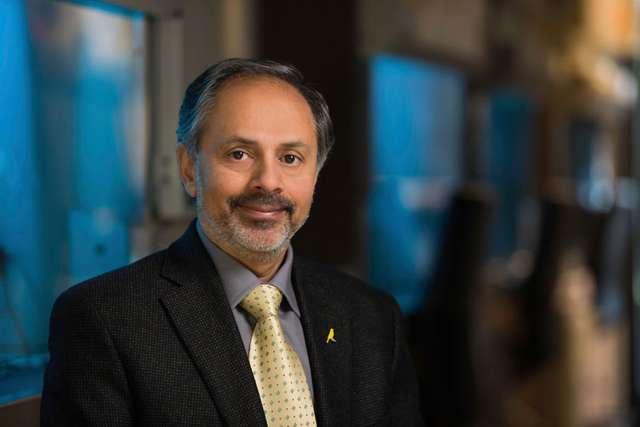
The bequest was made by the family of the late Sanjiv “Sam” Gambhir, a UCLA-trained physician and biomathematician who became an internationally recognized leader in molecular imaging and early cancer detection. He died of cancer in 2020 at the age of 57. His teenage son died of cancer in 2015; his wife, who received her M.B.A. from UCLA in 1996, died of breast cancer in 2023.
The bequest will enable UCLA to establish a $3 million endowed chair and a $1 million fellowship to support UCLA’s medical scientist training program. The UCLA-Caltech MSTP is dedicated to educating and training exceptionally qualified individuals for impactful careers in the biomedical research workforce. This program integrates and streamlines a rigorous program of combined M.D. and Ph.D. degree training and professional activities to develop physician-scientists with a unique and comprehensive understanding of biology and the causes and treatment of human disease.
“This generous gift from the Gambhir family will go a long way toward supporting future medical science leaders,” said UCLA’s Dr. Olujimi Ajijola, professor of medicine and MSTP co-director.
UCLA’s Dr. David Dawson, MSTP co-director and professor of pathology and laboratory medicine, concurred. “We are honored to be part of Dr. Gambhir’s great legacy and grateful for the generosity of the Gambhir family,” he said.
Sam Gambhir was a Phi Beta Kappa physics graduate of Arizona State University. He completed a Ph.D. program in biomathematics at UCLA in 1990 and then earned a medical degree from UCLA in 1993. Shortly thereafter, in 1994, he was recruited to the UCLA faculty as an assistant professor of molecular and medical pharmacology by the director of the Crump Institute for Molecular Imaging at UCLA, a position subsequently held by Gambhir. Gambhir also served as vice chair of the department of molecular and medical pharmacology until he accepted a position at the Stanford School of Medicine as head of the nuclear medicine division in 2003.
There, he was the Virginia and D.K. Ludwig Professor of Cancer Research, chair of radiology at the Stanford School of Medicine and director of the Canary Center at Stanford for Early Cancer Detection, the Precision Health and Integrated Diagnostics Center and the Molecular Imaging Program. An internationally recognized pioneer in molecular imaging, Gambhir made his life’s work the development of technologies to reveal early signs of disease — in particular, cancer.
In 2015, following a 21-month battle, his teenage son died of glioblastoma multiforme, a type of highly aggressive brain cancer that Gambhir was studying in his lab. After this, he increased his focus on early cancer detection and, to that end, helped advance the field of precision health.
“‘What motivates me is knowing if he’d been born 100 years from now, the tools of precision health could [have] possibly allowed him to live much, much longer,’ Gambhir said at a precision-health conference in 2020, according to Stanford Medicine. ‘I remain optimistic that the fundamental basic science that we all continue to do [will] lead to new technologies that will help reengineer our own bodies so that we can detect disease early.’”
In 2017, Gambhir helped launch the Precision Health and Integrated Diagnostics Center at Stanford, a program that uses cross-disciplinary collaboration to prevent disease or stop it in its early stages.
Gambhir’s accomplishments, inventions and contributions to health were legion. He co-authored nearly 700 peer-reviewed papers, and his research led to 40 patents and the establishment of several companies. He served in leadership positions on many advisory boards and committees, including the advisory council of the National Institute of Biomedical Imaging and Bioengineering at the National Institutes of Health and on the editorial boards of numerous scientific journals.
“When Sam died, medical science lost a great leader, as did our family,” said Sangeeta Gambhir, Sam Gambhir’s sister and trustee of the Gambhir Family Trust, who earned her M.D. from UCLA in 1991. “Although we are heartbroken by his death, we know Sam’s memory will live on in the future physician-scientists and patients who will benefit from his legacy.”