
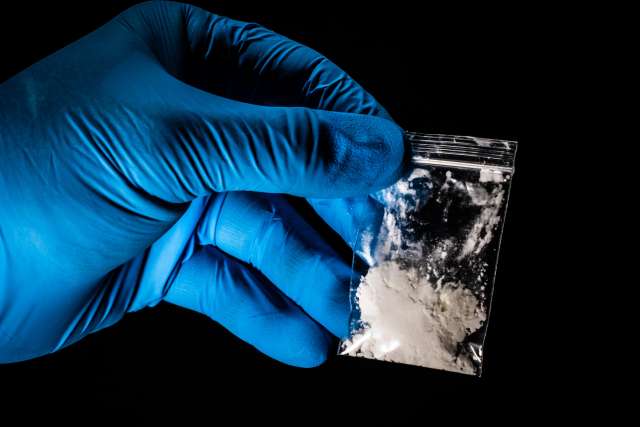
People in Los Angeles who use illicit fentanyl regularly consume quantities of the drug equivalent to morphine doses hundreds of times higher than fentanyl doses used in hospitals. This use is far beyond what addiction treatment protocols were designed to address.
The findings, published in the peer-reviewed journal Drug and Alcohol Dependence, suggest that this is likely a contributing factor toward high opioid tolerance, which complicates medications for opioid use disorder (MOUD) and contributes to overdose deaths.
MOUD with methadone or buprenorphine is highly effective in reducing overdose mortality. However, in the years since fentanyl has displaced heroin as the dominant street opioid in the United States, many patients have reported challenges starting and staying on MOUD due to the severity of fentanyl withdrawal.
This study, led by Drug Checking Los Angeles, a research and public health program founded by Chelsea Shover, associate professor-in-residence at UCLA and the study’s senior author, sheds some light into why. This modeling study aimed to quantify exposure to fentanyl using morphine milligram equivalence (MME), a standardized measure that enables comparison between opioids with different potencies. The estimate used real-world data from Drug Checking Los Angeles, including purity from over 500 fentanyl samples tested between September 2023 and January 2026, surveys of 47 people who regularly use fentanyl, and other measures.
Ultimately, the researchers found that people were consuming an average daily intake of estimated 8,887 MME per day.
The idea for the study arose from the experience of lead author Morgan Godvin’s own experience with opioid use disorder. She had seen first-hand just how wide the gap is between clinical knowledge of pharmaceutical opioids and clinical knowledge of illicit opioids, even though most public health attention has been on illicit opioids for over a decade.
“We had been treating illicit-opioid doses as a black box — an unknowable, a curiosity,” Godvin said. “Public health has precise quantification methods for other exposures, such as for tobacco or alcohol. If at the molecular level, fentanyl is fentanyl, we should be able to quantify exposure, so we decided to estimate it with the Drug Checking Los Angeles data. The results surprised us all.”
Per the Centers for Disease Control and Prevention, for an opioid-naïve person just 2 mg of fentanyl can be lethal. The average fentanyl consumer in Los Angeles takes in roughly 60 times that amount every day, according to their study. Tolerance develops not just to the intoxicating effects of a drug, but also to the respiratory depression that leads to overdose, Shover said.
“Now, we find that people are regularly exposed to doses of opioids that would have seemed impossible to me before I started this work,” Shover said. “To put it in perspective, in the hospital settings, fentanyl is often dosed in 100 microgram vials. One gram of average purity fentanyl that we tested had a dose equivalent to more than that 1,200 of these vials. So people are getting daily doses that are on par with injecting hundreds of the hospital vials or taking 440 Percocet pills.”
The findings are important for doctors and the general public to know because the strength and variability of fentanyl mean that a person smoking an average amount of average purity fentanyl is likely intaking a dose of opioids far exceeding treatment protocols, Shover said.
“Of course, starting MOUD is going to be harder for fentanyl than it is for heroin,” she said. “This study is a great example of where our science was directly informed by lived experience. It is a call to take withdrawal management seriously, with adjuvant therapies, and compassionate approaches.”
As a fully synthetic drug, fentanyl can be produced more easily and cheaply than heroin. In addition, its potency, which is much higher by milligram than heroin or oxycodone, can lead users to consume more than intended, increasing the risk of overdose.
Several factors limit the findings. They include the late arrival of illicit fentanyl to Los Angeles relative to the rest of the country, which may limit generalizability to other regions. The setup of the community-based drug checking program as voluntary and anonymous inherently creates a convenience sample, which may not reflect the full range of the Los Angeles fentanyl supply. Individuals who completed the survey may differ from other people who use fentanyl. And finally, there are simply very few sources of data about purity of street drugs at the consumer level. To the authors’ knowledge there are currently fewer than ten cities in North America where these data are available at all. Even if a particular region’s fentanyl is only half as pure as what is found in Los Angeles, the resulting MMEs are still dramatic, Shover said.
“It’s no longer,‘how do we treat someone who smokes a gram of fentanyl per day,’ it’s ‘how do we treat someone using thousands of MMEs of oral morphine in fentanyl per day?’ That question and its answers feel more accessible, less abstract to clinicians,” Shover said.
Dr. Joseph Friedman of UC San Diego was the study’s co-lead author along with Ms. Godvin. Caitlin Molina, Adam Koncsol and Ruby Romero of UCLA, and Dr. David Juurlink of the University of Toronto were co-authors on the study.
The study was supported by the Centers for Disease Control and Prevention as part of Overdose Data to Action: LOCAL (CDC-RFA-CE-23-0003), an equipment grant from the James B. Pendleton Charitable Trust to the UCLA AIDS Institute and UCLA Center for AIDS Research, the National Institute on Drug Abuse (K01DA050771, 1U01DA063078), and the NIH/National Center for Advancing Translational Science (NCATS) UCLA CTSI (TL1TR001883).