UCLA Research Alert
FINDINGS
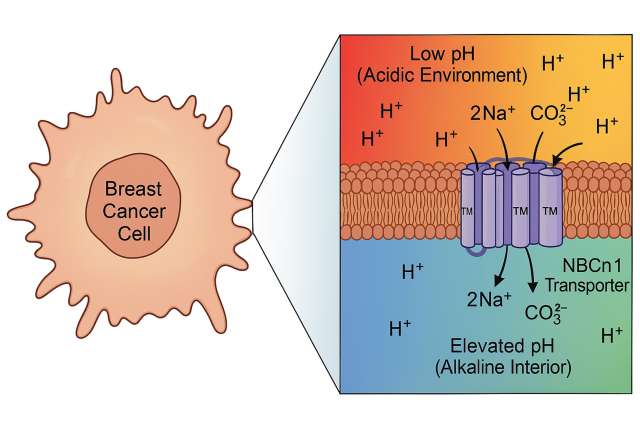
UCLA scientists have characterized the structure and function of a key survival protein in breast cancer cells that helps explain how these tumors resist environmental stress and thrive in acidic, low-oxygen environments that would normally be toxic to healthy cells.
Breast cancer cells rely on a transporter protein called NBCn1 to bring alkali ions into the cell and maintain a favorable internal pH. Using advanced cryo-electron microscopy combined with computational modeling, the researchers showed that NBCn1 moves two sodium ions and one carbonate ion through an efficient “elevator-like” motion that minimizes energy use. This allows NBCn1 to achieve a high transport rate of approximately 15,000 ions per second, helping tumor cells maintain an internal pH that promotes survival, division and resistance to acidic stress.
BACKGROUND
Tumor microenvironments are often acidic due to low oxygen levels and high metabolic activity. Healthy cells struggle to survive under these conditions, but cancer cells adapt by regulating their internal chemistry. NBCn1 is a plasma membrane transporter known to help control cellular pH, but until now, little was understood about its precise structure or how it achieves such efficient ion transport.
METHOD
To understand how this protein works, the researchers used cryo-electron microscopy to capture the first atomic, three-dimensional structure of human NBCn1. They then applied computational modeling to study the protein’s dynamics and how it interacts with ions. This combined approach allowed the team to visualize NBCn1’s structural changes and identify the pathways ions take as they pass through the transporter.
IMPACT
By understanding the structure and function of NBCn1, the study provides a blueprint for designing drugs that could potentially block this transporter and disrupt the internal chemical balance that cancer cells depend on. Targeting this protein in cancer cells specifically could offer a precise way to weaken tumors while minimizing harm to normal tissue.
“This work advances the field of cancer cell metabolism and membrane transport biology by providing the first atomic-level model of NBCn1, a major regulator of cellular pH,” said Dr. Ira Kurtz, a Distinguished Professor of Medicine, Factor Chair in Molecular Nephrology and a member of the UCLA Brain Research Institute. “By linking the protein’s structure, ion energetics, and function, the study shows how small molecular motions can generate high transport efficiency. These insights bridge a critical knowledge gap between basic biophysics and cancer therapeutics and lay the groundwork for new strategies that target pH regulation as a vulnerability in tumor cells.”
JOURNAL
The study was published in the journal Nature Communications
AUTHORS
Kurtz is the senior author of the study. Weiguang Wang, a postdoc in the Department of Medicine, Division of Nephrology, is the co-first author. Other UCLA authors are Kirill Tsirulnikov, Rustam Azimov, Natalia Abuladze, Liyo Kao, Dora Acuna, Z. Hong Zhou and Alexander Pushkin.
FUNDING
The study was supported in part by grants from the National Institutes of Health, the Smidt Family Foundation, the Kleeman Fund and the Factor Family Foundation.