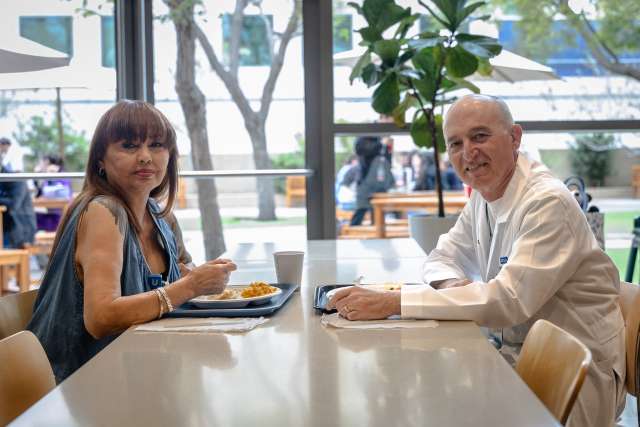
For years, Patty Coles, a food service worker at Ronald Reagan UCLA Medical Center, would see Abbas Ardehali, MD, in the dining commons on his lunch break. She knew his usual sandwich order, and she also knew that Dr. Ardehali provided heart and lung transplants.
But she never imagined that one day, she’d need a double lung transplant and he’d be the surgeon.
Dr. Ardehali’s busy operating schedule often meant he wasn’t able to eat lunch until early afternoon, when the mid-day rush had subsided and the dining commons was less crowded.
The two would chat while she prepared his sandwich. Coles, a longtime UCLA employee, knew Dr. Ardehali’s order by heart. “He always had the grilled veggie sandwich: grilled eggplant, roasted red peppers, and grilled zucchini and yellow squash on an artisan roll with pesto mayo,” Coles said. “But no pickle.”
Coles always greeted him with a smile, Dr. Ardehali recalled. “I’ve known her for many years, and I’d see her several times a week,” he said. “She knows who I am and that I have an affinity for sandwiches.”
Over the years, they also talked a bit about his work. When Coles found out that he performed heart and lung transplants, she told him she’d love to be able to watch him operate someday. “He laughed and said his wife often said the same thing,” Coles said.
A life-changing diagnosis
In August of 2024, Coles had just completed her shift and was walking to her car in one of the hospital parking lots – something she’d done on a regular basis for the past 20 years without any problems. This time, however, she noticed she was having trouble catching her breath.
When she arrived home and was still short of breath, she asked her partner to drive her to a local urgent care facility, where an X-ray revealed that Coles’ lungs were cloudy. “Something isn’t right,” the doctor on call told her. He referred her to a local pulmonologist, but two visits later, Coles was no closer to finding out what was wrong with her lungs. “I can’t treat you here,” Coles recalls him saying. “You should go to UCLA.”
By now, it was November. After a series of scans and other tests to measure her lung capacity, Coles finally received a diagnosis: She had pulmonary fibrosis, a chronic, progressive disease that causes scarring in the lungs. The scarring, which makes it difficult for the lungs to expand, was causing her shortness of breath.
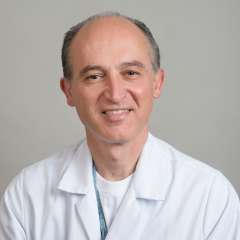
“We don’t know why it occurs,” said Dr. Ardehali, director of the UCLA Heart, Lung, and Heart-Lung Transplant Programs and professor of surgery and medicine at the David Geffen School of Medicine at UCLA. “Is it exposure to environmental or genetic or other factors? What we do know is that it causes gradual scarring of the lung tissue, and unfortunately there are limited treatments available except lung transplantation.”
Although pulmonary fibrosis has traditionally been more common in men, cases in women are increasing, according to the American Lung Association.
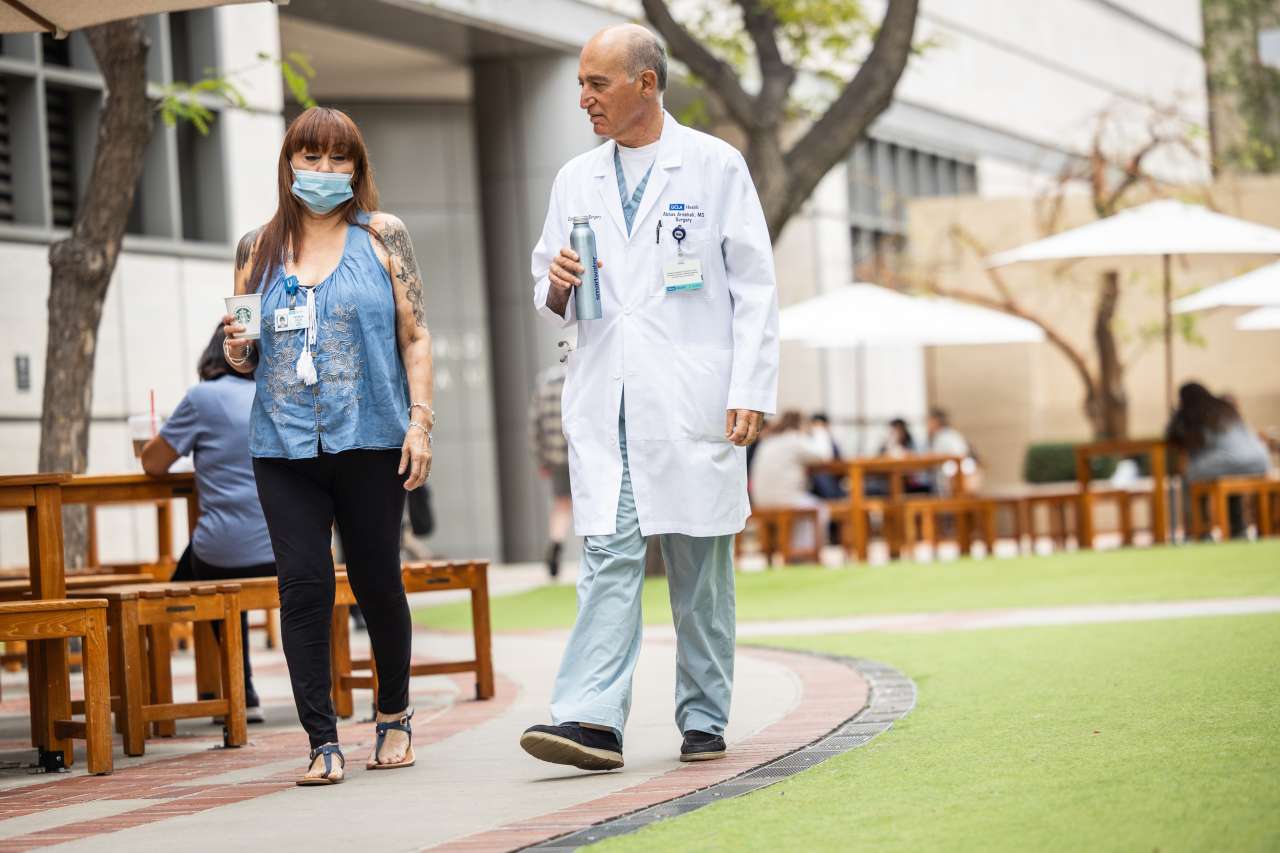
By April of 2025, Coles was using a portable oxygen concentrator that filtered the air so it would have a higher oxygen level to ease her breathing. When Dr. Ardehali saw her in the dining commons and noticed her nasal cannula, he asked her about it, and Coles filled him in on her diagnosis.
“The first thing he told me was ‘don’t be scared,’” Coles said. “And I told him that if I ever needed a transplant, I would want him to do it.”
Distinctive ‘honeycomb’ scarring
Coles continued to be monitored regularly, including undergoing frequent X-rays and other scans.
“I had a lot of damage, starting from the bottom up,” Coles said. Her lungs also showed “honeycombing,” a distinctive pattern resulting from the build-up of scar tissue in some of the small air passages within the lungs that impedes them from expanding to take in air. This scar tissue buildup, which resembles a honeycomb, is seen in late-stage pulmonary fibrosis.
By this point, it was a matter of when – not if – she’d need a lung transplant.
Coles began taking a steroid medication to try to slow the pace of the ongoing scarring, as well as an anti-rejection medication to start preparing her immune system for the new organs.
Despite her worsening condition, Coles continued to work until early January of 2026, when she collapsed as she was getting ready to leave her house to drive to UCLA.
“My legs got really wobbly,” Coles said, “and my coffee cup went flying.”
After a brief hospital stay, during which she was diagnosed with pneumonia, Coles was switched from an oxygen concentrator to an oxygen tank to provide her with the higher oxygen level she now required.
Because the tanks were bulkier and needed switching every few hours, Coles was no longer able to go in to work.
Not long after, Coles was admitted to Ronald Reagan UCLA Medical Center.
A commitment fulfilled
At first, Dr. Ardehali didn’t realize that the patient he’d been asked to see in the ICU was the same person he knew simply as “Patty.”
He was speechless when he saw her, Coles recounted. But he also remembered her request.
Two-and-a-half weeks later, when a match was found for Coles, Dr. Ardehali arranged to be the surgeon on call so he could perform her bilateral lung transplant.
First-ever transplant using newest transport technology
Coles’ procedure was also noteworthy for another reason: she was the first patient to receive donor lungs that had been transported using the newest perfusion technology.
Dr. Ardehali is the principal investigator for a clinical trial incorporating the latest advances during transport so the lungs arrive in the best state possible. He characterized Coles’ transplant as “a new chapter in the field of organ transplantation.”
For decades, donor lungs were transported using near-freezing temperatures that preserved the organs during the critical timeframe after being removed from the donor. This static cold storage posed risks, however, as the lungs were not in a functioning state and were also at risk of damage from prolonged exposure to such low temperatures.
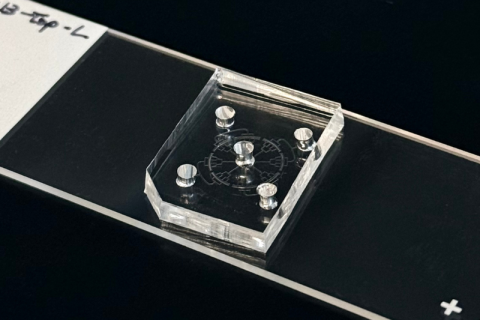
Newer devices have used ex vivo (“outside the body”) warm perfusion: a partial plasma solution that circulates through the lungs while they’re being transported to maintain them in a “breathing” rather than a static state.
Dr. Ardehali, who has long been at the forefront of developing new technologies for transporting hearts and lungs, has previously served as the principal investigator for trials that pioneered various warm perfusion techniques.
“The whole story behind ex vivo organ perfusion has been to preserve the organs better for transplantation,” he explained.
The newest device for transporting donor lungs – the one that ferried Coles’ new lungs to UCLA Health – updates the previous warm perfusion technology to improve the organs prior to transplantation, Dr. Ardehali said.
“The most prominent feature is that it removes extra fluid in the lung tissue,” he said. This build-up, known as neurogenic pulmonary edema, is a natural process that occurs following brain death, he explained, but one that can damage the delicate tissue of the lungs.
“Being able to remove the extra fluid before you transplant has been one of the challenges in the field,” Dr. Ardehali said. “With the new technology, the blood that circulates through the lungs has very high osmotic pressure.” This pulls the fluid from inside the lung tissue into the blood vessels to remove it.
The new device also improves ventilation of the lungs, he said, as well as providing a softer base for them to rest upon to decrease the possibility of damage during transport.
These modifications “make clinical sense,” Dr. Ardehali said, “and will likely lead to improvements in clinical outcomes.”
A leading center
Coles was able to go home about two weeks after receiving her new lungs. That is in keeping with UCLA Health’s track record of having the shortest length of stay after lung transplantation in the state of California, said Dr. Ardehali, “and that’s despite the fact that we are dealing with some of the sickest patients in the world.”
As a leading center for lung transplants, UCLA Health has one of the highest volumes in the country and has completed the most lung transplants of any center in California, based on data from the United Network for Organ Sharing.
Able to breathe again
For Coles, the difference was immediate. With her new lungs, she can once again take a full breath without coughing, which means she can also sleep through the night. And she’s gradually regaining her strength as she continues to receive pulmonary and physical therapy.
“Her prognosis is very good – I expect a full recovery,” Dr. Ardehali said. “I’m very happy to see her progress and to see that she’s slowly getting back to normal.”
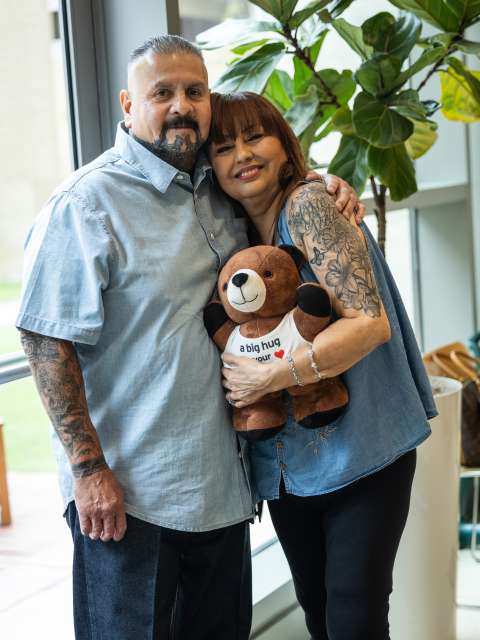
Coles is grateful for her new lungs, which she described as “amazing.” And she’s also grateful for Dr. Ardehali.
“He’s my miracle worker,” she said.
Related articles
UCLA Health a leader in extending transplant viability of heart and lungs