Key takeaways
- About 10% of children have recurrent migraines.
- Migraines and new daily persistent headaches are often linked to anxiety or depression.
- If a child has a headache weekly, or more than four times a month, that is a red flag for parents.
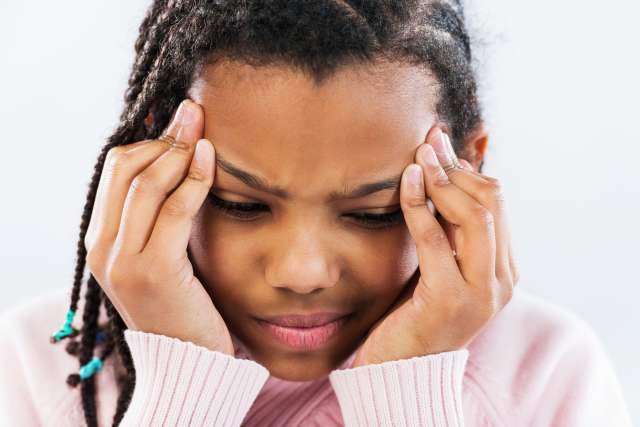
Headaches are common among children – more than 66% of kids experience one before they’re teenagers. Nearly one in 10 children experience recurrent migraines.
Yet parents may not realize how prevalent the condition is, and children often lack the vocabulary to describe their pain, says Maria Pia Grant-Tejada, MD, a pediatric neurologist at UCLA Health who specializes in treating headache and concussion.
“Parents need to know that kids do experience headaches the same way an adult experiences headache,” says Dr. Grant-Tejada, adding that headache in children is often dismissed or underdiagnosed.
Parents should seek immediate medical attention if a child experiences a headache that wakes them at night or early in the morning with recurrent vomiting, or if the headache is accompanied by symptoms such as double vision, projectile vomiting, loss of coordination and balance, difficulty speaking, or weakness on one side of the body. Other headache red flags are headaches that reach peak intensity in less than a minute or if they worsen significantly by lying flat, she says.
“These symptoms tell us that the headache might not be related to a primary headache disorder,” Dr. Grant-Tejada says. “Instead, they require a physician’s evaluation to rule out structural, vascular, infectious or systemic causes that could be impacting the brain.”
Primary headache disorders, including migraine, can be treated with pain medication and lifestyle changes.
Pediatric migraine
Migraine headaches are the most common condition Dr. Grant-Tejada treats, sometimes in patients as young as 3 or 4.
Children this age probably don’t have language to describe the throbbing, pulsing, or light sensitivity symptoms characteristic of these headaches, so she helps them through gentle questioning and demonstrating different sensations on their hand.
“Sometimes I’m like a detective here,” says Dr. Grant-Tejada, who considers herself a facilitator and translator, helping kids express their symptoms and parents understand them.
Parents are often surprised to learn the frequency and severity of their children’s symptoms, she says.
Dr. Grant-Tejada knows what her young patients are going through: she had migraines as a child, too.
After finishing medical school and pediatric residency in her native Puerto Rico, she decided to specialize in pediatric headache care. That desire brought her to UCLA, where she completed residency in pediatric neurology and fellowships in concussion and headache treatment.
“I’m very passionate about pediatric headache management,” she says. “To treat migraine, we have to consider our patients’ lifestyle behaviors and there’s a lot you can do from the prevention side.”
What causes kids’ headaches?
Just like in adults, headaches in children can have multiple causes.
Insufficient sleep or erratic sleep schedules can contribute to headaches, as can mental health issues such as stress, anxiety, or depression.
Dr. Grant-Tejada says she regularly screens her young patients for anxiety and depression. “It’s not until we talk about and normalize those things for kids that they feel confident to share about them,” she says.
She’ll often explain basic brain chemistry to children and how “pain players” such as CGRP, glutamate, dopamine, serotonin, norepinephrine and other chemicals affect migraines. Sleep and mood changes also play a role in these chemical levels and can lead to a migraine, she says.
“Just talking about this helps some patients realize, ‘Oh, I’m not making this up,’” Dr. Grant-Tejada says. “There are medications to treat pain. But if you’re feeling stress and that stress is leading to headache, medication is not going to take the stress away.”
It’s also helpful for parents to recognize the role mental health can play in headaches, she adds. She frequently refers patients to child psychologists to boost kids’ coping skills.
“For migraine, chronic migraine and new daily persistent headache, there often is a comorbidity of anxiety or depression,” Dr. Grant-Tejada says. “A lot of my patients do carry these comorbidities as well and it is important to be attentive to this.”
Symptoms and treatment
Migraine symptoms may include sound and light sensitivity, dizziness or vertigo and nausea, along with pounding head pain. In younger kids, these symptoms could present with localized abdominal pain rather than a headache, Dr. Grant-Tejada says.
Tension-type headaches present as tightness or pressure, like a band around the head. Then there’s new daily persistent headache, which is characterized by consistent, around-the-clock pain. These headaches may be precipitated by a stressful event, such as bullying at school. New daily persistent headache can be challenging to treat as it requires a multidisciplinary approach, Dr. Grant-Tejada says, adding that seeking early medical attention leads to better outcomes.
She advises parents to track how often their children complain of headache. If a child is having a weekly headache or more than four headaches a month, they would benefit from meeting with a pediatrician or pediatric neurologist to discuss preventive treatment, she says.
Treatment often includes pain medication and lifestyle changes, such as more consistent sleep, regular physical activity, healthy eating habits, improving posture (tight neck and shoulder muscles contribute to headache) and addressing any mood issues.
There are two approaches to medical treatment, Dr. Grant-Tejada says: rescue and preventive therapy.
Rescue therapy are medications to take at headache onset, including over-the-counter drugs such as ibuprofen, or prescribed medications known as triptans. Preventive therapy is recommended for patients having more than four headache days per month, she says. This could include natural supplements, prescribed medications or neuromodulation devices. Cognitive behavioral therapy can also be helpful as adjunctive therapy for some patients, she adds.
Rescue headache medication is most effective when given within 30 minutes of headache onset, Dr. Grant-Tejada says, adding that parents often wait too long to treat a child’s headache and may give less medication than the child needs.
Dr. Grant-Tejada also regularly provides letters for a child’s school that emphasizes their need for timely medication.
“My goal is to help patients navigate their symptoms and be able to treat the headaches properly,” she says, “so that way they can just enjoy being a kid.”