From chia water to sea moss gel to intermittent fasting, nutrition trends come and go on social media.
But dietitians say one recent trend is legitimately worth adopting: fibermaxxing, or loading up on fibrous foods.
“It’s definitely a trending term that basically is encouraging people to increase fiber intake,” which most of us actually need to do, says Yasi Ansari, RDN, senior dietitian at UCLA Santa Monica Medical Center.
The Department of Health and Human Services says more than 90 percent of women and 97 percent of men don’t meet the recommended daily intake for dietary fiber, which is 25 grams for women and 38 grams for men.
“Most people are getting around 15 grams a day,” Ansari says.
Health benefits of fiber
While fiber isn’t technically a nutrient, it’s essential for good health.
Increasing dietary fiber can help lower cholesterol and reduce the risk of chronic diseases such as diabetes, cardiovascular disease, obesity and colon cancer.
Fiber supports digestive regularity, gut health and blood-sugar balance, Ansari says. It also promotes satiety – that feeling of fullness after meals.
Two kinds of fiber
There are two main types of dietary fiber: soluble and insoluble. We need both, Ansari says, and most high-fiber foods contain both.
Soluble fiber dissolves in water and forms a gel-like substance in the stomach.
“This is the type of fiber that helps decrease LDL cholesterol as it binds to the cholesterol and excretes it from the body,” Ansari says.
Soluble fiber slows digestion, so you feel fuller longer. It also helps feed the bacteria comprising the gut microbiome.
Insoluble fiber doesn’t dissolve in water. It helps move food through the digestive tract and prevents constipation.
“It’s almost like a sweep,” Ansari says.
Soluble fiber can be found in foods such as oats, beans, seeds, apples, carrots and psyllium husk. Foods containing insoluble fiber include whole wheat bran, brown rice, nuts, seeds and many vegetables, such as cauliflower, green beans and potatoes.
Increasing your daily fiber intake
But should you really maximize your fiber intake? The idea of fibermaxxing may be good, but the term is a bit of a misnomer, Ansari says: There’s no upper limit to how much dietary fiber we can safely consume.
“Instead of the more fiber, the better, I would like to encourage a more sustainable approach where we’re just making fiber part of our everyday lives,” she says, “being more intentional about having fiber-rich foods at breakfast, lunch, dinner and our snacks.”
It’s best to increase fiber intake slowly, she says, and to drink more water when you do.
“If we go from ‘zero to 100’ when it comes to fiber intake, most people will experience some gas, some bloating, and for some people, maybe even constipation if they’re not getting enough water,” Ansari says.
People with IBS (irritable bowel syndrome), Crohn’s disease or ulcerative colitis should use care when increasing dietary fiber, she adds, and may want to consult with a registered dietitian about upping their intake.
High-fiber meals and snacks
Dietary fiber is listed on nutrition labels under “total carbohydrates.” Check the percentage of daily value that food provides, Ansari suggests. If it’s 20 percent or higher, it’s considered a high-fiber food, she says.
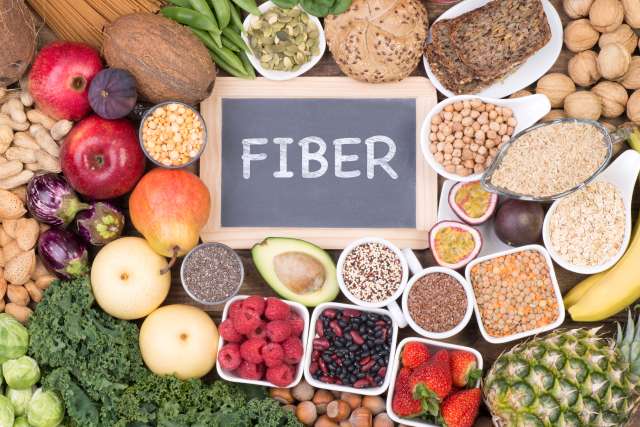
But plenty of fibrous foods carry no label at all. Half an avocado contains 5 grams of fiber. So does a cup of broccoli. A cup of raspberries has 8 grams. A baked potato has 4.
Some of Ansari’s go-to high-fiber meals and snacks include a cup of bran cereal (14 grams) with a cup of fruit (3 to 5 grams); a half-cup of hummus (about 5 grams) with a half-cup of baby carrots (2 grams) or a serving of whole-wheat crackers (2 to 3 grams); a cup of lentil soup (8 grams) with a slice of whole-grain avocado toast (about 8 grams).
Adding more fruits and vegetables to your diet will naturally increase your fiber intake – and it’s not just about fiber, Ansari says.
“You’re also getting a variety of micronutrients – vitamins and minerals along with antioxidants and phytochemicals that support overall health from a varied diet,” she says. “Many of these benefits come from eating a wide range of fiber-rich foods.”