Cancer isn’t just a health challenge; it’s a communication challenge.
Suddenly you’re meeting with a cadre of medical professionals, learning a whole new vocabulary of terms, and navigating uncharted territory when talking with family members, friends and colleagues. Existential questions emerge that you may have never considered before: What will my life be like now? Will I survive?
Porter Tolkin, MSW, thinks about these communication conundrums often. As a clinical social worker with the Simms/Mann UCLA Center for Integrative Oncology she helps individuals and families develop strategies for asking questions, expressing needs and establishing boundaries during cancer diagnosis, treatment and survivorship.
“Communication can help strengthen your relationships with medical providers and loved ones,” Tolkin said during a recent webinar, “Communication in the Cancer Context.”
The challenges of communicating about cancer
Discussing sensitive subjects is often difficult, perhaps even more so when facing serious illness. We feel pressure to be positive. We worry that if we talk about our diagnosis, we’ll be overwhelmed with difficult feelings, including fear, anger, worry and grief, Tolkin said. We want to protect our loved ones from bad news. We don’t want to sound like complainers or seem ungrateful.
“In reality, the more we try to avoid these feelings, the more they fester and lead to hardship,” Tolkin said.
Clarity is important for everyone involved in a cancer journey, she said: “Clear is kind.”
Since being open about our experiences can be so challenging, she recommends taking notes during medical visits, expressing thoughts in a voice-notes app before sharing them with others and developing scripts of prepared responses to use when needed.
Communicating with your care team
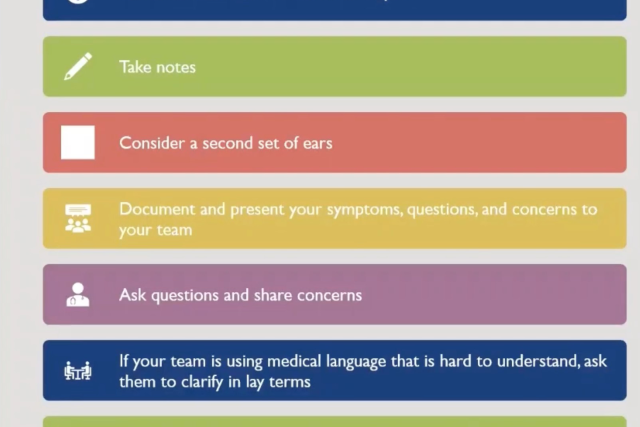
It’s normal to have many questions about your diagnosis and treatment – and also normal to feel weird about asking them. Tolkin suggested bringing a written list of questions to appointments, as well as having a friend or loved one with you, if possible, who can serve as a second voice and set of ears.
- Helpful questions for your medical team may include:
- What options for treatment do I have?
- What will my treatment involve?
- How much time will my treatment take?
- How will this affect my daily life?
- What are the expected side effects?
- How will we know the treatment is working?
- Is the goal to cure or manage the cancer?
- Can I continue working?
- What resources do you recommend for me and my loved ones?
Request a translator if necessary. And be sure to ask providers to explain any medical terminology you don’t understand.
Some patients worry that seeking a second opinion might offend their doctors, Tolkin said, adding that this is an area where having a script may be useful. She suggested saying something like, “I'm confident you are going to provide me with excellent care and I know that different physicians may take different approaches. But I'd like to connect with another oncologist for their opinion, to feel confident in the approach we will take together. Can you please recommend any physicians with specialties in this area?”
Communicating with loved ones
Before approaching any conversation, understand your primary objective, Tolkin advised, such as, “I want my brother to understand that when he sends me articles about what supplements to take, I find it unhelpful.”
Use factual “I” statements for assertive communication that’s clear, calm and direct, she said. It’s also useful to demonstrate that we understand the other person’s intention. For example: “I heard that you are sending articles because you thought they would be helpful. I appreciate your intention … and I would prefer if you just ask me how I’m doing rather than sending articles.”
With a wider circle of friends, it’s important to set boundaries and remember that “you control the narrative,” Tolkin said: “You choose how much or how little you want to share and the tone that suits you and your needs, assessing your appetite and energy for communication.”
And don’t hesitate to ask for help. Friends and loved ones generally want to be helpful when we’re down, and asking for help can bring everyone closer, she said.
She suggests being specific about what you need: Someone to drive you to your appointment on Thursday? Podcast and movie recommendations? Groceries delivered? Supportive text messages?
“It can provide a way for them to feel helpful instead of helpless,” Tolkin said. “It can put your energy and effort towards what is most meaningful for you during your recovery and not having to worry about that communication all the time. And it can allow for you to feel less overwhelmed and less lonely.”
It’s also OK to not want to talk about your illness or how you feel all the time, she added. Consider saying, “I appreciate your interest. I think about medical things so much these days. I’d rather spend our time talking about other things.”
Communicating with colleagues
Tolkin emphasized how important it is to “remember that you control the narrative” when discussing health matters in a professional context. You don’t owe anyone your personal medical details.
Language such as “personal leave,” “medical leave” or “taking time away to focus on my health” preserve privacy while communicating clearly.
Friends and coworkers can have good intentions behind their comments and questions but their inquiries might still leave us feeling uncomfortable. Some good potential responses include: “I appreciate you expressing your concern about my health and I don’t want to talk about this at work” or “I'm confident in my treatment plan, I'm doing all that is asked of me and waiting to see what happens.”
Maintaining personal boundaries supports effective communication, Tolkin said: “This can be one of the hardest things to do with people in your life, because, more than not, they’re just trying to be helpful and they’re coming from a place of kindness.”
Boundaries “define our edges and create a safe space for us to feel, act, think and just be ourselves.”
And they can be flexible, she added: “In the same way our personal needs change on any given day, so can our boundaries.”