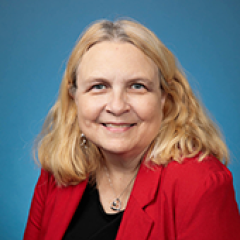
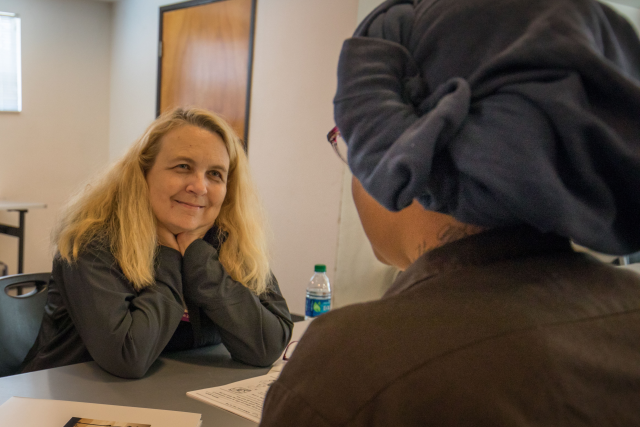
Jeannie Meyer, MSN, didn’t realize she was homeless as a child.
She thought everyone moved from place to place, hotel to hotel, and never answered the phone or the door in case a bill collector was on the other side.
“I knew what ‘eviction notice’ meant when I was 5 years old,” she says.
Those childhood experiences made her empathetic, but it was the pain of learning that her alcoholic father died on Skid Row that inspired Meyer, a palliative care nurse at UCLA Health, to advocate for advance care planning for homeless people.
What is advance care planning?
Meyer believes that everyone 18 and older should complete an advance healthcare directive, a document that outlines what kind of medical care you’d want should you become too incapacitated to speak for yourself. Do you want to be kept alive even if you’d be permanently hooked to a breathing machine? What if you couldn’t recognize loved ones or think well enough to make everyday decisions?
If Meyer had her way, everyone 18 and older, and emancipated minors, would have an advance directive on file as part of their electronic medical record.
“We all drive the 405,” she says. “If you came into us with a traumatic brain injury and you were never going to be able to be yourself again, I don’t know what you would want. Your doctors don’t know what you would want. Possibly your family doesn’t know what you would want.”
About 36% of adults have an advance directive on file, according to the National Institutes of Health. But among unhoused people, that number is less than 10%.
When a homeless individual comes into the hospital in “full code” status – a life-threatening medical emergency – there may be no immediate way to identify the person, much less their wishes around life-sustaining medical treatment.
In California, medical personnel are legally required to provide what Meyer calls “full court press” to patients in that condition, which can include intubation, tracheostomy and “sending you to a long-term care facility for the remainder of your biological existence.”
An advance directive allows an individual to define for themselves what constitutes a good life and set limits on what they’d want done – even if a family member or other designated decision maker would make different choices.
Every adult is entitled to delineate their final wishes, Meyer says, even those society overlooks.
Hearing Their Voice
With a $10,000 grant from the Coalition for Compassionate Care of California in 2015, Meyer and a colleague, social worker Delia Cortez, LCSW, created Hearing Their Voice, a grassroots, volunteer-supported effort to bring advance care planning to L.A.’s unhoused population.
They started working with the St. Roberts Center in Venice, which provides food, clothing and other necessities to people in need. Meyer, social worker Diana Ramirez, MSW, then-chaplain Tim Thorstenson and other volunteers came to the center and set up a table, ready to talk to visitors about end-of-life planning and provide simple advance directive forms.
They quickly learned that they’d have to ease into the topic.
“There was a lot of distrust,” Meyer says. “There was a strong belief that UCLA would bring homeless people in and allow them to die so we could have their organs.”
Instead, Meyer and her colleagues started sharing health information this population needed: where to get health care, dental care, new glasses.
“We noticed a lot of them had dogs, so we started finding out where they could get pet care for their animals,” Meyer says. “That was a huge step. When they trusted us, then we spoke about the directives.”
And people embraced the idea, she says.
She recalls one woman who said, “I know that probably from the outside, it looks like I have a terrible life. But I love every sunrise. I love looking at the ocean. And I would want to be kept alive as long as possible, because I believe that life is a gift.”
Another believed she was the deposed queen of Ireland, but understood that her chronic illness would prevent her from returning to her homeland.
“Do you want to argue capacity? Possibly,” Meyer says. “But I know from sitting on ethics, having something like this documented for her would give her a voice and be golden. Because she still deserves the dignity of having her voice captured.”
While there’s a misconception that homeless people are “severely mentally ill,” she adds, very few are so profoundly sick that they don’t understand the concepts in an advance directive.
Unhoused people experience higher rates of chronic disease, substance abuse and serious mental health issues than people with housing, a 2022 study found. Their lifespan is also a decade shorter, Meyer says.
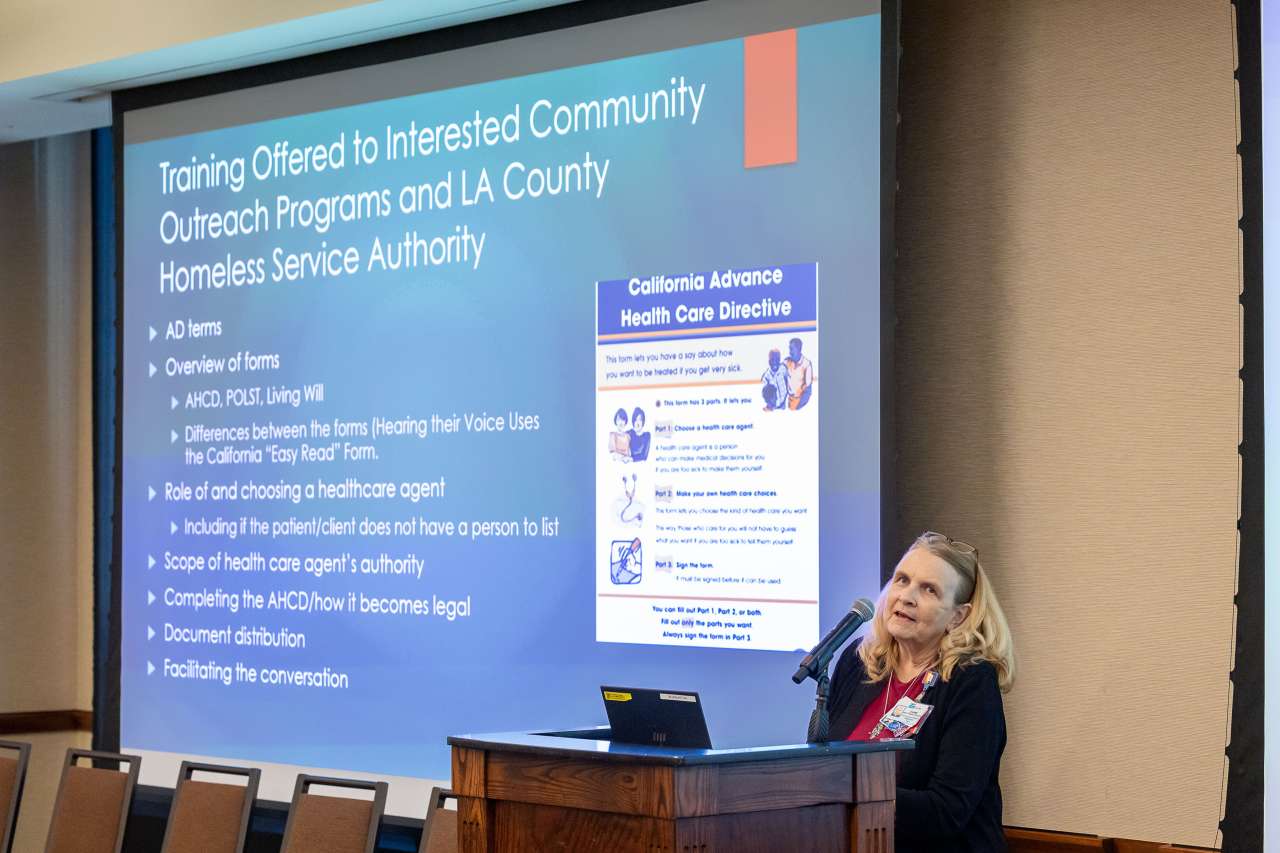
Meyer calls the effort Hearing Their Voice because “it’s a cumulative voice,” she says: “We are hearing a community that deserves to be treated with dignity. The unhoused community deserves a voice.”
Those who complete an advance directive are told to provide a copy to their case worker and to the staff where they typically receive health care. The more places it’s on file, the better, Meyer says. Once the form is uploaded into a patient’s electronic medical record, it’s accessible across most area hospitals, she says.
Spreading the word
Hearing Their Voice has distributed more than 1,000 advance directives to homeless people in Los Angeles to date, Meyer says.
And the effort has expanded beyond Southern California. Meyer has been invited to speak about this work across the country, with similar outreach to homeless populations underway in Oregon, Atlanta, Denver and San Francisco.
“If I travel to present this, I’m doing it on my own dollar because I believe in this that much,” she says.
Meyer’s work with unhoused populations has spawned a second project, a think tank called Hospice Under the Bridge that fosters partnerships with local hospice organizations willing to provide care for homeless people in their chosen setting.
“Turning that vision into reality has been an extraordinary challenge, but Jeannie's resourcefulness, perseverance and collaborative spirit have made it possible,” says Philip Levin, MD, chief medical officer at UCLA Santa Monica Medical Center.
He calls Meyer “an exceptional nurse leader with an unwavering commitment to our most vulnerable patients, particularly those experiencing homelessness.”
Meyer shares the story of one man who left hospice care to “go on a two-week meth bender.” When he returned, he reached out to the hospice organization to report that his wheelchair had been stolen.
“They came – absolutely no judgement,” Meyer says. “They picked him up, brought him back and cared for him until he died.”
Distributing advance directives and making this kind of care available to a population that’s so often overlooked and disregarded takes the dedication of countless individuals and organizations, she says. But for Meyer, there’s no worthier work.
“I would have loved, before my father died, if somebody had asked him, ‘What would, or would not, you want?’” she says. “Now, the odds are, his choice would have been, ‘As long as I can keep drinking, I’ll be happy.’ And if so, that’s fine. But it would have been great to think my dad’s voice was one time heard.”