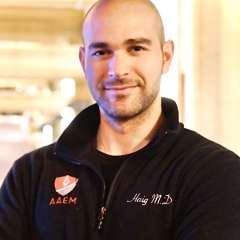
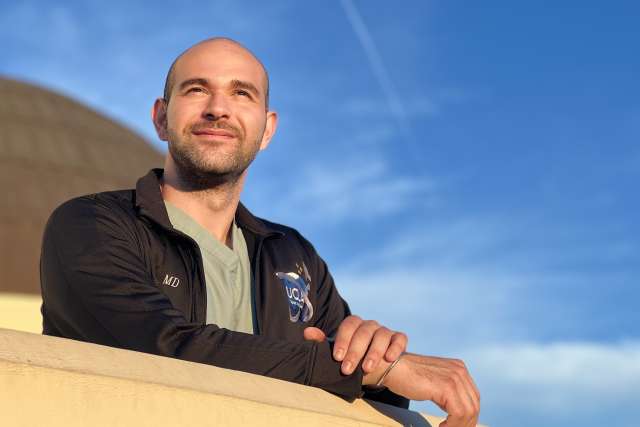
Long before Haig Aintablian, MD, created the nation’s first space medicine fellowship at UCLA Health, he was fascinated with the cosmos.
As a teen, his dad took him to see Steven Hawking speak at Caltech. They spent many afternoons at the California Science Center. Dr. Aintablian still has the telescope he got for Christmas as a kid, and his eyes light up as he recalls the moment he and his dad spotted the rings around Saturn.
“It blew my mind,” Dr. Aintablian says. “As a kid, it was one of the most impressive sights, to be like, ‘This actually exists. This isn’t just in textbooks.’”
Now director of the UCLA Space Medicine Program, Dr. Aintablian spends his days immersed in groundbreaking research and space-adjacent experiences. He works with NASA, U.S. Space Command, Jet Propulsion Laboratory and the private space industry internationally to support spaceflight. He’s also directly involved in astronaut medical care.
“It’s wild that I’m at this point,” he says. “We’re doing incredible research projects and building the future of medicine. It’s a dream come true.”
The human body in space
Early in medical school, Dr. Aintablian started studying how the human body changes in space, including publishing a NASA study looking at eye pathologies that develop in astronauts (he and his research team theorized the mechanism as to why the back of the eyeball flattens in space – a disease called Spaceflight Associated Neuroocular Syndrome).
As a resident in emergency medicine at UCLA Health, Dr. Aintablian was part of a conversation with a space company about the need for physicians trained to diagnose and treat the unique physiological conditions that develop in space.
“I was like, wait, why don’t we build this?” he says.
The UCLA Health Space Medicine Fellowship was born in 2021 to meet that need as space exploration and space tourism expand. Humans will become multiplanetary in the next few decades, Dr. Aintablian says, and space tourism might be as accessible as a trip to Europe in the next 15 years.
He was the fellowship’s founder and first graduate. Three other physicians have since completed the program.
These doctors are studying the myriad changes the human body experiences in space. NASA’s 2019 Twins Study — which explored how a year in space affected astronaut Scott Kelly compared to his Earth-bound identical twin brother Mark Kelly — pointed to the breadth of effects on the human body, including changes in gene expression, body mass, microbiome and DNA.
“The human body in space becomes an incredibly different organism and it's fascinating to research,” Dr. Aintablian says.
Three main environmental conditions in space are responsible for these changes: microgravity, radiation and vacuum – the absence of air or air pressure.
The lack of gravity leads to fluid shifts throughout the body, which results in the flattening of the eyeball, among other issues. Instead of collecting in the legs, as it does on Earth, fluids shift upward to the head and arms. Weightlessness also eliminates the need for bone and muscle to hold our bodies up against gravity, so they degrade in space, Dr. Aintablian says: “We become much weaker and flimsier.”
Radiation is another factor. Earth’s magnetosphere protects us down here, but there’s no such protection in deep space. The body is vulnerable to solar particle events, also known as solar flares, as well as galactic cosmic rays, which scientists often describe as “microscopic cannonballs.” These high-energy particles can cause radiation sickness, with symptoms ranging from nausea to organ failure; tear through cellular structures; and damage DNA.
Finally, vacuum presents instant, deadly risks to the human body. “The reason for space suits and capsules isn’t the lack of gravity or even radiation,” Dr. Aintablian says. “It’s vacuum.”
“If you expose a human to vacuum, a lot of interesting physics happen because we are all subject to the laws of physics,” he says. “Ebullism occurs — ebullism is when your blood boils at room temperature.”
Improving health on Earth
“Studying the impact of space on human physiology will lead to findings that benefit everyday earthlings,” Dr. Aintablian says.
For instance, neuroplasticity – or the brain’s ability to adapt – works differently in space. Dr. Aintablian explains that an organ in the inner ear senses gravity and its orientation. The absence of gravity provides incongruent signals, which is why astronauts in microgravity get motion sickness. But within a few days in that environment, the brain turns down the signal and motion sickness abates.
“None of our ancestors have ever had the problem where their inner ears have told them there is no gravity,” he says. “There’s this neuroplastic event where the brain senses, ‘This signal makes no sense, let me turn that down.’ How cool is that?”
Similarly, the Twins Study found that telomeres —protective caps at the end of chromosomes that typically shrink with age — unexpectedly lengthened in space. Dr. Aintablian is particularly fascinated with such genetic changes, because they unlock greater understanding about the various roles genetics plays.
Understanding why “the hourglass in your cell would have more sand in it in space” also has major implications for understanding aging on Earth, he says.
Space medicine studies are teaching researchers so much about the human body that it’s “almost like the olden days again,” Aintablian says. “We’re making more and more discoveries every year.
“It’s like you have these tablets in the sand,” he says, “and the windstorm came and just the tip is now visible.”
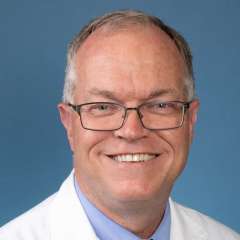
Greg Hendey, MD, chair of the Department of Emergency Medicine, says Dr. Aintablian “seems to have endless energy for Space Medicine because he loves the work so much.”
“Haig is one of the most enthusiastic, energetic and dedicated people I’ve ever met,” Dr. Hendey says. “When he sets his mind to something, he doesn’t stop until he succeeds.”
Is there anybody out there?
When Dr. Aintablian fell in love with science as a kid, he tried to study “the primordial soup” and discover the origins of life. He started college at 15 and earned a bachelor’s degree in biology and a master’s in molecular genetics by the time he turned 21.
Then he got interested in medicine. His early experiments didn’t create life, but life was all around him and he could study it.
“I started to understand the humanities and philosophy and what makes humans human,” he says. “So, I fell in love with medicine and the idea that you are a philosopher and a scientist at the same time.”
The complexity of life continues to fascinate him.
“I’ve become theistic because it’s clear to me that we are too complicated and it couldn’t have been a statistical anomaly,” he says. “Finding a laptop on the surface of Mars that lightning and rocks created is much more likely than a cell that could reproduce, and we can’t even find that. There’s got to be a higher power.”
This is why Dr. Aintablian doesn’t believe we are alone in the universe. His license plate is the alphanumeric code of the “Wow! Signal,” a still-unexplained radio signal received in 1977 that some researchers believe was an extraterrestrial transmission.
The drive to explore and discover what’s out there is why we’re destined to explore the cosmos, he says.
“This is a survival, subconscious thing that we’ve done forever,” he says. “This is what brought us across islands. It’s what brought the Polynesians to Hawaii and the Europeans to America. This is the drive that we have to expand and explore and adventure.”
The U.S. is planning a return to the lunar surface in 2028 and manned missions to Mars as early as the 2030s, according to NASA. Dr. Aintablian envisions many of these high-risk missions having physicians on board. The journey alone to reach Mars will take six months. An eventual lunar base would also need a medical platform, he says.
“A lot of people will be able to fly in the future, and we’re going to need more and more medical architecture to support that,” he says.
His biggest goal, besides traveling to space himself, is preparing physicians to support astronauts and other space travelers. To that end, Dr. Aintablian continues to develop the UCLA Space Medicine Center, which provides astronauts with medical screenings, trains crew members in medical procedures, provides medications for spaceflight, and conducts research for various space companies. Dr. Aintablian and his colleagues also manage medical operations for aerospace companies.
“The most exciting thing for me is that I’m doing what I always wanted to do,” Dr. Aintablian says, “which is understand more about ourselves with each of these quests.”