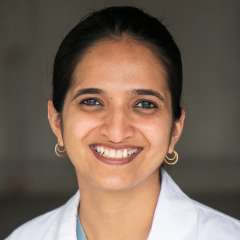
It wasn’t until about 15 years ago, during her residency in New Jersey, that Aparna Sridhar, MD, realized that female genital mutilation, or FGM, is a global problem that transcends continents, cultures and religions.
“For the first time, I saw someone with severe FGM who actually had to have a C-section because her vaginal opening had been narrowed to such an extent that she couldn’t deliver vaginally,” said Dr. Sridhar, professor of clinical Obstetrics and Gynecology at the David Geffen School of Medicine at UCLA.
FGM is the partial or total removal of the external female genitalia for mostly non-medical reasons, which causes severe, irreversible physical and psychological harm. It can also cause obstetrical complications such as obstructed labor, tears, bleeding and the need for C-sections. The World Health Organization (WHO) and United Nations affirm that female genital mutilation has no health benefits and only causes harm. It is recognized globally as a violation of the human rights of women and girls.
Women who have undergone FGM face a lifetime of both short- and long-term complications such as difficulties with urination and sexual dysfunction, as well as mental health conditions such as post-traumatic stress disorder (PTSD).
FIGO statement creates unified voice
Dr. Sridhar was one of the main authors of a statement titled “Ending female genital mutilation: a global call to action from the International Federation of Gynecology and Obstetrics (FIGO),” published in September. She said the FIGO statement unifies the voice of obstetricians and gynecologists from more than 140 professional Obstetric and Gynecological Societies across the world condemning FGM as a harmful practice and as a human rights violation. It supports advocacy efforts, raises awareness and guides health care providers on managing FGM's consequences, Dr. Sridhar said.
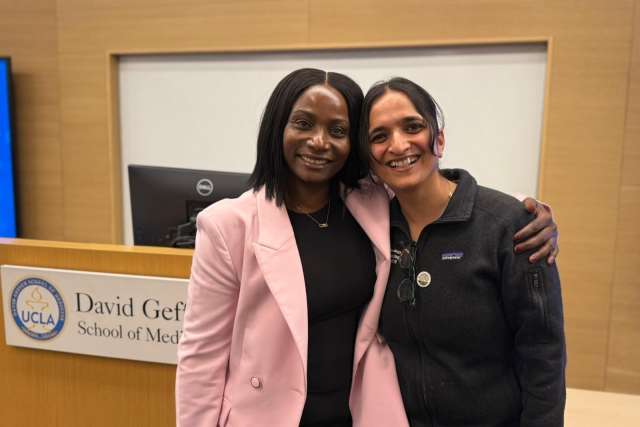
Her source of inspiration for this statement was Fatou Baldeh, an internationally recognized FGM activist from Gambia who was named one of TIME magazine’s 100 most influential people in the world in 2025. UCLA hosted Baldeh in March, which is when Dr. Sridhar met her. She calls it a transformative moment.
Baldeh has talked about her traumatic FGM experience in the media. She was 8 years old when she was taken to a family member’s house for what she believed was a ceremony. Baldeh said she was cut on the floor, along with several other young girls. Hearing Baldeh talk about that experience was “moving,” Dr. Sridhar said.
“You can’t help but wonder when one person is bringing all this energy, how can you help from a community perspective or from a provider’s perspective,” she said.
Baldeh is an example of how one person’s experience can effect global change, Dr. Sridhar said. When she heard Baldeh speak about how providers in Asia and Africa are discussing medicalizing the practice of FGM driven by the misconception that practicing it in a clinical setting makes it safer, Dr. Sridhar said she felt a sense of urgency to “make our voices stronger and help women like Fatou.”
Dr. Sridhar said she wrote the FIGO statement with other authors who are engaged in the global effort to eradicate FGM and help survivors.
Global public health and human rights challenge
According to the WHO, more than 230 million girls and women who are alive today have undergone FGM in 30 countries in Africa, the Middle East and Asia where the practice is still carried out. Girls are subjected to it between infancy and age 15. WHO estimates that treatment of FGM complications costs global health systems about $1.4 billion each year, a number that is expected to increase “unless urgent action is taken towards its abandonment.”
Dr. Sridhar said that urgency is present in the tone of the FIGO statement she co-authored, and the impact has been immediate and powerful.
“We are hearing from like-minded people and that’s a very good sign,” she said. “They are reaching out to us to partner on collaborations such as the Orchid Project, which is a global NGO that is working to end FGM.”
A big challenge for organizations united in this purpose is the sensitive nature of the topic, Dr. Sridhar said.
"Discussions on FGM remain sensitive, as they intersect deeply with cultural identity and religious beliefs," she said. "This overlap can create hesitation or fear around addressing the issue, and the stigma attached to it often prevents meaningful dialogue and education."
But, with the help of partners, there are inroads being made, particularly in the area of education.
Future projects
Dr. Sridhar spoke of plans to launch virtual surgical camps using augmented reality and virtual reality technology, allowing expert surgeons to stream reconstructive surgeries and provide real-time guidance to doctors working with limited resources. This greatly improves access to surgical training for providers who are in countries that are lacking in expertise but that have a great need for such procedures.
The other area that needs to be improved, said Dr. Sridhar, is training students and equipping them to deal with real-life scenarios. She said AI can be a game changer in this space.
To that end, UCLA is partnering with the University of Gambia to conduct needs assessments on how well future health care providers are educated about FGM and its consequences, Dr. Sridhar said.
“We’re developing AI-based clinical examinations to improve pre-service education and counseling skills related to FGM,” she said, adding that medical students, as well as those graduating as nurses and midwives, need more resources to better understand real-world scenarios relating to FGM.
“So, the biggest dent we can make is to understand how well-equipped this future generation of medical professionals are to counsel people about FGM and its consequences,” she said. “Most of the time, these issues are so sensitive that when you actually are trying to find a patient who can actually talk about it, it may become extremely challenging emotionally.”
In her current role, Dr. Sridhar says she is trying out AI-based structured clinical examinations, which means feeding the computer all there is to know about FGM and it creates “a simulated patient.” Students are then able to interact with this “patient” and learn how to counsel people they will see in real scenarios.
“Based on that model, we’re going to develop cases based on sexual and reproductive health, but introduce FGM in a way that is culturally appropriate and test it on graduating students to see how we need to augment the curriculum,” she said.
To develop this curriculum, they’ll partner with advocates as well as medical and nursing communities in Gambia, Dr. Sridhar said, with a target of starting by spring of 2026.
As she expands knowledge and advocacy, Dr. Sridhar says she also would like to see more work at the policy level because legal restrictions on FGM are necessary.
“It all needs to work hand in hand to contain the terrible harm done by FGM,” Dr. Sridhar said. “Bringing together groups of people who are working together, amplifying voices and working towards advocacy is always the key. I’m optimistic it will happen.”