
When you see an older person walking tentatively or needing a cane or walker for assistance, it’s often a result of poor balance — a change that happens to all of us as we age. So even if you don’t feel unsteady on your feet right now, your balance may not be quite as good as it was when you were younger.
It is true that balance naturally declines as we get older. But like many things related to aging, all it takes is a little extra work to help keep your balance strong.
Why balance declines with age
There are several possible causes of balance problems that become more common with age. Older adults are more likely to experience balance disorders and dizziness that can affect how steady they feel on their feet.
These types of balance issues can be the result of:
- Alcohol: Older adults may be more affected even by small amounts of alcohol, which can leave you feeling dizzy and unsteady.
- Inner ear problems: Infection or other conditions can lead to inflammation in the inner ear. That can lead to dizziness, vertigo and balance issues.
- Medications: Certain medications — including some for high blood pressure, antibiotics, antihistamines and sleep aids — can cause dizziness.
- Other medical conditions: Neurological conditions, stroke, vision problems and other conditions can also impact your ability to balance.
Physical frailty also plays a big role in how well we’re able to balance. Muscle weakness, loss of mobility and general loss of strength can make it physically more difficult to balance well.
The benefits of better balance
Balance isn’t only about the ability to stand on one leg. Your ability to balance significantly affects your walking gait.
Walking calls on several things with each step — including muscle strength, joint mobility, balance and coordination. When any of those are not functioning properly, your walking gait suffers.
A strong, steady, well-balanced walking gait helps you move faster and more efficiently. Research has found that a faster walking pace (63 to 88 steps per minute) is associated with longevity, reducing the risk of all causes of death by 33% compared to those with a slower walking pace (about 29 steps per minute).
Better balance is also essential for preventing falls, which become increasingly common with age. According to the Centers for Disease Control and Prevention (CDC), falls are the leading cause of injury among adults age 65 and older.
Balance exercises to try
Staying active and fit as you age is essential for every aspect of your physical health. You need aerobic exercise (such as walking, water aerobics, pickleball or biking) as well as strength training and some stretching. Together, those keep your heart and lungs fit to give you energy and endurance, plus the muscle strength and flexibility you need for ease of movement.
But too many people forget to actively target balance as part of their workout routine. Improving your balance is a simple and effective way to help you stay active and steady on your feet. Incorporate these moves into your exercise:
Standing balance
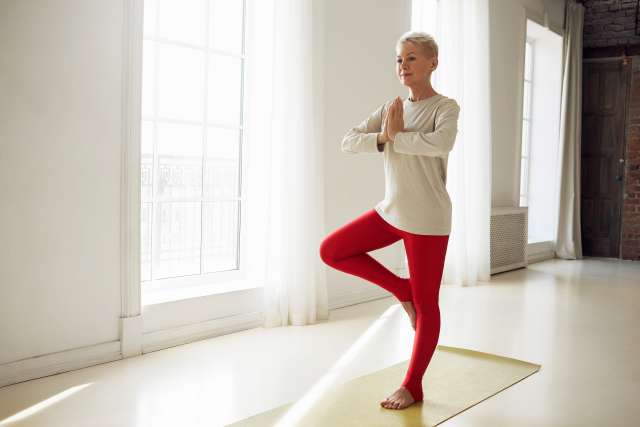
The simplest balance exercise you can do is just standing on one foot at a time. You can start by holding onto a counter or the wall if needed. The goal is to work up to balancing for at least 30 seconds on one leg and then the other.
Heel-toe walking
Start near a wall for support. Keep your feet aligned so that, with each step, you place the heel of your front foot directly in front of the toes of your back foot. Try to walk 20 steps or more.
Step-ups
Use a step that has a wall or secure railing nearby. Start at the bottom and slowly step up with your right foot. Bring your left foot up to meet it on the step. Step back down to bring both feet back to your starting position. Repeat, doing at least 5 step-ups on each side.
Yoga or tai chi
If you prefer a group activity or class, look for a gentle yoga or tai chi class. Both practices incorporate lots of moves and postures that encourage better balance.
Always consult your doctor before starting any new exercise routine. When doing balance work, always have a support (wall, railing, chair) nearby in case you feel unstable.
Consistently working on your balance will help you overcome age-related declines and keep you steady on your feet for years to come.