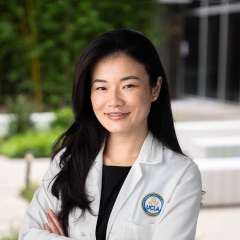
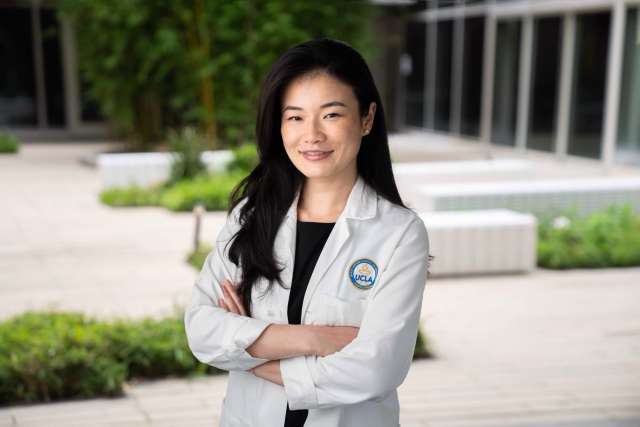
Dr. Jie Deng, assistant professor-in-residence of radiation oncology and a member of the UCLA Health Jonsson Comprehensive Cancer Center, has been awarded an American Cancer Society (ACS) Clinician Scientist Development Grant, co-sponsored by the American Society for Radiation Oncology (ASTRO) and designated in honor of Felix Feng, MD, an expert in translational genomics and preclinical therapeutics for prostate cancer. The award supports full-time faculty in maintaining their clinical practice while conducting cancer research.
The award will help further Deng’s research investigating how radiation therapy and the immune system can work together more effectively to improve outcomes for patients with non-small cell lung cancer.
Radiation therapy is a cornerstone treatment for many patients with non-small cell lung cancer, particularly those who are not candidates for surgery. In addition to directly killing cancer cells, radiation therapy can help stimulate the immune system to recognize and attack tumors. However, these immune responses are often not strong or coordinated enough to provide lasting benefit.
Researchers increasingly recognize that nearby lymph nodes play a critical role in coordinating immune responses against cancer, making them an important focus for improving the immune response generated by radiation therapy. Deng's research focuses on how lymph nodes serve as training centers where immune cells learn to identify and target cancer. Building on previous findings, her team will study how radiation therapy activates immune pathways within tumors and how those signals enable nearby lymph nodes to generate cancer-fighting T cells.
“I am grateful to the American Cancer Society and the American Society for Radiation Oncology for this award and for their commitment to supporting physician-scientists in honor of Dr. Feng,” said Deng. “The questions we study in the laboratory are inspired by the patients I care for in the clinic. This support will help our team better understand how radiation therapy activates the immune system and ultimately translate those discoveries into more effective treatments for people with lung cancer.”