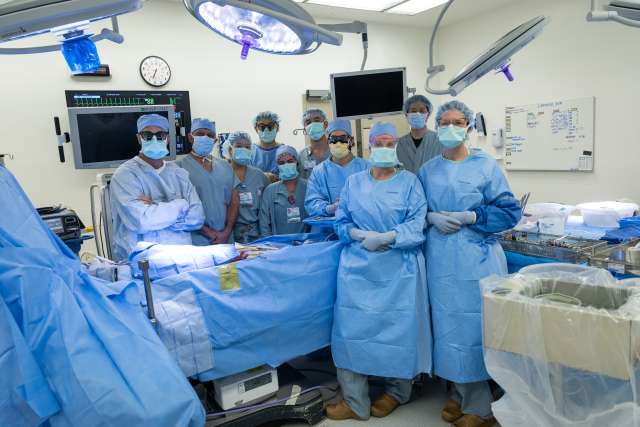
One year after the first human bladder transplant, the patient is thriving and the UCLA Health surgeon who performed the operation already has completed a second successful bladder transplant, laying a solid path for a field of surgery that until now has not been feasible.
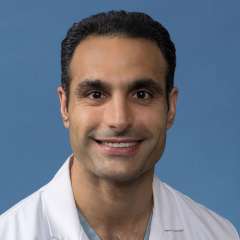
Dr. Nima Nassiri, urologic transplant surgeon, leads the groundbreaking UCLA Health clinical trial that launched by transferring a kidney and a bladder into a 41-year-old cancer survivor in May 2025. At the time, Oscar Larrainzar was on dialysis and hadn’t had a functioning bladder in seven years. After the first-of-its-kind surgery, he now has full use of his new bladder.
Nassiri leads a new research paper detailing Larrainzar’s progress at the critical six-month post-transplant milestone. The work, the first-ever chronicling of a human bladder transplant, was reviewed by peers before publishing in The Lancet on June 23.
Nassiri already has identified patients for two additional bladder transplants in 2026, as part of the ongoing clinical trial at UCLA Health.
“We learn from each procedure,” Nassiri said. “Our hope is to help many more patients – especially those with end-stage bladder disease who haven’t had much hope for a normal life.”
Meanwhile Larrainzar, now 43, is working again and even enjoyed a recent family getaway in Las Vegas, which included the first swim he’s taken with his 10-year-old daughter since she was a baby. And he was able to leave behind the trunkful of medical equipment that had been a burden for so long.
“To be honest, I didn’t believe it would happen – that the surgery would be so successful and I would wake up and not even need a catheter,” Larrainzar said. “I never imagined I’d be going back to having just a normal life.”
Although he’s healthy now, Larrainzar’s recovery did hit a wall early on, as the study details. On day 25, he developed a urine leak from a tube that was draining the bladder through his abdomen. The area became infected, and Nassiri operated again to close the leak and remove the tube, which had been placed as a backup to new catheter.
Larrainzar healed quickly, and after studying the complication, Nassiri and his team learned they will be able to forego using those secondary “suprapubic” tubes in future transplants.
The transplant procedure that Nassiri pioneered, alongside mentor Dr. Inderbir Gill of USC, leaped beyond the longstanding method of treating patients with terminal bladders. It was the first to transfer a bladder as an independent, vascularized organ with its own blood supply. The previously established standard is to construct a bladder from intestinal walls, which can come with serious infection or metabolic-related complications.
In the new study, Nassiri outlines how – because the transplant was the first of its kind – his team had to define the benchmarks for success prior to the operation. After 30 days, Larrainzar was able to hold 270 ml of urine (almost 7 oz), surpassing the 200 ml-benchmark; by six months, he was holding 600 ml. That’s 20 oz and the full capacity of a normal, healthy bladder.
Nassiri’s initial two surgeries – the first in May 2025 and the second in February 2026 – transplanted both a bladder and a kidney into each patient.
In the second enrolled patient, who ultimately received a successful kidney transplant, the new bladder suffered a complication that led to its removal. The patient recovered; his new kidney is working well, and the team is planning a potential second attempt to transplant a bladder.
Nassiri’s third patient is recovering well from a combined kidney and bladder transplantation, and is almost 2 months out from surgery, urinating by himself without the need for a catheter.
The case of the patient who received a kidney but had a failed bladder presented a prime opportunity for the team to learn, Nassiri said. Not knowing if planning a “re-transplant” would be possible, team members were surprised to discover they could in fact try again. Nassiri expects this patient’s future surgery to be successful. If it is, his team will have accomplished yet another milestone – a “re-transplant” of a human bladder.
“It’s not a fairy-tale story. These things happen,” Nassiri said. “But the fact that you could re-transplant a bladder would tell us that even in the event of bladder failure, salvage may be possible and we may still be able to help these folks. That would guide future treatments and protocols for these patients.”