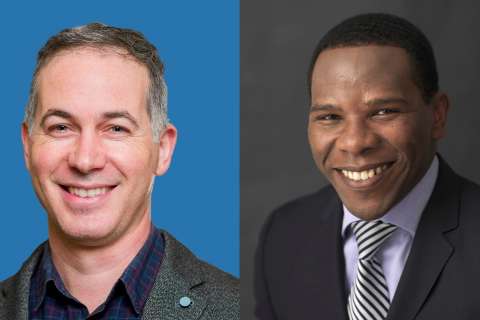
UCLA Health gastroenterologist Lin Chang and Dr. Bruce Sands of Mount Sinai were awarded a $4 million federal grant to investigate why some ulcerative colitis patients continue to experience irritable bowel syndrome-like symptoms even after inflammation has subsided.
The five-year study will be jointly conducted at UCLA and Mount Sinai, with Chang and Sands serving as co-principal investigators.
Ulcerative colitis is a chronic disease that causes long-term inflammation and ulcers in the inner lining of the large intestine and rectum. Symptoms such as bloating, irregular bowel movements and cramping can resemble those of irritable bowel syndrome (IBS), a separate condition that does not cause inflammation. In about one in three patients with ulcerative colitis, these IBS-like symptoms can persist even when inflammation is minimal or absent.
In this new study funded by the National Institutes of Health, Chang and Sands, chief of the gastroenterology division at Mount Sinai, will investigate if persistent symptoms are driven by ongoing gut inflammation or altered gut-brain signaling. To achieve this, the researchers will use a combination of brain imaging, wearable technology to measure autonomic nervous system function and will test whether non-invasive vagal nerve stimulation can improve symptoms.
The study aims to ultimately support new personalized treatment approaches for ulcerative colitis patients with little to no active inflammation with persistent IBS symptoms.
The study is set to conclude in June 2031.
Chang is the vice chief of the Vatche and Tamar Manoukian Division of Digestive Diseases at UCLA, director of the Walter and Shirley Wang Center for Integrative Digestive Health, co-director of the G. Oppenheimer Center for Neurobiology of Stress and Resilience, director of the Clinical Studies and Database Core of the Goodman-Luskin Microbiome Center and program director of the UCLA Gastroenterology Fellowship Program.