Twenty-four hours a day, every day, Zach Monticello felt like someone was smashing his right hand with a hammer.
Except his right hand – his whole right arm – had been amputated months earlier after a devastating all-terrain vehicle rollover accident.
Monticello, 31, underwent a dozen surgeries beginning in July of 2024 – the first 11 trying to preserve his arm. The 12th, in October, was an amputation just below the shoulder. For months afterward, he needed significant amounts of opioids, muscle relaxers and gabapentin to manage nerve pain.
His surgeons suggested a surgical solution could help, but Monticello would have to travel from his home state of Arizona to access it.
That’s how he ended up at UCLA Health, undergoing a 13th surgery, one he says made “a huge, life-changing difference” in his pain levels and future outlook.
“It’s given me the best possible outcome,” says Monticello. “The relief that surgery provided was life changing.”
Redirecting loose nerves
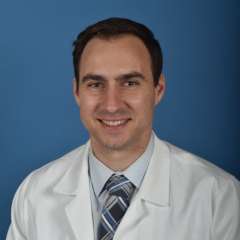
UCLA Health plastic surgeon Michael DeLong, MD, performed targeted muscle reinnervation (TMR) on Monticello’s amputated arm. The procedure reroutes nerves severed during amputation into remaining muscles, which reduces nerve pain and prepares the residual limb to effectively use electric prosthetics controlled by muscle impulses.
“Within a couple months, we could already see him able to move his muscles in different ways based on the new connections we made,” says Dr. DeLong, who performed the operation with hand surgeon Tim Schaub, MD. “The surgery has the potential to have a pretty profound impact on his quality of life.”
When a limb is amputated, severed nerves can act like loose electrical wires, sending aberrant signals. Those nerve endings continue to grow, looking for their target, Dr. DeLong explains. Not finding any, they become tangled balls, forming painful benign tumors called neuromas.
“Neuromas can cause a lot of phantom pain and residual pain,” he says. “They're kind of like loose nerve ends, so if you touch anywhere near it, people can have pretty significant pain. There’s a lot of discomfort associated with it in terms of quality of life.”
Five neuromas, which had formed inside the few inches of Monticello’s remaining limb, were removed as part of the surgery.
Surgeons wired the severed nerves into different parts of Monticello’s remaining muscles. Now, when he thinks of opening his hand, a part of his triceps fires based on these new connections. Similarly, when he thinks of closing his hand, a portion of his biceps contracts. These are the signals his prosthesis will ultimately “read” when Monticello wants to move his prosthetic hand.
“I’m going to get the best functional prosthetic I can, and this surgery has played a vital and huge role in that process,” he says.
Receiving and using that prosthesis is still likely months away. Because of the damage to his residual limb, ordinary prosthetics haven’t fit properly. Monticello needs an osteo-integration prosthesis, which has yet to receive approval from the Food and Drug Administration for upper extremities. Monticello has filed a compassionate care request for the procedure, which involves grafting a metal abutment into the bone to connect to the prosthesis. UCLA Health recently began offering the procedure, Dr. DeLong says.
Is targeted muscle reinnervation appropriate for all amputees?
TMR may eventually become standard care, given its proven benefits without drawbacks for amputees, Dr. DeLong says: “We should probably be doing this for every patient in the United States that gets an amputation.”
But the procedure isn’t widely available yet, which is why Monticello traveled from Phoenix to Los Angeles to have it done.
TMR was developed by plastic surgeons, a different specialty than orthopedic surgeons, who typically perform amputations.
“It lived in the plastic surgery literature and people who are commonly doing lower-extremity amputations weren’t necessarily familiar with it or hadn’t heard of it,” Dr. DeLong says.
Also, the technique hasn’t been around for very long, so only surgeons who completed residency within the last decade or so would have had a chance to learn it in training, he adds.
Dr. DeLong was inspired to learn how to do TMR – studying at the institutions where the procedure is commonly practiced – so he could bring it to UCLA Health. Now he teaches plastic surgery residents how to do it.
Adoption of TMR may still be slow because it continues to bridge two surgical worlds, he says. Plastic surgeons are accustomed to working with tiny blood vessels and nerves using a small, high-powered magnifying glass, where orthopedic surgeons work with bones, so learning TMR would require a bit of a different skill set. Scheduling is also a challenge, as a plastic surgeon coming in to do TMR would take operating-room time away from the orthopedic surgeon.
Dr. DeLong has learned to do amputations so he can perform TMR at the same time.
“That’s been very helpful,” he says, “because now (orthopedics) can just send these patients to me.”
Moving forward with hope (and Cleo)
Monticello continues to navigate life as an amputee. He had to give up his job with the sheriff’s department because he no longer meets its physical requirements. He’s also had to advocate for himself to access disability insurance and other benefits he’s entitled to, he says.
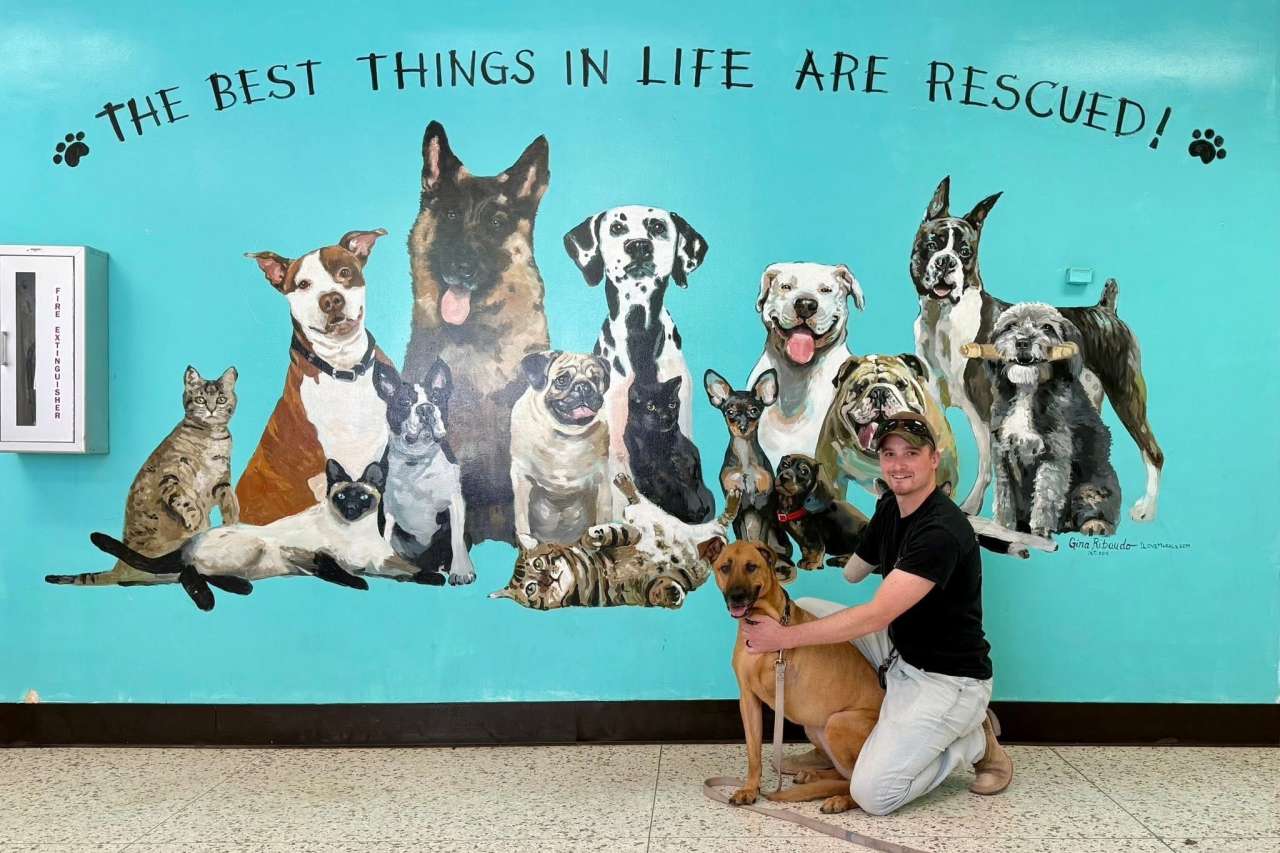
Besides his loving wife, Katie, who’s helped him through the journey, Monticello also has three dogs, including an amputee pup he adopted after losing his arm.
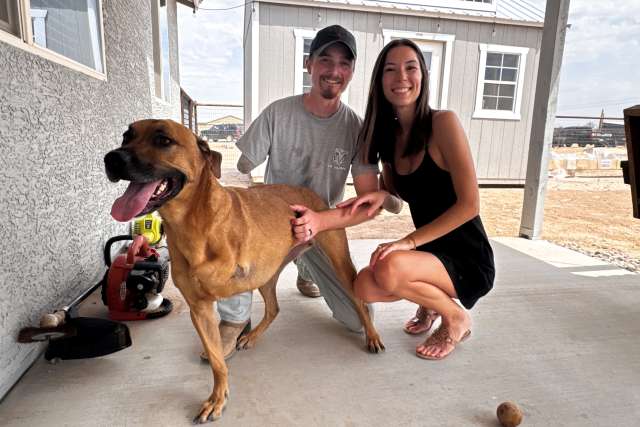
On the one-year anniversary of the ATV accident, Monticello and his wife saw a segment on the local news about a three-legged dog rescued by police and rehabilitated through its animal cruelty unit. A female Rhodesian Ridgeback, Cleo lost her front left leg after being shot with a shotgun. Two days after seeing Cleo on the news, Monticello brought her home.
“The bond between us was immediate and it was special,” Monticello says. “She jumped in the back of the vehicle, and within like, four minutes, she was putting her head on what I had left of my residual limb, like she knew.”