
MR-Guided Focused Ultrasound
Find your care
We offer neuromodulation for a wide range of movement disorders and pain conditions. Call 310-825-5111 to learn more about neuromodulation therapies.
UCLA Health is the most experienced hospital in California to offer noninvasive treatment for essential tremor
MR-guided focused ultrasound (MRgFUS) is a noninvasive technique to create very precise lesions deep within the brain. It is one of many tools used in neurosurgery to treat essential tremor. The other most common technique is deep brain stimulation.
To request an appointment, please call or email
MRgFUS FAQs
What is MRgFUS?
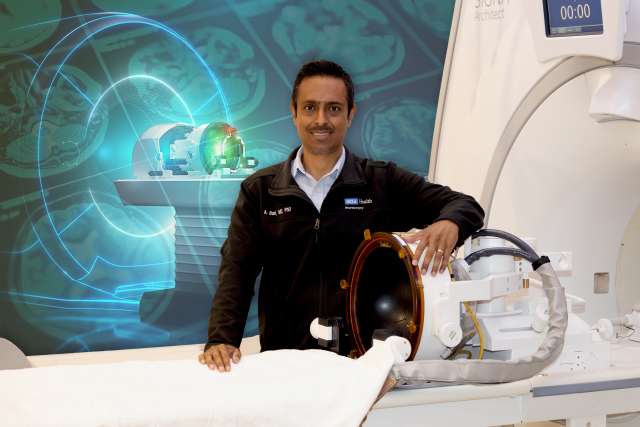
MRgFUS is a technique which uses high-intensity focused ultrasound energy waves to heat up a precise target in the brain, creating a permanent lesion. MRgFUS uses a dedicated device to focus the energy from over 1000 ultrasound sources. The ultrasound is applied while the patient is in an MRI machine, so that we can precisely monitor and confirm where the energy is being delivered. The process is safe and has few side effects. It does not require any implants, long-term maintenance, programming or battery replacements.
Am I a candidate for MRgFUS?
MRgFUS is FDA approved for the treatment of patients with essential tremor and tremor-dominant Parkinson disease. Treatment is available on both sides (staged, unilateral with 9 months separation) for ET patients. If first-line medications (primidone and propranolol) fail to adequately control your tremor, your doctor may consider recommending either MRgFUS, deep brain stimulation or radiosurgical thalamotomy. Compared to other surgical treatments for essential tremor, no device implant is needed, no incision is required and the treatment works immediately. Read more about what to expect during consultation for essential tremor.
How do I know if I am eligible for treatment?
Your doctor is the best person to ask about this. They will be able to tell you if you are a suitable candidate. In general, people who cannot go into an MRI will not be able to go through the treatment. This includes patients with metallic implants, patients who are claustrophobic, patients who are allergic to contrast agents (a dye used during MR imaging), patients who are over 300 pounds and patients who are under 22 years of age. Other factors that may affect eligibility include if you:
- Have any kind of metallic implants, such as pacemakers, neurostimulators, spine or bone fixation devices, total joints, metal clips or screws. Any metallic implants must be nonmagnetic to prevent injury to the patient from the MR’s strong magnetic field.
- Are not generally healthy enough to withstand the treatment and lie still in the same position for approximately 3 hours
- Had a recent myocardial infarction (heart attack) or have congestive heart failure (fluid around the heart), unstable angina pectoris (chest pain) or spinal conditions
- Have extensive scarring on the scalp
- Have any tumors inside the skull
- Are on dialysis
- Have an active infection or severe hematological, neurological or other uncontrolled disease
What insurance covers MRgFUS?
MRgFUS treatment of essential tremor is covered under Medicare Part B.
At this time, Medi-Cal, California’s Medicaid program, does not cover MRgFUS. Please contact Medi-Cal directly for coverage information.
For other insurance types, we recommend confirming coverage determination with your health plan.
Can I travel to other states to receive the treatment if my state is not covered?
We recommend confirming coverage determination with your health plan prior to treatment.
What is the five-character CPT code for the procedure?
The current CPT code for MRgFUS is 0398T; Magnetic resonance image guided high intensity focused ultrasound (MRgFUS), stereotactic ablation lesion, intracranial for movement disorder including stereotactic navigation and frame placement when performed. We provide this code for general information purposes only. Each provider is responsible for its own coding and billing activities.
What happens during MRgFUS?
In preparation for treatment, your doctor will order a specialized CT scan to understand your skull anatomy (which can affect your treatment eligibility).
On the day of surgery, the patient is given a mild sedative and pain medication before treatment. A stereotactic frame will be placed on your head to enable exact targeting and to prevent your head from moving during the procedure. At this time, your entire scalp will be shaved and cleaned to enable adequate cooling of the scalp. You will be placed in a specialized MR scanner with an MRgFUS helmet that contains a cooling system as well as the ultrasound sources. During treatment, it is normal to feel a warming sensation. You will be awake throughout the procedure and your tremor will be evaluated after each treatment (or sonication). Once the target is confirmed, a lesion is created in a focused manner using ultrasound energy. Patient will be informed when images are being acquired (scanning) and when the system is sonicating (treatment). The clinical team, made of the physicians, nurses and technologists, will be communicating with the patient using a microphone and a speaker. Your heart rate, blood pressure and blood oxygen levels will be monitored throughout the procedure.
During the procedure, ultrasound waves are focused to a specific point in the part of the brain that is believed to cause tremors. These focused ultrasound waves create a tiny ablation or burn that will cause the improvement in tremor. The entire procedure is conducted inside an MRI scanner which functions as the eyes of the treatment. MRI provides images to plan, treat and verify complete ablation of target. The treatment lasts about 3 hours during which you are awake and can give feedback on the treatment effect in real-time.
Following the treatment, the patient would be asked to rest for a couple of hours in the clinic while the light sedation wears off. Once cleared by the nursing staff, the patient is released to go home.
What to expect after MRgFUS for tremor?
On average, tremor improves by about 50% and effects are sustained in most people up to 6 years after treatment. Side effects include risks of numbness or tingling or walking difficulty, which are rarely serious or disabling.
UCLA Health Neurosurgery has over 10 years of experience with focused ultrasound, making us the most experienced team in Southern California. We were also the first in Southern California to perform second side FUS for tremor. As of 2024, we have expanded FUS treatment for chronic pain and addiction.