Like other snowbirds in Colorado, Marsh Bull was packing up for the move back to California. But he couldn’t catch his breath.
His wife Peggy – already at their home in Agoura Hills -- saw on a security camera that he kept having to sit down. She urged him to call 911.
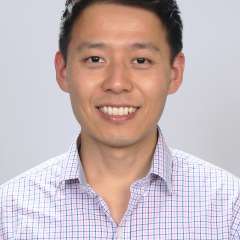
It was only when he returned to Los Angeles that his shortness of breath was explained. UCLA Health hematologist Steven Tsai, MD, PhD, diagnosed Bull with myelodysplastic syndrome (MDS). His bone marrow wasn’t producing enough healthy blood cells.
“When I saw it was another cancer, I thought ‘Bring it on,’” said Bull, now 82, who describes himself as extremely competitive. He has had six joint replacements and is in remission from prostate cancer treated at UCLA Health.
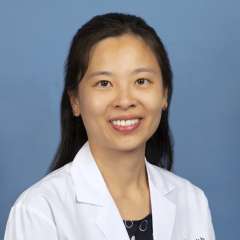
While discussing standard treatments for MDS, Dr. Tsai offered another choice. His colleague Wanxing Chai-Ho, MD, was overseeing a study of a new drug. Bull decided to participate.
Every week, he received a three-hour infusion at the UCLA Clinical and Translational Research Center (CTRC), which supervises anywhere from 400 to 450 active clinical trials across all ages and diseases.
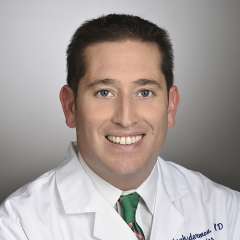
“We're doing some of the heavy lifting of bringing inventions and laboratory discoveries to the bedside,” said Noah Federman, MD, medical director of the CTRC for the last decade and principal investigator on a variety of oncology clinical trials.
The center is one of a dozen programs within the larger UCLA Clinical & Translational Science Institute.
The CTSI catalyzes research into treatments and cures for disease, from regulatory compliance to a precision health biobank with a quarter of a million de-identified patients, and from workforce development to community engagement for more inclusive trials.
Since 2011, that has resulted in 32 drugs approved by the U.S. Food & Drug Administration.
That was possible because the CTSI has built a robust research infrastructure, according to the institute’s co-directors Arleen Brown, MD, PhD; Arash Naeim, MD, PhD; and Mitchell Wong, MD, PhD.
“We use translational and open-science principles to build an effective, efficient and community-engaged research infrastructure that supports reproducible, replicable discovery and connects local, regional and national partners,” they said, “so new treatments reach people faster.”
‘Homegrown’ therapy
Like Bull’s clinical trial, pharmaceutical and other industries sponsor about two-thirds of the CTRC’s studies. Their vetting process is exacting, according to Dr. Federman.
“They'll walk through, look at everything from the refrigerators to the nuts and bolts of where the patients are being seen and the qualifications of the personnel,” he said.
Many research centers struggle with complex therapeutics, he added. But the CTRC is conducting more than 35 “high risk, high reward” gene and cellular therapy trials, as well as handling the intense, hours-long testing of pharmacokinetics: a drug’s journey through the body.
The CTRC is also one of the very few centers with the expertise and technology to conduct trials with therapeutics that are paired with radiation. Several are in progress, including a precision therapy study that Dr. Federman is leading for osteosarcoma, a rare, primary bone tumor most often seen in teenagers and young adults.
The study is testing a specially engineered monoclonal antibody developed at UCLA. Two days after it opened in February, a patient enrolled. More than 20 other patients are in the process of screening, and Dr. Federman and his team continue to field patient inquiries from all over the world.
Patients first
For many patients enrolled in clinical trials, the CTRC is the main hub. The hospital-grade clinic was built in a subterranean emergency room on the site of the old UCLA Medical Center, which was moved to a new building after the 1994 Northridge earthquake.
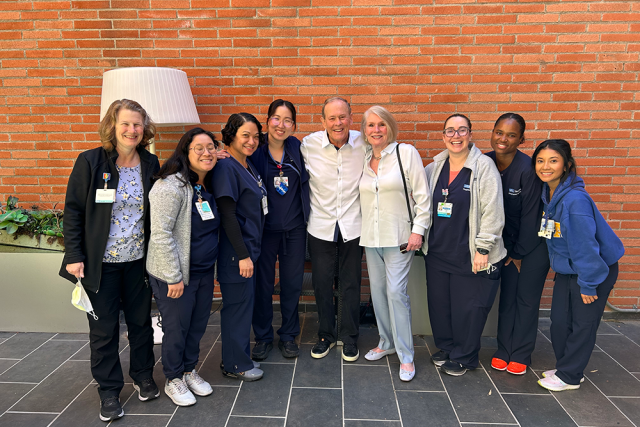
Marjorie Weiman, RN, MSN, has been the unit director for the last decade. On a walkthrough of the CTRC’s 12,000 square feet, she pointed out treatment rooms, negative pressure procedure rooms, an infusion area, and a commercial kitchen for food studies.
Weiman oversees 14 nurses who administer the research products, perform blood draws and monitor patients’ reactions to their therapies.
“I throw a lot at our nurses,” said Weiman, who hires less for prior research and more for clinical skills experience in such fields as emergency medicine, pediatrics and oncology.
By Weiman’s side was Jonas, a golden retriever and very likely the only facility dog at a clinical trials site.
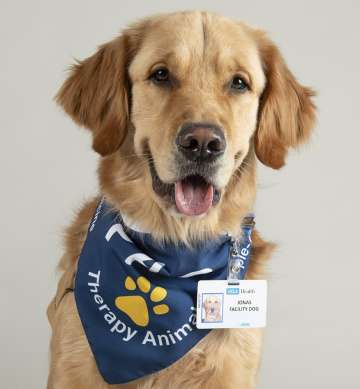
“He’s great for our patients and our staff,” said Dr. Federman, who also brings Jonas along on his rounds with pediatric oncology patients. “Everybody can relate to Jonas. He really changes the energy in a room in a positive way.”
CTRC nurses and clinical trial coordinators often travel to UCLA Health hospitals and ambulatory clinics, a mobile program called CTRC-WOW (“without walls”) that other research centers now want to adopt.
“The patients always come first,” said Dr. Federman. “You want the research and the investigator team to meet them in the environments most comfortable to them.”
After he first walked into the CTRC three years ago, Marsh Bull found it a place to look forward to. He was responding well to his weekly infusions, but the pharmaceutical sponsor terminated the trial. Three months later, Dr. Tsai enrolled him in another study which he continues today.
He credits his remission from MDS to his positive attitude, his faith and the clinical trial.
“I think the key to the CTRC is the personal attention you get,” Bull said. “They're a special group and it’s fun to be there. It's a little capsule of safety and joy.”