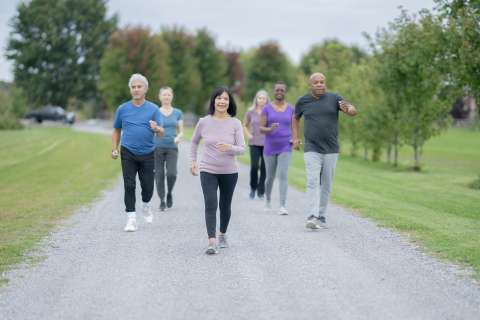

More than 7 million Americans live with some form of dementia, including Alzheimer’s disease, according to a 2025 report from the Alzheimer’s Association. There is no cure for dementia and given the rapid aging of the U.S. population, finding ways to reduce the risk of developing dementia is increasingly urgent.
Dementia is an umbrella term for several types of disorders that cause memory loss, with Alzheimer’s disease being the most common. Unlike age-related memory impairment, such as forgetting a word or name, dementia is memory loss accompanied by a cognitive function affecting daily life, such as not being able to perform simple tasks or not recognizing familiar places or people.
Certain lifestyle factors can reduce dementia risk, and one of them is regular exercise, said David Reuben, MD, the Archstone Professor of Geriatrics and director of the UCLA Alzheimer's and Dementia Care Program.
He explained why exercise may be beneficial.
Blood flow and chronic inflammation
A type of dementia called vascular dementia is caused by strokes due to plaque in the arteries or other causes of stroke.
“One way that exercise may be protective is by altering that vascular component,” said Dr. Reuben. “It’s well known that exercise is protective against heart disease — the buildup of plaque — and a good percentage of the population who has dementia has vascular dementia, or mixed dementia where they often have Alzheimer’s and vascular dementia,” he said.
Chronic inflammation has also been linked to increased risk of dementia, and “one possible intervention in the prevention of Alzheimer’s disease is to reduce inflammation,” Dr. Reuben said. Studies show that exercise can reduce inflammatory markers, he said.
Even short bouts of exercise can help.
“There are a number of studies that show that you get some protective effect with actually relatively small amounts of exercise, even 20 to 30 minutes a day,” said Dr. Reuben. “And there are also studies that show the more exercise you do, the more protection you have.”
Another question is how exercise may affect the development of amyloid plaques, which play an important role in the beginning of Alzheimer’s disease, he said. Researchers believe that Alzheimer’s disease begins long before a person shows symptoms.
Not surprisingly, Dr. Reuben is an exercise advocate. “Exercise on an ongoing basis, almost whenever you start in life, is a good idea,” said Dr. Reuben.
Exercising in mid- to late-life can be particularly effective at reducing the risk of dementia, according to a November 2025 study published in JAMA Network. This could be due to the fact exercising in mid- or later in life may interrupt plaque buildup and chronic inflammation before they cause serious damage, Dr. Reuben suggested.
However, he warns that anyone who takes up or resumes exercise at mid-life or later should begin slowly. “Don't start by immediately trying to do what you did 20 years ago,” he said. “The best way is to gradually build up your exercise routine.”
Other lifestyle factors
As important as exercise is, it is just one of several lifestyle changes that can reduce dementia risk.
A study published this year in JAMA Network showed that older adults at risk of cognitive decline and dementia who followed a structured program of healthy eating, physical and cognitive activities, social engagement and careful monitoring of their cardiovascular health, experienced greater benefits two years later than people who followed an unstructured, self-guided program.
There is still much to be learned about how exercise and lifestyle habits affect a person’s risk of dementia, however.
“A lot of observational studies look at people who exercise more versus people who don't exercise more,” Dr. Reuben said. “But there are other things about them that may also be different. They may have better diets. They may be more socially engaged. They may have higher intellectual training backgrounds. So, it may not just be the exercise that’s reduced their dementia risk. We also don't know whether exercise affects all dementias or just specific types of dementia. But it is increasingly clear that exercise will likely be a part of the prescription for the prevention of dementia.”