
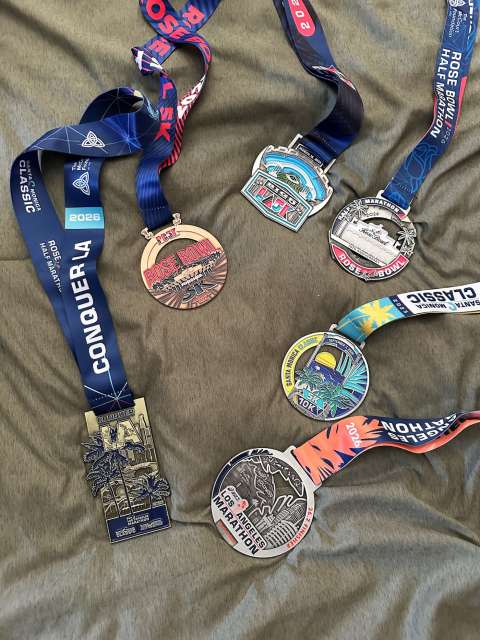
From the moment Dayle Silverio set his sights on earning the McCourt Foundation’s Conquer LA Challenge medal – which requires completing the Santa Monica 10K, Rose Bowl half marathon and LA marathon within a 12-month period – it was never just about crossing finish lines.
It was about proposing to his girlfriend.
His plan started in January of 2025, when he signed up for a 5K. At the time, Silverio hadn’t run in years.
“My goal was to get back in shape,” he said. “And the personal touch is that I planned on proposing... . So my goal was to not just be in shape, but I wanted to be able to present the best version of myself when that time comes.”
Silverio, 31, a clinical research administrator for the UCLA Health Department of Medicine’s Office of Research Administration, discovered during that first 5K that running 3 miles was harder than he’d remembered.
So he committed to training, using an app to track his weekly mileage and joining the Little Tokyo Run Club for support and camaraderie.
By the time he did the 10K, the distance felt easy. His clothes were fitting better. His blood-sugar numbers had improved. Even his dog, Atlas, was getting in shape.
January’s half-marathon was a challenge, but Silverio could tell his training was paying off. He covered the 13.1 miles without pain. His girlfriend, Leila Regio, treated him to a steak dinner afterward at a place he’d spotted along the route.
At that point, Silverio was “getting closer to feeling like that version of myself that I wanted to be,” he said. “Once we’re done with the LA Marathon, that’s pretty much the green light for me to propose.”
At the end of February, Silverio felt pain in his right foot. Worried it might be a stress fracture, he paused his training. Doctors cleared him for the ASICS Los Angeles Marathon just weeks before the March 8 race. Then Silverio worried he hadn’t trained enough.
Still, after losing an hour of sleep because of the change to daylight saving time – and many more because he was anxious about the run – he was up before dawn on race day. Regio dropped him off at the starting line at Dodger Stadium. And she surprised him throughout the race by showing up every couple of miles to cheer him on.
“She had her own marathon,” he said. “She followed me around all the way to Culver City.”
Silverio ran through the pain in his right foot and through the unseasonably hot weather. With temperatures predicted to reach the high 80s, marathon organizers offered an unusual early-out option: Runners “having a tough day” could end their race at mile 18 and still receive a finishers’ medal.
As the marathon went on, Silverio struggled with this choice in his head. His body said to take the early finish. His mind said to keep going. He asked himself: “Am I comfortable putting this aside right now for something more important to me, which is my proposal?”
He knew Regio was worried about him: “I think that’s why she wanted to see me at every stop,” he said.
So when he reached mile 18, he made the turn. He received his marathon medal and the Challenge medal he’d been working toward for more than a year. Regio was standing there with a homemade sign, telling him, “Your younger version of you would be proud.”
“I teared up a little bit,” Silverio said.
It took a couple days to recover from the exertion of the run: He slept for 16 hours after the marathon and “ate so much.”
“I feel like I fulfilled what I set out to do,” Silverio said. “It was never about finishing the marathon. It was never about being the fastest. It was just about pushing myself to be a better, healthier version. And now the biggest challenge for me is getting ready to propose.”
He popped the question on Sunday, March 15.
She said yes.
Falling in love with endurance sports
Another first-time marathoner, exercise physiologist Jose Hernandez Carcamo, MS, has enjoyed a lifelong love of fitness. He decided to take on the ASICS Los Angeles Marathon to have what he considered a “milestone experience.”
But he didn’t expect to love it so much that he’s already looking ahead to next year’s race.
Hernandez Carcamo, program manager of health and well-being for UCLA Health’s Department of Anesthesiology and Perioperative Medicine, was an avid runner until 2017, when he was sidelined by a series of injuries. First, he was hit by a car while bicycling and broke his right kneecap. He rehabbed, returned to running, then tore the meniscus in the same knee a few years later.
After recovering, he ran occasionally but focused more on weight-training and bicycling. He got serious about increasing his running mileage last year when he committed to doing the 2026 marathon.
Since Hernandez Carcamo designs fitness programs professionally, he tailored a training plan for himself. Ultimately, though, he joined the LA Road Runners, a run club that serves as the official training program of the ASICS Los Angeles Marathon.
Following the Road Runners’ plan, he carbo-loaded the week before the race, paid special attention to hydrating with electrolytes because of the forecast high temperatures and kept his last few training runs to just a few miles apiece.
“I played things by the book and it was worth it,” he said.
He also road-tested the clothes he planned to wear on race day and ran in compression socks.
“That really helped me,” he said. “No pain in my calf, no cramping and no blisters.”
Losing an hour of sleep to daylight saving time wasn’t ideal, he said. And the heat was a challenge, but hydrating with electrolytes ahead of time left him feeling good throughout the race —as did pouring water over his head at every other water station after mile 12, as temperatures started climbing.
He also didn’t end up needing the playlist he’d made to keep him motivated during the 26.2 miles.
“There was so much energy from the crowd everywhere,” he said. “I think that speaks volumes about LA culture.”
Mentally, Hernandez Carcamo controlled race-day anxieties by giving himself grace, he said: When he needed to walk, he walked. He released any expectations of specific finish times.
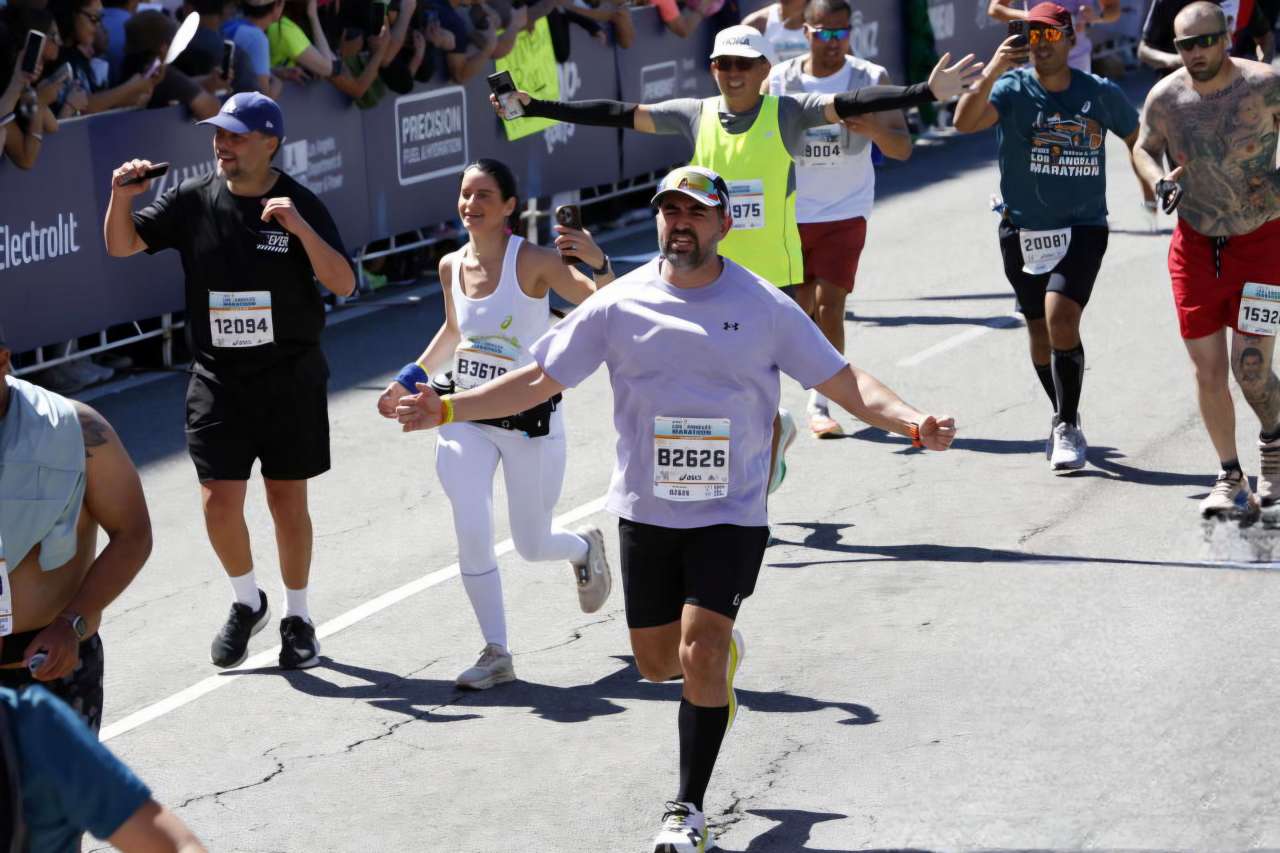
But when that finish line came into view, he gave it all he had.
“I raced the last few meters of the race — just for the photo,” he said with a laugh.
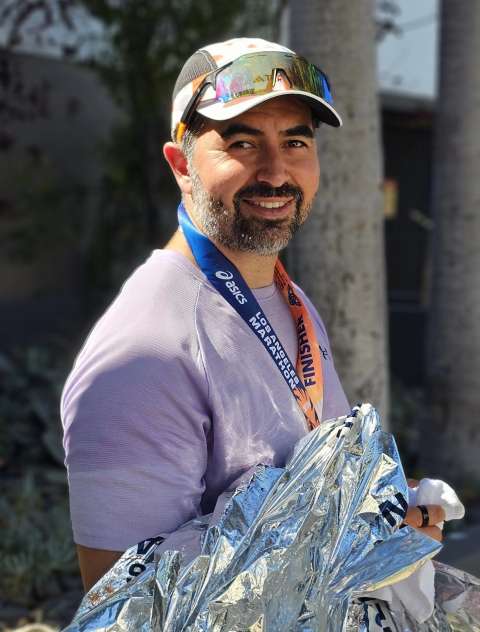
Most surprising for the 38-year-old athlete, however, was how much he truly enjoyed the experience. He’s already thinking about how he might improve his performance next year (“more volume,” he said, which means more running). And he’s considering signing up for an Olympic-distance triathlon, too. He completed a sprint triathlon in 2025, and now sees the longer distance as “the natural next challenge.”
“All this has been teaching me that this is what I like doing,” he said. “I’m so happy that I get to do it, that I have the privilege of doing it. My body is responding well. My knees had no issue.”