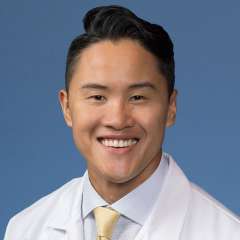
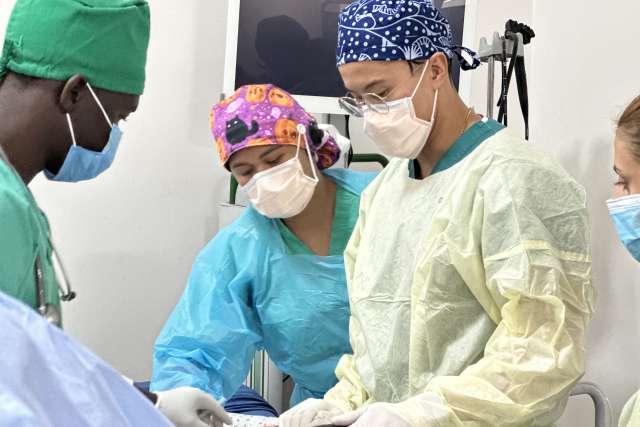
Sean Nguyen, MD, used his right hand to guide the thin, flexible tube with a camera and light – an endoscope – through the mouth of the patient to examine his esophagus, stomach and duodenum, the first part of the small intestine.
In his left hand he grasped a handle to manipulate the angle and the movement of the endoscope and manage the flow of air and water to inflate and clean tissues.
This delicate dance of left-hand, right-hand movements – critical to ensure precise maneuvering and control during endoscopic procedures – took Dr. Nguyen back to his youth, when he loved to play video games such as Super Mario as well as instruments including the viola, guitar and piano.
Such synchronized use of his hands is one of the reasons Dr. Nguyen was drawn to gastroenterology, the branch of medicine that diagnoses and treats diseases affecting the digestive system, from the mouth to the anus – including GERD (gastroesophageal reflux disease), colitis, cirrhosis and hepatitis – via procedures such as endoscopies and colonoscopies.
Health trips to Rwanda
In November, Dr. Nguyen took his talents to the small, landlocked country of Rwanda in sub-Saharan East Africa to supervise and teach Rwandan, US and international trainees in gastroenterology for Rwanda Endoscopy Week (REW) 2025. He had been to Rwanda for REW twice before, in 2022 and 2023, during his gastroenterology fellowship at UC Davis Medical Center.
A new attending physician for UCLA Health who works out of the UCLA Torrance Specialty Care clinic, Dr. Nguyen is the first member of the Vatche & Tamar Manoukian Division of Digestive Diseases to participate in REW.
But he certainly hopes not to be the last.
He’s working on getting UCLA Health gastroenterology fellows who have a passion for global health to participate in future iterations of REW, a collaboration between the US nonprofit GI Rising, the Rwandan Society for Endoscopy, the Rwanda Health Ministry and multiple Rwandan health facilities.
A desperate need
REW aims to improve access to gastroenterology specialty care in Rwanda. Back when REW started in 2017, such care was severely lacking in the nation of 14 million. Only a handful of foreign-trained gastroenterologists were working in the capital city of Kigali.
Now, thanks to the efforts of REW partners, GI consultation and services are available for a significantly greater portion of the Rwandan patient and provider population.
In fall 2024, the nation’s first cohort of gastroenterology fellows graduated as attending physicians, ensuring that new cohorts of Rwandan GI specialists will be trained to expand access to care in Rwanda moving forward.
Dr. Nguyen said his experience with REW changed the trajectory of his career.
“The endoscopic experience and the clinical experience were incredible,” he said. “That first year, I performed more endoscopies in a week in Rwanda than I would do in a month at UC Davis. I do not think global digestive health would have been a part of my career had I not participated in REW as a GI fellow.”
Valuable lessons
In November, Dr. Nguyen was part of a team of some 60 doctors, nurses, technicians, medical students and residents who treated 1,069 patients at 10 sites throughout the country.
He was the team leader at Butaro Hospital, located in the remote northern mountains.
There, he collaborated with Dr. Sarah Rwema, the clinical director of Butaro Hospital, and her team of Rwandan intern and resident physicians, nurses, pharmacists and surgery colleagues. Together they oversaw the care of more than 100 patients with varying backgrounds and pathologies. Most, however, were extremely poor patients who traveled far to receive GI care.
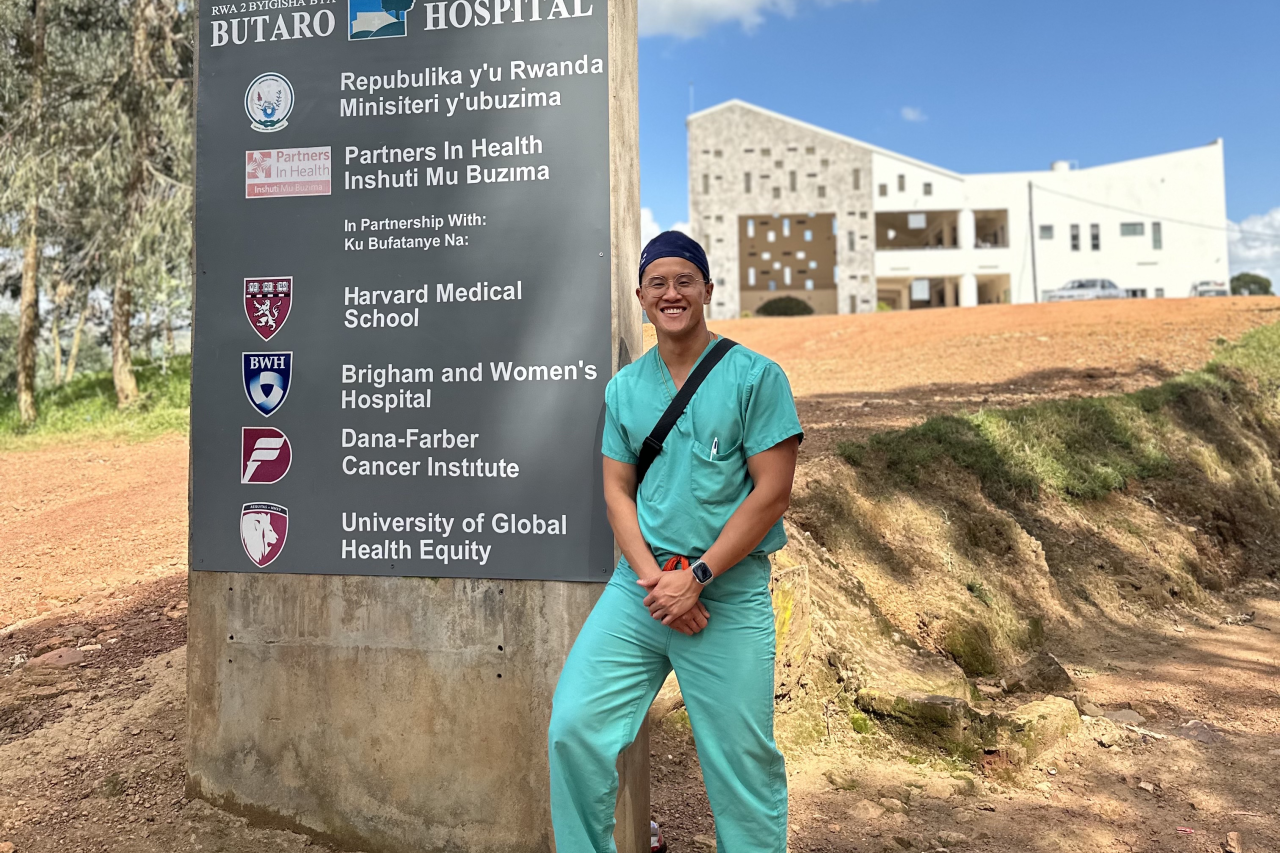
At Butaro Hospital, Dr. Nguyen’s team treated a 40-year-old man with a chronic illness that caused significant weight loss, nausea and vomiting. The patient underwent a colonoscopy, which revealed an obstructive sigmoid colon mass that was biopsied. He now is undergoing treatment for cancer.
Dr. Nguyen’s team also cared for an 11-year-old boy with rectal prolapse – when the last part of the large intestine slips down and turns inside out – and bleeding. The boy underwent a medical test during which a thin, lighted, flexible tube called a sigmoidoscope revealed a mushroom-like polyp that was successfully removed and allowed the boy to avoid surgery.
Numerous other patients of Dr. Nguyen and his team underwent upper endoscopies. Many of them were found to be infected with the Helicobacter pylori (H. pylori) bacteria, which can infect the stomach lining and cause gastrointestinal problems.
“I learned valuable lessons about the delivery of gastroenterology care to under-resourced areas, refined my leadership and endoscopic skills, and once again immersed myself in the beautiful cities and countryside of Rwanda,” Dr. Nguyen said of his latest trip.
“I was grateful to see new parts of Rwanda — to appreciate the hills and wild unpaved roads of Butaro, observe mountain gorillas in Volcanoes National Park, and explore new neighborhoods of Kigali with Rwandan friends made during previous years.”
Dr. Nguyen also was grateful for the UCLA Health undergraduate group MAI (Medical Aid Initiative) for providing him with GI supplies that weren’t being used – endoscopic consumables such as dilation balloons and forceps – and an Australian company that sold to the team at a steep discount rapid bedside testing kits for H. pylori. A US company also donated tablet-based laxative preps for colonoscopies, which allowed many more to be performed.
A shared passion
Growing up in Rancho Palos Verdes, Dr. Nguyen said he always wanted to go into medicine. His parents encouraged charity work and the family took trips to Mexico with Habitat for Humanity.
While at Peninsula High School, he volunteered at a local hospital and found it very rewarding.
He entered college as an English major at UCLA but later switched to physiology with a minor in global health. While an undergraduate, he visited Vietnam, Honduras and other countries on global health trips.
During his fellowship at UC Davis, a co-fellow and friend, Alex Zhornitskiy, MD, told him about REW.
“I mentioned it in passing to Sean, and like myself he was extremely interested in exploring it further,” said Dr. Zhornitskiy, now an attending GI physician and an assistant professor at UC Davis.
It took a fair amount of effort and paperwork on both of their parts to make the first REW trip happen.
On their second trip to Rwanda, in 2023 (a planned trip in 2024 was cancelled due to an epidemic of the hemorrhagic Marburg virus), the two started working on small research projects. That led to a small global health seed grant from UC Davis, which paved the way for them to create the first nationwide prospective observational study of H pylori in Rwanda.
“One of my proudest accomplishments is being able to say that Sean and I helped train the first cohort of Rwandan gastroenterology fellows,” Dr. Zhornitskiy said.
Dr. Steve Bensen, MD, president of GI Rising and professor of medicine at Dartmouth Geisel School of Medicine in Hanover, New Hampshire, praised Dr. Nguyen for his involvement with REW.
“He brings fresh energy and ideas, especially expanding our educational and research efforts,” Dr. Bensen said. “He has worked hard between trips on various projects and his securing of H pylori tests kits was a game changer on our most recent trip. He is very involved in improving our impact. He is very driven and inspired by his global health work.”
Dr. Nguyen and Dr. Zhornitskiy recently joined GI Rising’s board of directors.
A deep commitment
Dr. Nguyen is working with Lin Chang, MD, the fellowship director for the GI division at UCLA Health, to develop a program to get future fellows involved in REW. Lynn Connolly, MD, clinical chief of gastroenterology community practices in the Division of Digestive Diseases, is hopeful the program will take off.
“Dr. Nguyen is an exceptionally energetic, compassionate physician who brings a genuine sense of joy to his practice,” Dr. Connolly said. “He is deeply committed to patient care, education and global health. His passion for global health, particularly his work in Rwanda, is very authentic. He truly believes in the mission and wants to inspire others, especially trainees, to consider how they can make a meaningful impact globally.
“As a colleague,” Dr. Connolly added, “Sean is always positive, collaborative and generous with his time. He cares deeply about people, and that comes through in everything he does. We are very fortunate to have him in the division, and his leadership in global health reflects the very best of what we hope to instill in our trainees.”
As for Dr. Nguyen, he’s grateful he decided to become a GI specialist.
“It all goes back to wanting to help people,” he said. “I get the same satisfaction from helping people in my clinic at work every day. But I think there’s something special about this program specifically and how it’s providing and helping to expand GI care in a sustainable way in Rwanda.”