
There is no simple, singular definition of what survivorship is for people who have received a cancer diagnosis and undergone treatment.
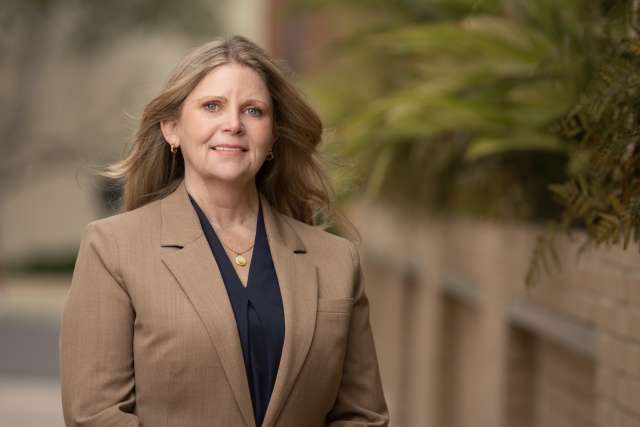
That’s what Shannon La Cava, PsyD, director of the Simms/Mann UCLA Center for Integrative Oncology, will address Saturday, April 18, in her keynote presentation at the Women’s Cancer Survivors Conference on the UCLA campus.
“My goal is to introduce the idea of survivorship and that it’s not really for me to define – it’s for each person to define what it is for them,” Dr. La Cava said of her talk, “What’s Next: Finding Yourself in Survivorship.”
“It’s not one size fits all and that’s OK,” she said. “It’s about normalizing survivorship for them as an individual and providing resources that they can use that work for them.”
The conference, “Navigating Survivorship: Charting Your Strongest Path Forward,” will include gynecologic and medical oncologists, physicians and other health care providers discussing strategies to thrive after cancer, with regard to mood, intimacy, nutrition and other areas of psychosocial and physical well-being. The conference is co-sponsored by the UCLA Department of Obstetrics and Gynecology, the UCLA Health Jonsson Comprehensive Cancer Center and the Simms/Mann Center.
A time of change
Survivorship is a period of adjustment, Dr. La Cava said. One of her goals is to help patients gain a sense of control during this crucial time.
“In treatment, sometimes we feel like we don’t have a lot of control, but we can find more control and have choice in our survivorship,” she said. “It’s about giving people control over choice and options and not saying, ‘You know, if you read this and you do this and you accomplish this, that’s the way to go.’”
Dr. La Cava will discuss support available for women who are in cancer survivorship. This may include individual counseling or support groups to help with normalization and to meet other survivors. It could be art programs, mindfulness, movement such as yoga or qigong, or a spiritual approach to survivorship.
Communication with loved ones
Along with a patient’s own perceptions of survivorship, sometimes they have to navigate misconceptions among family and friends.
“I work with patients who often, their social circle is saying, ‘Your cancer is over, everything is back to normal, let’s go to the movies, let’s dine at your favorite restaurant, let’s have a drink together.’ But for the patient, it’s not over,” Dr. La Cava said.
“For some, this time is even more intense,” she said. “Now they’re untethered from their routine of treatment. I’ve seen individuals even seeking out more help in survivorship. Meanwhile, the greater community is saying, ‘Oh, you’re fine.’”
Dr. La Cava said survivorship programs are now considered a crucial segment of overall cancer care, in part as a way to facilitate continuity of care after treatment.
“There’s always been the idea of survivorship and how do we support this,” she said. “It’s definitely now a standard of care, a vital component.”
Find out more
The Women’s Cancer Survivors Conference will be held from 8:30 am to 1 pm April 18 at the UCLA University Club on campus. The event is open to the community. To register and for more information, visit the conference website.