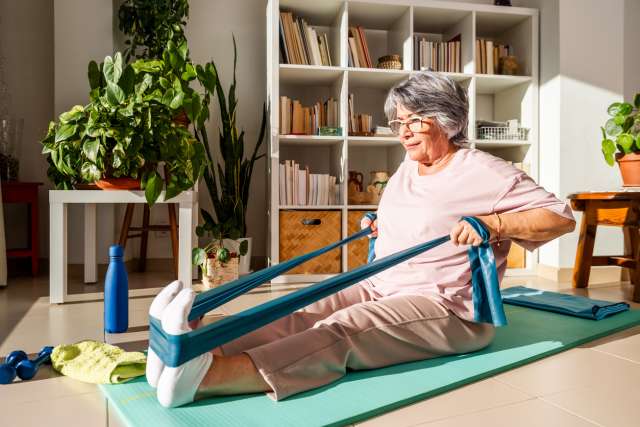
The general benefits of physical activity are well-known. Moving your body regularly improves brain function and mental health, keeps your heart and lungs healthy, improves sleep and is critical for weight management.
Resistance training, or strength training, has particular health benefits that are especially critical for older adults. According to the National Institute on Aging, about 30% of adults older than 70 have trouble with everyday mobility, including walking, climbing stairs and getting to a standing position.
When mobility is limited, your risk for falls and fractures increases. These challenges are often caused by age-related loss of bone density and muscle strength. That's where resistance training comes in.
What is resistance training?
The idea of strength training may conjure images of sweaty gyms and bodybuilders. But as an older adult, the goal is to build muscle strength, not necessarily muscle mass or bulk.
Resistance training requires your muscles to contract against an external force. With each contraction, your muscles get stronger and gain endurance. The greater the force and the more muscles are worked, the better the result.
There are several ways to safely incorporate resistance training into your routine. While a gym offers equipment and a space to perform strengthening exercises, it's not necessary. Resistance training can be performed using:
- Bodyweight
- Dumbells and free weights
- Medicine balls
- Resistance bands
- Weight machines
3 significant benefits of strength training for older adults
Resistance training supports bone and muscle health, leading to better daily function and a longer life.
The vital benefits of strength training include:
Improves bone mineral density
Bone mineral density (BMD) refers to the concentration of calcium and minerals in your bone tissue — two things that determine bone strength. Decreasing BMD weakens and thins your bones. It also increases your risk for osteoporosis — a disease characterized by frailty and increased risk of fractures.
After age 50, you begin to lose bone faster than you can build it. In the first seven years following menopause, women can lose up to 20% of their BMD. Resistance training not only reduces that decline but may also strengthen your bones.
Two approaches to resistance training have been studied for their effect on BMD:
- High-intensity resistance training (HIRT), which involves higher resistance or lifting heavier weights for fewer repetitions
- Low-intensity resistance training (LIRT), which involves lower resistance or weights for more repetitions
While research shows that LIRT can counteract the loss of BMD, HIRT is found to be more effective for increasing BMD in older adults. For optimal protection from osteoporosis, studies suggest HIRT with a twist — lift the weight rapidly, but lower it slowly and with control. The explosive lift of the weight increases the load, which stimulates bone-building cells.
Increases muscle strength and function
As you age, your risk increases for sarcopenia — decline in muscle mass, strength and function. In fact, once you turn 30, your muscle mass (total amount of muscle tissue) starts declining by as much as 8% per decade. That decline speeds up after age 60.
Research has not conclusively shown that strength training over 60 offers a significant increase in muscle mass — any positive effects tend to lessen with age. But a study of more than 500 older women with sarcopenia concluded that resistance training at least twice weekly enhances muscle strength and physical function, specifically gait (walking) speed. A second study of older adults with sarcopenia found that resistance training three times weekly for eight to 12 weeks significantly increases hand grip strength and knee extension — functions that are critical for daily living and mobility.
Lowers mortality risk
Resistance training offers benefits specific to your bone density and muscle strength. But the overall health benefits are also impressive.
Researchers followed more than 200,000 older adults for 15 years to analyze the effects of strength training. They found that engaging in any weight training — compared to no weight training — is associated with lower risks of mortality associated with cardiovascular disease, cancer and all other causes. The risk reduction was noticeably larger for women and people who also did aerobic exercise in addition to strength training.
Tips for getting started safely with strength training
Beginning a resistance training regimen should not be overwhelming. Here are some tips to help you get started and avoid injury:
- Talk to your primary care physician (PCP) before starting: Any time you are considering a new workout, it's always a good idea to discuss it with your PCP. They can guide you to helpful exercise resources for older adults, such as SilverSneakers® — a senior fitness program offered at no cost through select Medicare plans.
- Focus on form first: To avoid injury, begin with body weight exercises (no equipment). Good exercises to start with include squats, lunges, wall pushups and going from sitting to standing from a chair. When you are comfortable doing eight repetitions and feel confident about your form, add resistance bands or light weights to make it more challenging. For pushups, work your way from the wall to a counter, bench and finally the floor.
- Progress slowly to heavier resistance: The goal is to build muscular strength — not necessarily to increase muscle size. To accomplish that goal, the American Council on Exercise recommends lifting more weight or using heavier resistance, even if it means fewer repetitions. Progress slowly to avoid injury or extreme soreness.
- Be consistent: Try to strength train two or three times a week on non-consecutive days. Your muscles need time to rest in between resistance training sessions.
Remember, anything you do today to strengthen your muscles and protect your BMD is better than doing nothing at all.