
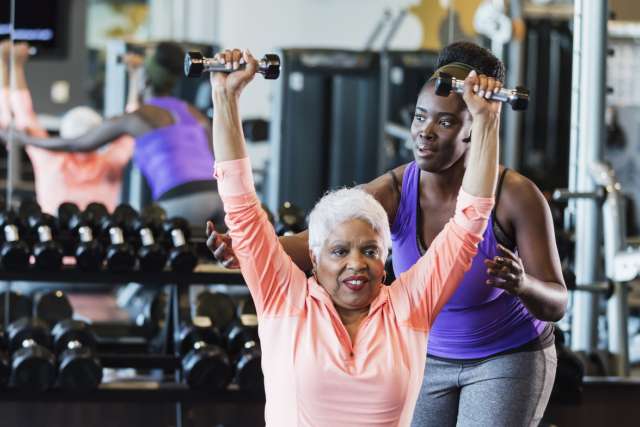
Any time you increase your strength and physical fitness, you improve your body's ability to function. But exercises that work multiple muscle groups at once and use movement patterns that mimic daily tasks can help you maintain functional independence as you age.
Functional fitness training strengthens your muscles using the same movement patterns that you use for daily activities, such as:
- Carrying groceries
- Climbing stairs
- Getting out of a chair or up off the floor
- Picking up a young grandchild
- Reaching a high shelf
The good news is that functional fitness does not require a gym membership or fancy equipment and can be done just about anywhere. Ready to get started? Here's what you need to know:
What is functional fitness?
The primary goal of functional training is to train muscles and movements. The exercises involve compound movements. That means that one single exercise may involve several exercise groups and bending at multiple joints. Working multiple muscle groups and taking a whole-body approach also helps improve your balance, coordination and ability to move efficiently.
Examples of functional movements include:
- Balancing
- Lifting and carrying weight
- Pushing and pulling
- Reaching above your head
- Squatting and lunging
- Stepping up and down
- Twisting and hinging at the hip
During a functional fitness workout, these movements may be in combination. For example, stepping forward into a lunge while performing a bicep curl improves your balance while simulating walking while carrying something.
You can perform these exercises with bodyweight only, but adding weight — dumbbells or full water bottles, for instance — or resistance bands can help you progress as you grow stronger.
Benefits of functional training
Any time you strengthen your muscles, you reduce your risk of injury. But while bench pressing a lot of weight can make you strong, the benefits do not always transfer to the complex movements you perform in everyday living.
The exercises used in functional training make you stronger and can also help you maintain your mobility and independence. Functional fitness may:
Lower your fall risk
Many of the exercises involved in functional fitness strengthen your legs. When you are steadier on your feet and have improved balance, you are less likely to fall — and less likely to get injured if you do.
A study of more than 650 adults 65 and older showed that functional fitness is directly associated with risk of falling. Participants performed functional tests, measuring functional abilities such as moving from sitting to standing, hand grip strength and standing on one leg. Those with lower levels of functional fitness were classified as having a higher risk of falling.
Help relieve joint and back pain
Moving through daily tasks requires certain muscles and joints to work together efficiently. Functional training helps by stabilizing your body while you're moving to protect your joints and back.
Half of older adults report hip pain, knee pain or both. But research shows that older adults with hip and knee pain find relief when their physical fitness includes a combination of:
- Endurance conditioning
- Strength training
- Stretching and flexibility
Combining functional training with daily walking accomplishes all three.
Increase bone and muscle strength
Many of the exercises associated with functional fitness are also used in traditional strength and resistance training. Using your bodyweight or outside resistance puts stress on the musculoskeletal system and stimulates bone building and muscle strength.
The difference between traditional strength training and functional training is the way you move as you train. However, to build bone and muscle strength with either style of workout, you'll need to train consistently and progressively increase the resistance as you grow stronger.
Improve mental health and brain function
According to the Centers for Disease Control and Prevention (CDC), all physical activity helps reduce anxiety and depression. When that activity is moderate — it raises your heart rate and breathing but still allows you to talk — it can also reduce your risk of cognitive decline and dementia.
Functional training offers moderate physical activity. But functional fitness also improves your ability to perform daily household tasks, which can also increase your overall daily physical movement.
In addition to the physical benefits of exercise for your brain, the ability to stay mobile and live independently can improve your mental health. Research shows that symptoms of anxiety and self-reported depression are significantly higher among adults age 70 and older who have impaired physical mobility or are not physically active.
Tips for getting started with functional fitness workouts
Talking to your primary care physician should always be the first step when you are considering a new physical fitness program. Once you are cleared to begin functional training, these tips can help you make the most of your exercise program:
- Personalize your workouts: When deciding which exercises to prioritize, consider what actions currently feel challenging. Can you get out of a chair easily without using your arms? If not, squats can help. Do you have trouble walking with grocery bags or lifting them onto the counter? Choose exercises that involve lifting motions and walking with weight.
- Progress slowly: Functional training can be done with just bodyweight, which is a great place to start. Once exercises feel easy, consider adding some resistance with hand weights, resistance bands or a medicine ball.
- Train consistently: Make functional fitness workouts a habit. Training two times a week is the minimum for muscle and bone health. However, you can train with functional exercises up to four days per week if it feels good. Just be sure to take a day of rest between each training session. Rest can help repair muscle and prevent an overuse injury.
As you age, moving more makes it easier to maintain your mobility. Functional fitness is a great way to keep your body moving in the way it needs to so you can stay independent and injury-free.